A Witch Perceives First, then Believes (by Helix)

[Or: the personal is political, but the political is not necessarily meant to be personal]

Image by Gerd Altmann from Pixabay

In 1988, Mike Nichols wrote an essay on how the experiences of new Pagans in the 1970s and before differed from those in the 1980s and after (read it here: “Old Guard Paganism”). Some of his observations continue to ring true today; others are out of date now that the internet is the main way that new seekers come to Pagan traditions.

Nichols’ remarks about feminism, however, have continued to resonate with me. He writes that before the late 1970s, many Pagans became feminists as a result of their Pagan beliefs. In the late 1970s and thereafter, the causality of that relationship flipped: many feminists became Pagans because of their feminist beliefs. Nichols considers both approaches valid, emphasizing that these different generations of Pagans are indeed each others’ siblings (complete with sibling tensions and rivalries).

Nichols’ essay got me thinking about my own journey with feminism and Paganism, especially about how my attitude toward ideology in general changed as I became more committed to the Craft. So I will tell you this, and some of you will not like it any more than I would have when I was most committed to my feminist identity:

The Craft will always challenge your ideology, regardless of which one you hold. To perceive before believing, you must be able to lay ideology aside.

Before I go on, let’s make sure we’re on the same page. What do I mean by “ideology”?

An ideology is a system of ideas and ideals, especially relating to social policy and politics. Ideologies guide us in making big-picture decisions about ethics. They give us frameworks to look at how decisions play out socially, politically, economically, and otherwise. They contribute to a coherent worldview and help us determine what things mean and how to tell right from wrong. Examples of ideologies are feminism, neoconservatism, Marxism, and nationalism.

Religions can also be ideological, sometimes in an all-encompassing way. Evangelical Christianity, for example, offers an ideological worldview that can help the believer figure out how to do basically everything, from having sex to losing weight. All decisions, even the most minor, can be tested against core evangelical principles, which are discussed in community using specialized language (“Have you surrendered?” “How’s your walk with God?”).

Ideology is not something we can ever escape. Human culture is shot through with competing ideologies. Our thinking is informed by them, regardless of whether we “drink the Kool-Aid” and fully embrace one, or whether we attempt to remain skeptical of all.

The ideologies we grew up with can be especially hard to think critically about, as the attitudes we were exposed to in childhood form our perceptions of what is “normal.” Even if we reject the ideology with which we were raised, it can be easy to get stuck in a reactive mode where we criticize everything associated with our upbringing rather than evaluating it piece by piece.

All of this is to say, most of us are trained to believe first—to filter all new information and experiences through an ideological lens, either one we were raised with, or one we embraced as adults. Our ideologies tell us what our experiences mean and what to do about them. Only rarely are children raised to sit in a state of uncertainty with experiences and allow their meaning to unfold. Children look to adults for answers and, hoping to grant a sense of safety and stability, adults often give answers—and yet in that moment of dictating meanings, the opportunity to perceive first can be lost.

Needing a feminist religion was a large part of my original motivation in seeking out Paganism. I was struggling with being female, struggling with my gender identity, and groping for tools to explain myself to myself. Happily, I came to Paganism through a part of the women’s spirituality movement that was feminist but not gender-essentialist. The feminist Paganism I found showed me many, many different ways to inhabit a female body, and in that freedom I found healing.

For some years I was a committed feminist. Feminism opened my eyes to systemic inequalities that affect women in superficially egalitarian Western countries, as well as to the overt oppression that women and girls face internationally, oppression that white Christian nationalists now seek to return to the United States. Feminism became a lens through which I approached the world and evaluated political decisions, media, and my own life choices.

Even as I was embracing feminism, however, feminism was losing much of its ability to engage younger generations. When I taught my first college class in the early 2000s, none of the young women considered themselves feminists at all—as far as they were concerned, it was a movement that had accomplished its aims and was no longer needed. The feminism I embraced in the late 1990s had more complex ideas about gender and sexuality, race, and class than feminism had had in the 1970s and 1980s. At the same time, new queer, postcolonial, and neo-Marxist theories were popular in universities. I was thoroughly seduced by the sophistication of these theories, which feminism could not completely assimilate. For a time I became critical of feminism, particularly feminist philosophies that seemed to deny the full range of female sexuality or the fluidity of gender. My ideological loyalty shifted toward queer theory and stayed there for a time.

At length, I got out of grad school. I took jobs that involved working with people from a large variety of race, class, and educational backgrounds. I lived in predominantly Black neighborhoods. I had a child. And I studied the Craft, always practicing to see the world and the beings around me more clearly.

None of those university-based ideologies held up in the face of experience. In fact, some of them threatened to get in the way.

An example. One summer, a Black teenager was murdered on my block by two other teenagers. The neighborhood came together to mourn; my neighbors were his relatives, his friends. I went to the community vigil that the neighborhood held for the young man, and I walked there thinking about the injustices of systemic racism, the impact of poverty, the ongoing intergenerational trauma of broken families, the legacy of slavery and colonialism.

When I arrived, I listened to the local leaders of the Black community speak about the ongoing gun violence between young men in our city. They talked about the negative influence of rap music and of video games, and the need for Jesus. I saw a woman scoop up her four-year-old son and mutter, half to herself, half to him, “You’re never going to listen to that music.”

I held space for the community and for the young man. I walked home, and I kept my mouth shut. Nothing I had learned from theory helped me be an effective support for my neighbors. To the extent I was a positive influence at that vigil, what I was able to bring came from studying the Craft: being present, being open-hearted, suspending judgment, mourning with respect.

Feminism ultimately broke my heart. I withdrew from groups identifying as feminist when it seemed to me that the members spent most of their time criticizing each others’ beliefs and behavior, rather than building coalitions and pursuing actions to create a more just society for all people. After the success of the movement to legalize same-sex marriage in the US, I noticed the same concern with ideological purity (and resulting infighting) in the LGBTQ+ movement that I continue to serve. Too often I observe fellow activists—even friends—shouting at each other without listening in return, objectifying each other as straw men for the opposing viewpoint, to be torn down at any cost.

Without a robust sense of justice—an idea of a community in right relationship, one that benefits all—ideology is dangerous. It leads us to categorize each other with collections of identity labels, rather than being open to the inconsistent and multitudinous complexity that makes up every human being. It leads us to cast aside or embrace others’ opinions based on their apparent gender or sexuality or race or class, rather than waiting to fully perceive who they are.

What a disappointment it can be when a brilliant representative of one’s favorite ideology turns out to be driven by revenge! What a sweet surprise when the seemingly backward and old-fashioned neighbor is the one that rushes to others’ aid regardless of who they appear to be!

None of this is to say that my engaging with ideology was useless. I am far more sensitive to power dynamics, and far more aware of the privileges I enjoy, than I would have been without those theories. When I hold those ideologies loosely, informed by all of them but committed to none, they often guide me in making ethical decisions.

But—and here’s the most important part—all of them tried to tell me about how the world is, and from that analysis, how it should be. But the world is too complex for any ideology to encompass.

It is not easy to perceive first, then believe, as Victor Anderson often advised. I do not claim mastery of that skill, though I aspire to it. I do believe, however, that a certain skepticism is necessary in order to see others accurately. We cannot take for granted the things we are told are true—not by our families, not by our communities, not by our friends or our religions. We must wait, and test; we must listen and touch and see for ourselves.

I no longer call myself an –ist of any kind, although there are –isms that continue to inform my thinking and behavior. As I grow older, however, and especially as I raise a child, I desire ever more deeply to see what’s really there.

Without being able to see the child I have, I cannot parent him well; if I am driven too much by ideology, by a fixed idea of who my child is and should be, I will inevitably deny his authentic self and damage our relationship. It is ideology that leads conservative Christians to try to reprogram their queer and trans children; it is ideology that causes parents to dress their children exclusively in pink or blue and provide them with “gender-appropriate” toys. If I had taken away my son’s beloved trucks and given him only dolls, would that not also have been ideology? Shouldn’t my parenting be guided by my insight into my child’s needs, talents, and joys, rather than by expectations set either by mainstream culture or by the queer subculture I joined as an adult?

I have the same goal when it comes to my Craft: to see what’s really there. For me, true seeing is the foundation of relationship, the foundation of intimacy. True seeing is at the heart of my work as a witch.

The Conduct of a Feri Witch (by Willow Moon, with Helix, Shea, and Peaseblossom)

Introduction: View Teachings as the Basis of Conduct

Conduct, or the way one comports oneself, is critical to building community. One’s conduct will either build bridges or burn them. Our conduct is as inescapable as our shadow, and it flows from our worldview.

As Helix wrote in “Feri and View Teachings,” worldview orients practitioners of religious or spiritual paths in their lives. It describes what right relationship with natural and divine forces looks like by giving us examples. Worldview, in other words, is a kind of belief, a belief that is based on anatomy and physiology. Each animal has their own particular sense organs that determine what is possible to perceive. However, it is our habits both physiological and psychological that determine what we actually perceive. We can alter our view of the world by changing what we pay attention to, thus developing new neuropathways that change our experience. In biology, this is called neuroplasticity. What we believe in drives what we pay attention to; thus, belief is the foundation of our worldview. 

Our worldview shapes what is possible for us and determines how we will act. For instance, if we view ourselves as independent individuals in a competitive, hostile world, it could make sense to harm others to better one’s own lot. If we instead see ourselves as cells in an integrated living body that is the earth, we are more likely to behave cooperatively.

Feri is an extremely diverse tradition, and our rituals, our gods, and even our initiations vary from line to line. Yet our story of creation—which is the basis of our worldview—is one of the core things that unites us. Although each telling of the story is different and emphasizes different elements while omitting others, we all still recognize and treasure the origin myth of the Star Goddess (one version of which is quoted here). Helix explains:

The creation myth conveys much about the qualities of Feri. Ours is an embodied, fundamentally relational tradition that affirms the erotic nature of being in all things, especially the interdependent ecosystem of which humans are a part. The life force that we move in our practices arises from love and desire between Self and Other, who are part of each other, reflections of a divine and holy birth. We know that the universe began in lovemaking, not by word or commandment. We honor these ways of being not just in our overtly spiritual practices, but in every breath and moment of our lives. To practice Feri is to seek the constant awareness of God Hirself’s unfolding in us.

We are a relational tradition in that we relate to our world with pride and care. We recognize that we live in an interdependent ecosystem from which we are never separated for a moment, even after death. We can fantasize about the past and future, but we can never leave the present moment. Since the present is inescapable, we must live in and relate to it, including the environment of which we are a part. 

When we retell our creation myth, we remind ourselves of how it feels to embody our tradition. It gives us an anchor point that keeps us from losing ourselves in philosophical speculation that leads away from the deeper experience of Mystery. When we teach students, our worldview also acts as a signpost along the path. It keeps us pointed in the direction we want to go and helps us recognize our destination. That recognition can be felt in our bodies as a current of life force. Body sense connects us to the present and to the presence of the Feri current. The flow of the current doesn’t stop where our bodies end, but rushes ever onward into the future. 

The Feri current is a mighty river of life itself. Tumbling and surging with desire, we learn to subtly seduce the raging raw power of sex that flows through the land. Unapologetically and with delight, we skillfully steer the course of our own boat through the rapids and eddies of life. 

Recognizing this inherent blissful life force, we don’t need to coerce spirits to cooperate with us, and we instead engage them with a lover’s tenderness. The universe is that which desires, and like responds to like. Do we not feel deep in our bones that the greatest gift we can give to the gods is to honor ourselves and each other? Not only in the lofty space of spirit, but in everyday life as well. 

Ritual is the pillow talk of the witch with the world. The rites of witchcraft are our way of talking to nature, the divine, and each other. The world’s response is found in subtle signs and omens: a look, an offhand comment, a suddenly rising wind, the moon revealed from behind a cloud, or any of a range of natural human or other-than-human expressions. When we understand the part we play in the dance of life, we are able to talk with our world as an expression of our spirituality.

Our spiritual practice is embodied because our world is itself spiritual. Our breath synchronizes naturally with the rhythm of our hearts and the beating pulse of the earth. Resting in being, there is no greater seduction, and no greater honor.

Photo by Zongnan Bao on Unsplash

Conduct: The Self and the Other

How does the worldview described in our creation myth lead us to interact with others?

1. Mutual, Consensual Relationships

In our creation myth, the Star Goddess, complete within Hirself, looks into the curved black mirror of space. This alone tells us that the universe is a reflection of Godhirself. At the very core of our being is Godhirself; what we experience is our own reflection. Considering this makes sense of the phrase, “Do unto others as you would have done to you.” Mutuality is the basis for all authentic interactions. If you want respect, give respect. 

By hir own light, Godhirself sees hir reflection and falls in love, desiring Hirself. This part of our creation story shows us that love of the other flows from the feeling of love within. It also calls us to honor desire as the driving force of creation, without which we would not be. Love and the desire to unite with love is holy. Sex is holy just by itself. 

Of course, sex must be completely consensual, or it not an expression of love, but of power. Victor Anderson saw sexual predation as the worst sort of violation against humanity and condemned it vigorously. He insisted those who sexually prey on others for whatever reason or in whatever way are anathema to the Goddess of all creation. They must be held accountable regardless of their status in the community. When consensual, however, sex is to be celebrated as a divine act. That includes sex in all its forms. Thus Feri witchcraft celebrates all diverse gender expressions and sexualities. 

2. Hospitality

The way we treat others is encapsulated in our hospitality, or lack thereof. How we welcome people into our home or community reflects how we welcome people into our coven or indeed, into our hearts. Do you want your guests to have everything they need to be comfortable? Do you want everyone to be respected and listened to? Being conscious about welcoming guests and seeing to their needs helps to create warmth and respect among all people in the home, whether they are newcomers or old friends. Hospitality also plays a part in public places, whether physical or electronic. We can choose to be hospitable by co-operating with others as siblings of the Star Goddess, or we can have a hostile attitude by viewing our interactions as competitive.

Hospitality is not a difficult practice. Simply ask yourself how you would like to be treated as a guest, and be curious about your guests to learn how their needs may differ from yours. The opportunity to welcome a guest well is an opportunity to honor Godhirself in all hir mystery, as it honors yourself.

3. Responsible Power Dynamics in Teaching

As an initiate of several witchcraft traditions, I have led training covens for decades in traditions that are based on a degree system of initiation. I was fortunate to have been trained by a dedicated and professional teacher in these systems, and I have experienced harmonious coven dynamics in the various covens I have led.

However, I have also witnessed damage done to covens and coven members from authoritarian behavior within these hierarchical systems. Although authoritarianism is not necessarily inherent in hierarchy, I have seen how easily it can arise as an expression of fear. Fear and its subsequent desire to control another often drives the complexes of superiority/inferiority which can interfere with healthy relationships.

In hierarchical coven structures, the teacher rules the circle, but the teacher must always understand the value of their students: not for their skills, but for who they are. If the teacher doesn’t recognize the inherent value of the student from the beginning of training, then the teacher will never fully accept their equal status later. 

The Feri creation myth informs the responsibility Feri teachers have toward their students. As children of the Star Goddess, we are all equal and deserve equal respect, although we may not have equal levels of skill or knowledge. As teachers, if we want to produce the best sorcerers, then we have to support our students in developing their maximum ability. One cannot fully develop one’s capabilities from a sense of being “lesser than.” 

If the student’s value is diminished by the teacher, then the teacher is restricting them by encouraging a lack of self-esteem. The student can maximize their potential only if they can feel their worth and that they are capable of meeting their goals. The teacher’s confidence in the student is infectious. It is part of a teacher’s job to encourage their students by helping them change their thoughts of “I can’t” into “I can.”

Thus the dilemma of training someone with lesser skill to become one of greater skill than yourself! If one starts the training emphasizing the lesser ability of the student, then one needs to ask, at what point does the student become a master? Is that at initiation? After a certain number of years or amount of skill and wisdom developed? What is the test and what are the necessary skills?

The benchmarks to assess this must be based in reality and appropriate to each student. They need to be definitive and expressed openly so that there are clear goals and boundaries. Otherwise, there is the danger of the student never gaining the status of an equal in the mind of their teacher. However, if the teacher simply focuses on teaching to the best of their abilities instead of being overly concerned with the status of the student, then the learning process develops naturally to nurture the student.

We are fortunate in Feri witchcraft not to have a degree system of initiation with its potentially incumbent hierarchy. Theoretically, this means that helping a student to develop their sense of empowerment should be less encumbered. A good teacher will rejoice when their student exceeds them. For is that not why we teach—so our traditions will thrive and flourish?

4. Ethical Community Relationships

Occasionally, a situation develops where a student who is studying with a teacher of the Craft expresses interest in studying with another teacher. If we respect all seekers and students, as well as our fellow initiates, as children of the Star Goddess, it follows to handle all involved with tact, courtesy, and care.

Firstly, before taking on a student, it’s helpful to protect yourself by doing some research. As a prospective teacher, it’s a good idea to talk with others who know the potential student. If they were previously studying with another teacher, it can be useful to talk with that teacher to learn about possible pitfalls the student may be prone to. 

If the student is still studying with a teacher, it’s especially important to get feedback from their teacher, not only to avoid possible conflicts of interest, but to show respect for the teacher themselves. Perhaps there is a good reason why the student wants to change teachers, or perhaps not. In either case, talking with their current or previous teacher can help to avoid problems with their training. 

It may be that asking questions reveals that the teacher was exploiting or abusing the student, either sexually, financially, or for labor. Teaching someone is a lot of work, which can lead teachers to feel that they must be due some compensation. However, Victor and Cora Anderson never required any form of payment, labor, or other compensation for their teaching. They are the source of every Feri lineage, and I follow and recommend their example in this matter.

For me, the best “payment” a teacher can receive is for the student to practice well and then to ensure that the teachings are properly passed on. This is the only energy exchange that is necessary for a healthy teacher/student relationship. In my opinion, the continuation of the tradition is why teachers teach: because we recognize that it is valuable for our traditions to continue, and we wish to pass on the benefit that we were freely given.

Abuse or exploitation of students is never okay. If I became aware of such a situation, I might not be able to change the behavior of the teacher, but I would consider helping the student to circumvent that behavior. 

5. Equality Among Initiates

My initiator Niklas Gandr often said: “All are equal within the Feri circle of initiates because all points of the circle are equidistant from the center.” This means to me that no Feri initiate has authority over another. One’s teacher or oath mother may feel protective and wish to guide the new initiate, but that has to be done while recognizing the initiate as an equal. After initiation, it is not appropriate for a teacher or oath mother to try to restrict the behavior of their initiates or exert authority over them. Every initiate is autonomous and free, bound to other initiates only by love.

As members of a diverse tradition, different teachers and Feri lines train students differently. Accordingly, we often have different understandings of what lore is held secret based on the ways we were trained. This can cause friction when initiates gather together with students to discuss our tradition.

When in a forum where a teacher expresses a desire not to share certain lore with students, I respect their wishes. What is the harm of deferring to that other teacher so that one doesn’t interfere with their students’ training? There seems to be only benefit from showing respect to them and to their teaching process, even if it is different from one’s own methods. Showing respect makes it more likely that one will be treated with respect in return.

We all know what respect does and doesn’t feel like. It is obvious when an initiate treats others as reflections of Godhirself, and it is also obvious when they treat others as a mere means to benefit themselves. Healthy relationships between initiates are based not on power or control, but on co-operation and respect for self-determination.

6. Respectful Treatment of Creative Works

Feri initiates and their students have responsibilities to other initiates surrounding their original contributions to the tradition, such as ritual, poetry, and liturgy. If our rituals are the pillow talk of the witch with the gods, our poetry and liturgy are our love letters. If the appropriate boundaries around a piece of liturgy are unclear, then if possible, ask the creator or their close Craft kin what they would want. After asking for advice, then respect their wishes – or else, why bother to ask?

In the past, original liturgy and other materials that my late husband Niklas Gandr gave another initiate in confidence were published without his permission under that person’s name. We were deeply hurt by this person’s choice to steal our creative work and others’ in this way. Additionally, because of this violation of trust, traditional training materials that we believe require person-to-person context and guidance have now entered the public domain, where they may be easily misunderstood, exploited, or used unethically. 

Ethical behavior toward others simply requires treating other initiates as you would want to be treated. Would you like it if material you created were published and copyrighted by someone else who makes money from your work? How would you feel if a prayer that was special to you was taken out of context, commercialized, or used against its intended purpose? Respectful treatment of ritual, poetry, and liturgy helps to maintain the integrity of our tradition, as well as to preserve harmonious relationships between initiates.

7. Integrity in Diversity

Different rivers take different courses. Each river traverses different terrain and has its own beauty; each is fed by many tributaries, and each creates their own rich mud. Yet a river with many sources and traversing many environments is still called by one name. So it is with the many lines within a tradition of witchcraft. 

The various branches of the traditions of witchcraft are like a tree rooted deep in the earth. Like a thicket of hazel trunks arising from a single root of wisdom, traditions of witchcraft arise and branch abundantly. All are equal in value and splendor, in that they all can entice and seduce the divine through ritual. 

It can be difficult to determine what is and isn’t specifically Feri as opposed to simply witchcraft or esotericism. However, our tradition does have a distinct flavor. It is different from other witchcraft or magical traditions in certain ways, particularly in its co-operative approach to spirits and magic. Although we are incredibly diverse, kin can be sensed. Some initiates say that Feri initiates have a certain glint in the eyes or scent about them that is recognizable. 

As a bardic tradition, creativity is encouraged in Feri, but there is a recognizable cultural milieu which is passed in training. This milieu, which we express as the Iron and Pearl Pentacles, is based in a self-empowerment that recognizes the value of others. As teachers we each must decide for ourselves whether or not certain creative output should be recognized as Feri. My test is simple: Does it resonate with my Feri worldview? Does it teach the skills necessary to practice Feri witchcraft? If it was adapted from another tradition, was that tradition learned in an authentic and appropriate way? We return to our creation myth as our anchor point in order to maintain the integrity of our tradition while also celebrating its many expressions. In the same way, the multitudinous variety found in nature and in human culture remains connected to its source and is thus integrated within Godhirself.

The Ethics of Interconnection

This article is written in the hopes of encouraging discussions. We don’t need to tell each other what to believe or do, but discussion helps us come to a greater understanding of our role in making our world a better place. Although Feri is amoral, our ethics are based on our creation mythos of a mirror-gazing Star Goddess. These ethics are not a set of rigid moral rules, but instead are principles of conduct. We recognize as sorcerers that our actions have effects. If we want a certain effect, we must pay attention to our actions to discover for ourselves their real consequences. Otherwise, we stumble through life blind.

As part of a tradition that emphasizes the importance of embodiment, we draw some of our understanding of ourselves from the life sciences. Biologically speaking, we are holobionts: in other words, we have evolved as discrete biological entities composed of many different organisms, each with their own consciousness. Within, on and around our bodies live communities of many diverse organisms that help make our bodies functional. Forests with matrices of mycelium and oceans teeming with life are holobionts, as are human societies and earth Hirself. Our inherent interconnectedness within a complex web of life is the reason why we feel enjoyment in harmonious natural settings and in harmonious interactions with other humans and non-humans. That interdependence is the basis of our biology and a source of basic satisfaction and strength, particularly in times of difficulty.

When we acknowledge our interdependence, forming communities of initiates and students can be of great benefit to us all. Talking with community members can help us develop appropriate boundaries, deepen one-on-one relationships, and learn more about our customs. A community can be relied upon in times of need, which helps us survive individually and as a tradition. Additionally, supportive bonds between Feri witches help us to be of service to our friends, family, and larger communities. We are interconnected, and we cannot survive isolated or cut off from the world of people, politics, and societies.

If a view of Feri based in our creation myth and in interdependence naturally leads to appropriate conduct, then conduct is the glue that holds communities of Feri witches together. Having codes of conduct that are based on core beliefs can strengthen Feri communities, but only if transgressions carry consequences. We obviously cannot police such codes with force or law. However, in addition to encouraging appropriate behaviors through training and community norms, ancient methods of discouraging harmful behaviors such as shunning can be applied. These tools are not used lightly; careful discernment is necessary for how we hold each other accountable.

Conclusion: Kinship Among Initiates

Though our creation myth continues to connect Feri witches in spirit and guides our conduct and ideals, our tradition has grown rapidly and our practices have become ever more diverse. There are now many lines and communities of Feri witches that have little to no direct communication with each other. As a result, our assumptions about what it means to be an initiate among initiates have diverged.

We have found that when relationships deepen between initiates of different lineages, it can be helpful to craft rituals that align our expectations. We suggest to our estranged or distant siblings that affirmations articulating the joys and responsibilities of kinship are one tool that may help us better recognize the mystery of each other. With statements of trust, gifts of love, and acts of service, we stitch the fabric of our tradition back together where it has become frayed.

May we work to reweave bonds of kinship when we are called to do so, not out of some misguided optimism, but in recognition of the values that Victor and Cora taught us and the love of God Hirself—and so strengthen our bonds as bearers of the beloved Mystery that we hold in common.


The Pentacles as a Virtue-Based Ethical System (by Sara Amis)

[originally published 2007 – reprinted by permission of the author]

I’m occasionally puzzled by assertions that Feri is amoral, or alternately lacking in moral substance. This statement is made either as a criticism (we don’t have Rules, therefore we don’t have ethics, therefore Horrible Things Will Happen) or in defiance (you can’t tell me what to do, because we don’t have rules). I think both of those attitudes are rooted in a very basic misapprehension: Rules don’t equal ethics.

As it happens, following rules is a stage of moral development, but not a very advanced one.[i] Rules are nothing more nor less than received authority, either from society or from some posited divine influence. It should be immediately apparent why Feri doesn’t have many of those.

I’ve spent quite a bit of time in my life organizing groups in person, and moderating communities online. The very first Pagan-ish group I was ever in, there was this one guy… I’ll call him Dave. Every single rule we had… from “Discuss what you are doing with the group and make sure your ‘experiment’ is okay with them BEFORE you lead everyone through a meditation” to “Please do not tell people they can join the group before the rest of us have even met them”… was because of something Dave had done. The trouble was, he kept thinking up new things to do. We were always one calamity behind.

One tidbit of wisdom I gleaned from this is that while clear expectations and goals are useful if you want a group of people to work together, rules are almost useless. Bluntly put, grownups don’t need rules, and the individuals who do need rules won’t follow them, plus they will always think up stuff that would never cross a sane person’s mind. You can deal with that problem in various ways, but if someone’s mama didn’t raise them right, you aren’t going to be able to. In other words, if they haven’t internalized certain values, they will not act according to them.

It’s true that there is no way to enforce ethics in Feri from outside. Feri expects you to be a grownup. It does occasionally happen that we get someone whose mama didn’t raise them right. The appropriate response from a community of equals when a member misbehaves is disapprobation. It need not even be unanimous censure, though it helps when we discuss such things openly. What we can’t do is un-Feri someone, or impose sanctions on them, because there is no organization or decision-making body to do such a thing, and I think personally that creating one would prove to be a cure worse than the disease. (Nor will it solve the problem, as the world is full of structured organizations with clear ethical rules that nonetheless have members who behave unethically.) It’s entirely possible for a Feri initiate or otherwise affiliated person to behave very unethically indeed… or simply act like a jackass… and get away with it. I will refrain from offering examples.

I wish to offer here the very radical notion that the primary purpose of an ethical system is not to set down rules covering every possible circumstance or to enforce punishment of infractions, but to allow those who are interested in behaving ethically to find sustenance. In that, I have found Feri to be extremely successful. That is because it offers several methods of internalizing certain values about human beings, what they are and how they should interact with the world around them. Those methods are in fact at the core of the tradition… the Iron Pentacle, the Pearl Pentacle, and the notion of the Three Souls. Notice those are not discussions of values, but the values themselves. They are also meditative tools which many of us work with every day. They are both the principles and the means of internalizing them. The basic underlying value is integrity: The point of our practice is to be a whole person, and a whole person will behave ethically.

I’m not sure what we can do about the other problem anyway without undermining very important values that we do have, such as autonomy. The radical independence of each initiate is part and parcel of the expectation that we will act like grownups and therefore don’t need rules. What we can do with someone who isn’t and does is… well, a matter for discussion. I won’t attempt to embark upon that discussion right now; I will merely point out that it can’t be scotched or dismissed or despaired of on the premise that we don’t have any ethical principles to begin with. We certainly do have principles, and they’ve been right out there on the living room table the whole time. I’m often perplexed as to why they aren’t obvious to everyone. Perhaps the elephant sat on them.

…Wait, I was going to talk about those. Principles. We have several that are explicitly about how you act towards (or with) other people. They are five in number: Love, Knowledge, Wisdom, Law, and Liberty, the points of the Pearl Pentacle. There are also five points in the Iron Pentacle which describe the forces which drive the human psyche: Sex, Self, Pride, Passion, Power. The PP, roughly speaking, is about your relationship with the not-merely-human world around you, and the IP is about your relationship with yourself. Of course, they are intertwined; if you value Pride or Passion, for example, you don’t just value it in yourself. Honoring the pride, passion, selfhood, sexuality, and power of others goes along with honoring your own. That is what seems to trip most people up; they can see how valuable some of those traits are in themselves, but the way it makes other people act seems to perplex them.

Symbol Green Mystical Pentagram Fire

Steve Hewell believes, and I tend to agree with him, that if you work with the Iron Pentacle enough the Pearl will unfold from it automatically; however, sometimes we need to grease the hinges a little. I hesitate to even attempt to explain the points as I see them because I’m equally afraid of someone either arguing with my interpretation of them or taking them as a directive. The point is to work with the Iron and Pearl until you embody those traits, as fully as possible and in your own unique way. But here goes:

Sex as a virtue? Well, how do you think you got here? Remember that we Feri folk believe that the primary creative force is erotic. The universe came into being because the Star Goddess experienced divine, er, joy. We also don’t believe in original sin of any description. We reject the notion that matter is dead, or wrong, or inferior. Life is good. Therefore, existence, the universe, other people, the whole shebang, are all in a sense fundamentally good, and also worthy of love just by virtue of being here. That doesn’t mean love everyone you meet in an intimate or emotional sense, but it does mean that you recognize their basic worth.

Your unique self is valuable. So are all the other unique selves. Self is inherently paradoxical: “God is Self and Self is God and God is a person like my Self”[ii] doesn’t quite mean what it appears to mean. Self is an illusion, but a useful one. It’s a big universe; one of the ways to express joy in it is to know things about it. Knowledge also brings clarity: it makes a difference what the truth is, especially in your dealings with others. Knowledge as a virtue also means not fudging the facts, because lies distort knowledge. Know thyself, know the truth; as best you can.

But intellectual knowledge, demarcated by the boundary of the self, can become a bit detached. Passion is about connection; wisdom about understanding on a visceral level, whole understanding based on having experienced something rather than only observing or reading about it. Again, it’s an expression of being in love with the world. (Com)Passion and Wisdom also grant empathy with the experiences of others.

Pride is the absolute knowledge of your own worth and the worth of your place and work in the world. Law is that knowledge plus the understanding of the worth of others, plus the comprehension that “the moral arc of the universe… bends towards justice”[iii] in your dealings with them. Act from centered self-worth, and recognition of the worth of others.

If you are worthy, so are your actions in the world. We don’t shy away from power; many of our meditations and aphorisms are aimed at gathering it and conserving it: “Never submit your life force to anything or anyone for any reason.”[iv] This is the one that makes people twitchy the most; we all have images of abuse of power in our heads. However, if you value Power and Freedom as ideas, you must value them in others as well as yourself. Empowerment is not just for you, but for other people. Freedom is for everyone. Liberty for all.

__________
[i] See Lawrence Kohlberg’s work on the stages of moral development, as well as criticism of it by Carol Gilligan.

[ii] Victor Anderson

[iii] The full quote is, “Let us realize the arc of the moral universe is long but it bends toward justice.” There are some other quotes from Martin Luther King, Jr. in the same speech that are very interesting from a Feri point of view:

Now power properly understood is nothing but the ability to achieve purpose. It is the strength required to bring about social, political and economic change. Walter Reuther defined power one day. He said, “Power is the ability of a labor union like the U.A.W. to make the most powerful corporation in the world, General Motors, say ‘Yes’ when it wants to say ‘No.’ That’s power.”

Now a lot of us are preachers, and all of us have our moral convictions and concerns, and so often have problems with power. There is nothing wrong with power if power is used correctly. You see, what happened is that some of our philosophers got off base. And one of the great problems of history is that the concepts of love and power have usually been contrasted as opposites – polar opposites, so that love is identified with a resignation of power, and power with a denial of love.

It was this misinterpretation that caused Nietzsche, who was a philosopher of the will to power, to reject the Christian concept of love. It was this same misinterpretation which induced Christian theologians to reject the Nietzschean philosophy of the will to power in the name of the Christian idea of love. Now, we’ve got to get this thing right. What is needed is a realization that power without love is reckless and abusive, and love without power is sentimental and anemic. Power at its best is love implementing the demands of justice, and justice at its best is power correcting everything that stands against love. And this is what we must see as we move on.

– Speech to the Tenth Anniversary Convention of the Southern Christian Leadership Conference, Atlanta, Georgia, August 16, 1967

[iv] Victor Anderson

Owning It: Autonomy, Accountability, and Liberty in Faery (by Moriquendi)

Those of us who identify as Faery share, among many other things, a statement of principles of conduct and affirmations about what the Tradition is, who can teach it, and how. One of those principles reads, “We recognize the value of individual autonomy, but we also recognize and honor the fact that our choices affect the choices of others.” The two clauses that make up this statement establish a balance between autonomy and accountability, where neither one trumps the other, but are seen as part of an integral ethical whole.

I’ve heard it said that, unlike some forms of modern Pagan spirituality, Faery lacks a guiding set of ethical principles. This is, of course, nonsense. To be sure, we do lack anything as pithy and quotable as the Wiccan Rede or the Ten Commandments, but I would suggest that, taken together as a unified whole, the powers and principles encapsulated in the Iron and Pearl Pentacles form the basis of a truly Faery system of ethics or moral philosophy. The trick is, of course, that they are the basis of that philosophy, not an explicit statement of that philosophy, nor a collection of instructions on how to enact it. As with so much else, one must do the work of putting it together oneself, or with the help of one’s teachers and fellow students and initiates. (That can be a pain in the ass, to be sure, but anyone who says that Faery is “easy” or “convenient” is lying to you, and shouldn’t be trusted.)

The Faery Pentacles are multifaceted, fulfilling multiple roles within the practice of Faery, and I won’t presume here to give instruction on the use of these most holy symbols, meditative tools, and complex magical sigils. I will restrain myself to mentioning that one of the points of the Pearl Pentacle—and, therefore, one of the key principles of Faery—is named sometimes as Liberty, sometimes as Power. I’m quite sure most folks interested in Faery are familiar with both concepts. I’m equally sure that most readers have an idiosyncratic and deeply nuanced definition of, and relationship with, those concepts. While I’m focussing on the point as Liberty, I want to keep us aware of its equally valid identity as Power; indeed, as mentioned later, an awareness of the relationship between Power and Liberty can usefully inform how we approach either concept.

What I mean when I use a conceptual term like “liberty” is not, and cannot be, identical to what you mean by that same term; even if we agree on the denotative meaning, our individual personalities and histories will give us connotative meanings that cannot be equated. I do think it’s reasonable, though, to start with agreed-upon denotative meanings and work from there. More than reasonable, I think it’s necessary. We need to talk about liberty, autonomy, sovereignty, and accountability: what those words mean, how they’re related, and why understanding those ideas is important, not only for Faery, but for life in general. The trouble is, these are pretty heavyweight concepts, better suited to university-level philosophy courses (or late-night pub sessions) than to necessarily-brief blog posts. Nevertheless, if we’re to have any real grasp of what Faery looks like in practice, of how to walk as a Witch in the real world of actions and choices and responsibilities, we need to understand them as well as we know the sound of our own hearts beating.

And to do that, we need to talk about Westphalia.

Westphalia is a region of Germany known for producing camper vans. It’s also known as the place where, in 1648, three treaties were signed in the cities of Münster and Osnabrück. At the time, Europe was in the midst of throwing, not one, but two wars (designated “the Thirty Years’ War” and “the Eighty Years’ War” by historians) which were ravaging the populace and destabilizing the whole region. These three treaties, collectively known as the “Peace of Westphalia,” ended both of them.

They also created the modern political world in which we live, move, and have our being.

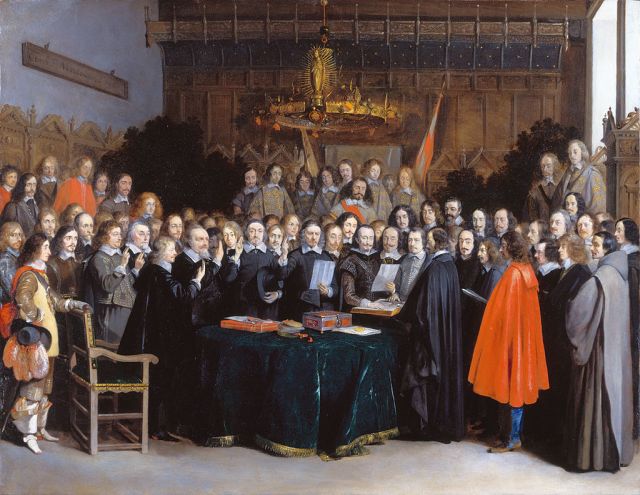
In other words, it was created by these dapper gents. Ponder that for a moment. "The Ratification of the Treaty of Münster," 15 May 1648 (1648) by Gerard ter Borch. Public domain. Image via Wikimedia Commons.
In other words, it was created by these dapper gents. Ponder that for a moment.
“The Ratification of the Treaty of Münster,” 15 May 1648 (1648) by Gerard ter Borch. 
Public domain. Image via Wikimedia Commons.

To unpack that a bit: the Peace of Westphalia established the concept of “the state” as an independent entity with total and unquestioned control over its own internal affairs, free from any external influence. In the Westphalian system, each state is equal to all others, no matter how great or small, and no state is permitted to impose its will on another merely by dint of force. This concept, referred to as “sovereignty,” became a central component of international law in Europe and, later, throughout the world.

Sovereignty is a tricksy concept. It seems quite simple on its surface: “supreme power or authority,” as the Oxford Dictionary would have it. The nuances are where it becomes interesting, and harder to nail down. Following Westphalia, the term took on a particular set of connotations: independence, freedom from coercion, absolute control over one’s own actions and interests. Sovereignty is also applied to people at times, often people wearing funny hats: emperors, kings, bishops, and the like. The meaning is quite the same: a sovereign is someone over whom no one else has power, someone who has total and final control over their own actions and lives. When speaking of a head of state, or (as some Christians do) of a Supreme Being, it carries with it the implication of control over the lives of everyone under that individual’s power, as well.

It’s a compelling idea, as you’d expect from anything that’s been the core of modern geopolitics for going on 400 years. At its best, sovereignty supplies the logical foundations for self-determination and resistance, enabling a small nation to tell to a larger nation, “No, you may not invade us and take our goods, our land, or our lives, because we are us and they are ours.” At its worst, it tacitly supports the worst atrocities the state can bring to bear on its own people, as in the U.S. massacre and genocide of Native Americans, or the Nazi genocide of German Jews.

So, a bit of a mixed bag, as it were.

Autonomy is similarly tricksy and complex. The word, from the Greek αὐτο (auto, self) + νόμος (nomos, law), literally means “self-legislating,” as in “being a law unto oneself.” In ethics, it refers to the ability of an individual to make unhindered, un-coerced choices. Like sovereignty, though, it’s a bit more complicated than that. Deriving in great part from the work of Immanuel Kant, autonomy specifically refers to an individual’s ability to make moral choices: to choose to act in a manner consistent with an objective or outside moral standard, regardless of any desire to the contrary, precisely because that choice is consistent with the moral standard. To be autonomous, in other words, is to have moral agency, to be able to choose to do the right thing… even if you don’t necessarily want to.

In modern parlance, autonomy has taken on some of the characteristics of sovereignty, to the point that many people equate the two. For the purposes of this essay, however, I suggest that they are quite different things: related in their approach to questions of power, coercion, and self-determination, but ultimately referring to two different categories of entity: states (to include autocephalous entities such as churches) and individual people. Simply put, only states (and heads of states, who are effectively the State personified) have sovereignty. Likewise, only people can have autonomy.

“What’s the difference,” you may well ask, “and what the hell does any of this have to do with Faery?” Valid and valuable questions, both of them.

Sovereign Westphalian states exist in relationship to one another, but as separate entities without interconnectedness; in other words, they may have foreign policies and treaties with their allies, but their internal affairs and sovereign conduct are intrinsically isolated from the opinion and coercion of other states, even their allies. This is why, for instance, the United States can criticise other countries for their shabby treatment of children or the environment, but has yet to ratify the UN Convention on the Rights of the Child or the Kyoto Protocol, the tossers. They’re sovereign, which means they can do as they bloody well like within their own borders, even when doing so ultimately hurts everyone else.

Autonomy, by contrast, exists in the context of an interconnected moral universe. I can choose to act or to refrain from action, to speak or to remain silent, based on my estimation of the ethical weight of the choice, which necessarily incorporates the effect of my words or actions, or of my silence or inaction, on the world around me. Autonomy requires responsibility as an intrinsic component of moral agency. In other words, there is no autonomy without accountability. Thus, whatever autonomy means, one thing it cannot mean is “license,” defined as “I do whatever I want, whenever I want, without regard for the outcomes of my actions.”

cartman
NOT this. Pretty much the converse of this. Just… no.
Image from South Park.

South Park references aside, I hope the relation of all this philosophical blather to Faery is beginning to come clear.

What we’re talking about when we talk about “autonomy” is not merely Liberty, but the interrelation and interconnection of Liberty with all the other points of the Pearl Pentacle, and with Power, its own other name and its corresponding point in the Iron Pentacle. Liberty is an essential core principle of a truly Faery ethic… but no greater than any of the other points. It does not trump Knowledge and Wisdom, nor Love and Law, and without them it becomes nothing more than license, which is not a magical virtue, no matter what that one pseudo-Thelemite guy at the pub meet tried to tell you, all the while staring at your ass and offering to buy you drinks. In fact, even Aleister Crowley—that noted proponent of license, impropriety, and Doing What Thou Wilt—made it quite clear in his writings that there was a bloody great difference between “doing one’s True Will” and “doing whatever the hell you want.” Faery can, and should, have at least as solid a grasp on that distinction as Crowley did.

Blessedly, we do… and characteristically, perhaps even frustratingly, it doesn’t express well as a sound-bite.  If I have learnt anything at all about Faery (an open question, surely, but go with me on this), it’s that Faery is about relationships, about being in relationship: with Gods, with spirits, with our kinfolk, with our families and friends and neighbors, with the worlds around us and within us.

A central part of the work of being in relationship is being aware of how what I say and do affects those around me, and accepting responsibility for that: accountability, or as some would say, “owning it.” Sometimes, owning our words and actions means apologising and attempting to make amends. Other times, it means arguing, negotiating, or standing on our principles and refusing to budge, even in the fact of conflict with those we love. Sometimes, it’s mildly uncomfortable. Others, it’s excruciating, or joyful, or dull drudgery. In all cases, it’s about being authentically we you are, exercising moral agency, and accepting responsibility for what that means.

Accountability is the other half of autonomy, without which there can be no autonomy. Lacking accountability, the individual believes itself to be sovereign, as a state or a Supreme Being is sovereign, and inflates its own ego to the point of collapse (or prolapse, if you like). From there, everything else—magic, relationships, personality itself—follows suit. Accountability is what connects us to the world around us, what enables the very relationships that lie at the heart of Faery. To whom are we accountable? Why, to those with whom we’re in relationship: Gods, spirits, our kith and kin, the world in which we live and move and have our being. If we treat with them, we do so with the force of our very beings, and in so doing, we make ourselves accountable for what we do. This is why our oaths are sacred, why our words are imbued with power and meaning, why our actions cause change far beyond the range of our sight: because through them, we are accountable. If we are not accountable, we betray our words and actions, and the power leaks out of them as through a hole in our cup.

Or, you know, whatever vessel you put power in.
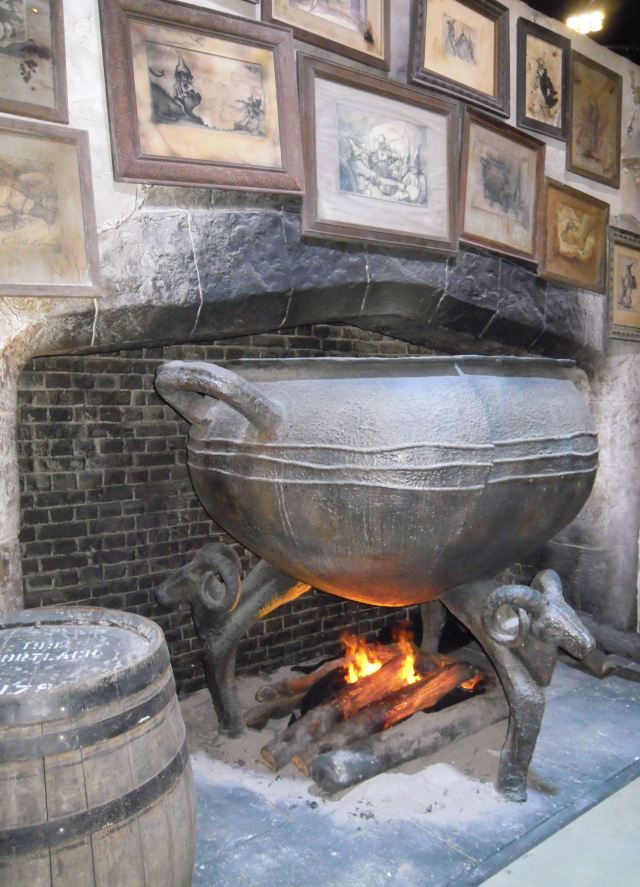
The Leaky Cauldron. Harry Potter film set at Warner Bros. Studios, Leavesden, UK. Image by Jack1956.

In the context of Faery, let’s look again at that statement from the beginning: “We recognize the value of individual autonomy, but we also recognize and honor the fact that our choices affect the choices of others.”

Viewed through the lens of autonomy and accountability, as defined above, this statement begins to unfold to us. After all, I cannot make a choice that changes the world without, y’know, changing the world. Of course, some choices are more impactful than others, and affect others’ choices to a greater degree.

Let’s say, for instance, that I decide to eat an orange. No one else may eat that orange, but that’s unlikely to cause much strife even in my home, where we lurve oranges. If there are no other oranges in the house, I can always pop out to market and pick some up. However, should I be amongst a group of friends when I decide to, say, spoil the new Star Wars film, my behaviour would get me tossed out on my ear, and rightly so. In both cases, I am accountable to those with whom I am in relationship, and to the fact that my choices affect theirs. If I eat the last orange, I merely need to pick up more oranges at market, but if I choose to spoil a movie (or book, or whatever) for someone, I’ve permanently ruined an experience for them, which is potentially an unforgivable offense. At the very least, it reveals me to be a churlish boor, and I’d have no leg to stand on if they chose not to invite me to future engagements… or to take a poke at me, for that matter.

So, then, how much more so with Faery? What if I wish to publicly reveal some shared material of the tradition considered by other initiates, folk I consider “kin,” to be oathbound? Or, if not oathbound, then “merely” sacred, to be held in confidence and secrecy? What if I should suggest to students, seekers, or other interested parties that my particular, idiosyncratic take on Faery is normative, and that Faery who practice in some other way are somehow beyond the pale? What if I decide to charge students money to be “initiated” into Faery, or to demand sexual favors from students, or to dox my fellow initiates, publishing their names and personal details for the world to see? When someone (or, more likely, several someones) comes to me with criticisms, grievances, even outright anger, how should I receive that?

Well, if we are in relationship to one another, as suggested by the term “kin,” then I am accountable to them. If it is my claim that we are part of the same tradition, I owe it to them—I am obliged—to hear their words, to consider their counsel openly and honestly, and to allow that counsel to inform the choices I make. If someone with whom I am in a relationship tells me that my choices are impeding or harming their own choices, I have a responsibility to take that seriously, to consider the possibility that I am behaving in an immoral and unethical fashion, and to modify my behaviour accordingly.

Why?

Because at the end of the day, as a wise woman once said to me, we are the choices we make and the stories we tell. The choices we make show us what kind of people we are; the stories we tell shape the choices we believe we have, and put those choices into some kind of context. If my story is that I’m wholly independent, beholden to no-one and nothing—save, perhaps, the Gods—then my choices I perceive will be limited in scope, and will tend to reinforce that worldview. If I see myself as sovereign, as hermetically isolated from other initiates, I am denying our kinship, spinning a story in which we have no relationship, and in which I’m therefore not accountable for how my choices affect theirs.

At the risk of belaboring an obvious point: that’s magic. It’s a spell… or, if you prefer, it’s a glamour, an illusion. It’s illusory, because sovereignty is a delusion. What we have, instead, is Liberty: power and agency. We have autonomy. We exist in a moral context, in relationships with others of our lineage and with the world around us. Our choices change the world, and affect the choices others can make, which makes us accountable.

At our initiation into Faery, we formally acknowledge and accept both our autonomy and our accountability, each as part and parcel of the other. However, being an initiate doesn’t grant autonomy; we have it merely by being human. As such, it shouldn’t require an oath to enforce accountability. All it should take is a basic level of consideration for others: Say “please” and “thank you.” Don’t steal somebody else’s things. Ask before you use them. Don’t spoil the movie. Share nicely, and without pouting. You know, the things we expect children to learn before they leave primary school.

After all, if we cannot be at least that accountable, if we cannot own our own words and actions, however do we expect to treat with spirits, Gods, or our own shadows?


The Crafte and Feri (by Cornelia)

It is understandable, in this age of super information coming at us from all sides and media, that we have different kinds of information and lore from many various traditions and cultures mixed up together. This has resulted in many styles of modern Paganism.  Still, there is a certain bottom-line of cornerstones that connect all forms of Crafte.* Confusion about this occurs at times because people have either lost sight of what the cornerstones of the Crafte historically are, or because there has been a deliberate effort to destroy or twist these fundamentals into forms that serve no one.

Victor and Cora Anderson were called to the work of helping people through humanity’s entangled complexes and magical snares. Now more then ever, it becomes necessary to recall and reflect on these cornerstones of our Crafte and how they apply in any age.

I offer these to think upon for those who want to embark on the spiritual life of Feri/Faery Crafte:

  1. To respect and know nature in all its forms, for this is what we are all a part of.
  2. To strive to embrace life and humanity, and to value life’s lessons as well as its pleasures.
  3. To live with joy and wonder, understanding the wisdom that lies between dignity and ecstasy.
  4. To live honorably and in accordance with our oaths, so we have the strength of character, if need be, to shun that which has become broken or twisted in its nature or values.
  5. To defend the tradition with love and the courage of true warriorship.
  6. To know your life is of purpose, to be filled with education, creativity and spiritual truths.
  7. To strive for rightful pride and rightful humbleness, becoming your true self and reaching for your human refinement.
  8. To recognize, respect and celebrate one another’s gifts and talents.
  9. To honor and respect our elders’ experience.
  10. To offer help to those in need, especially our kin.
  11. To Honor the Gods and spirits of all nations and places.
  12. To live in balance in ourselves, our covens, and our communities in accordance with our oaths.

A witch holding a plant in one hand and a fan in the other. Woodcut, ca. 1700-1720. WellcomeImages.org. Licensed under Creative Commons 4.0.

The paradox that brings wisdom is knowing that, although the journey from birth to death is in essence one we make alone, the journey is not possible or complete without each other. Be it from our smallest cell, to the great forces all around us, it is all part of us. This is but one of life’s deep mysteries, what drives us to contemplation, meditation, prayer, science and all spiritual arts.

To walk the path of Crafte, it becomes our duty to endeavor to practice self-honesty and humility, as well proper pride before each other and the Gods. We must know when and how to be silent, for the greater good and for the inspiration and wisdom it brings. Our code of honor contains both kindness and discernment, joyfulness and dignity, that which seeks to explore and stretch boundaries yet not overstep common sense. Our code asks of us that we not conduct ourselves in such a way that brings confusion or mistrust to our kin or neighbors. We model Devotion not as enslavement, but as a unity of love and trust.

We are wise ones, artists and healers of various skills and talents. We should be trained well in these skills and have faith in ourselves as well as in our partnership with the divine. We should have clear understanding of our oaths and live to uphold them and our tradition. If one does not understand this, then one is not seeking the paths of the wise, but is at best having a well-meaning or innocent dalliance with the mysterious, or at worst becoming some kind of con artist of varying malevolence and criminality. There are many bitter pills in life, but none so choking as spiritual debasement; so remember you are living and walking a path, not just wearing its apparel.

When Initiation is fully realized, the doors of imagination open the mind to Wisdom and Science, the heart to Magic and Art, the spirit to Love and Reason. Realize that all the talent and genius of anyone without Love and Self-discipline comes to naught, for these provide the backbone and heart of true warriorship. The path of Feri Crafte offers skills of mind, body and spirit to strengthen and protect the seeker and Initiate. We learn to refine our nature as well as help uplift human kind. Only those who truly desire such goals and are ready to pursue them will see this Crafte for what it truly has to offer.

Know that any magic you make is real, because all of creation is an illusion that is very real. This is a paradoxical truth and one reason why genius and madness can walk hand in hand.

Realize that human evil is birthed from fear and greed, and these are the stepchildren of arrogance and ignorance.

Realize that all forms of slavery and violence are our enemy. Yet we will aid and defend, for such are our oaths.

We walk this path in partnership with the Divine as their children, and thus we have great possibility, and responsibility.


* Editor’s Note: The author has used the older spelling of “Crafte” here for historical reasons… and because it has not yet been the title of a major motion picture!

Consent, Coercion, and Teaching the Craft (by Shimmer)

[Slightly revised from the original published at Boston Bloodrose Faery.]

We are a sex positive tradition, but you must know the heart of the one you approach. No one must ever be approached with force or poor intent.

~ Victor Anderson, 2001

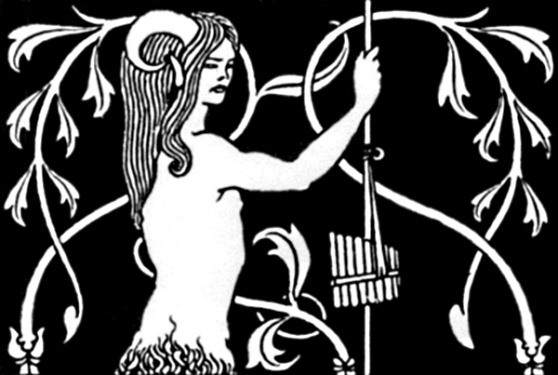
beardsley_pan_jacket94_1336663077_crop_558x375

Coercion under any circumstances is morally and ethically wrong.  When coercion appears in the sphere of teaching, however, there is a particularly invidious taint that enters the picture.  Teaching is, at its heart, a fostering—which often requires challenging the student.  It is thus a process which has as its aim to provide a space in which the student can fully realize hir own potential to the finest possible flowering.

In horticulture, gardeners employ techniques of training and “forcing” and other potentially harsh methods.  But the human flower does not prosper under such conditions.  Sri Krishna in the Bhagavad Gita says that to follow the path of Self Realization is to walk the razor’s edge; the path of the teacher can be one that requires, every bit as much, a course of conduct as rigorously disciplined.  My happiest moments as a teacher have been seeing a student come fully and completely into the recognition of hir own Power; to fully own, and be at ease in, the wielding of hir own Strength, hir own faculty to pursue and embody Wisdom.  Coercion can have no place in this.

Tests are needed in the course of time to determine whether a student is ready to continue.   Often, the result of such a test is that the teacher must withdraw for a period and allow time to pass and seeds to germinate.  Such testing must not be exercised in a coercive manner.  It should never be about the teacher’s supposed superiority over the student.  It should always be about knowing just when the student is really ready to trod terrain that could otherwise be daunting, frightening, or overwhelming.  Perhaps all of that is part of why one of my favorite teachers always described himself as a tourguide.  A good guide knows not to lead one into the swamp until one is wearing proper wellies—so to speak.

Witchcraft is a deeply physical discipline.  The Faery current is fierce, feral, and unabashedly sexual.  It also holds high the values of honor, respect, and what Victor Anderson called “impeccability.”  Cora Anderson wrote:  The Craft as we know it has a code of honor and sexual morality that is as tough and demanding as the Bushido of Japan and of Shinto, which it strongly resembles and in many important ways is identical to. This code is in no way puritanical, ascetic or anti-sexual.   When I teach the Craft, I bear this code of honor rigorously in mind.  And all of this is why, when I evaluate a potential student, I look for an individual who has a secure, well-established sense of hir own boundaries and the capacity to learn and maintain habits of good psychic hygiene.  If the individual seems too unsteady, unsure of hirself, or just unstable, I will advise hir to go home and work on personal growth and nurture.  In such cases, I think it is most inadvisable for a person to engage in magical work that has any goal beyond self-healing and self-care.  And again, this is why I always begin by teaching the work of grounding, clearing, and centering:  observing a person going through these exercises and checking in with hir immediately afterwards can tell one a great deal about what’s really going on inside, as opposed to the “public version”—how the individual presents hirself to the outside world.​

Let us be clear and concise in expressing this foundational principle:  teaching and coercion, on any level, don’t go together.