Qwyr Magic: Part 2 (by Willow Moon)

[Part One of “Qwyr Magic” can be found here.]

Introduction to Part Two

Using historical references found within Gardnerian and Wiccan mythology, I will demonstrate how history supports the inclusion of Qwyr folks in Gardnerian and Wiccan circles as working partners. Based on ancient folk customs, I show how transvestites are explicitly connected to fertility rites still performed in our modern world. Finally, I explore how modern Witch mythology informs the intimate connections between ecstasy, fertility and creativity and what that could look like in Qwyr ritual magic. In addition, I explore the benefits to our society of the collusion of Qwyr magic with non-Qwyr magics.

A historical basis for including Qwyrs in Wiccan circles

Despite institutionalized homophobia and the heterocentric notion that the God/Goddess pairing is the only way to operate within a Gardnerian or Wiccan coven, there is a liturgical and historical basis for including Qwyr people in these rites. Wiccans often use a well-known piece of liturgy called the “Charge of the Goddess.” This liturgy is published in the Farrar’s book Eight Sabbats for Witches and starts with the words: “Listen to the words of the Great Mother…” The Farrars write:

In the [what the Farrars describe as an Alexandrian] Book of Shadows, another sentence follows here: “At her altars [of Artemis] the youth of Lacedemon in Sparta made due sacrifice.” The sentence originated from Gardner, not Valiente. (Farrar: 1985, 42)

According to the Farrars, most covens omit this historical reference, considering it to be too “gruesome” for modern Craft practices. Oddly, this same piece of information that points to a historical antecedent of modern Witchcraft is also a precedent for including sexually active Qwyrs as working partners in Wiccan circles. Curiously, in Starhawk’s The Spiral Dance this historical reference is omitted in her version of the Charge. In most Faerie circles the Charge of the Goddess isn’t traditionally used, but it is still loved and preserved by many Witches of different traditions who feel it expresses their concept of the Goddess.

Shedding light on the Charge of the Goddess

The early Dorians in the 12th century BCE established their capital at Sparta. They maintained many of the most ancient traditions of earlier ages, especially with respect toward women. Spartan women wielded the power to compete with, publicly praise, or censor men, and they had greater authority over property than anywhere else in Greece. Elsewhere in Greece, women were only allowed to call their husband “Lord,” were not allowed to eat meals with their husbands and only lived inside the house. In addition, Plutarch wrote in his 1st century CE book Lives that “the unmarried women love beautiful and good women” (Evans: 1978, 34).

Homosexuality had a high status among the Dorians. In fact, homoerotic activity was more highly regarded in Sparta than in Athens during the later classical period. Male homosexuality often took the form of paiderestia – the love of an older experienced man and a younger, more inexperienced man. Paiderestia was a form of religious, military, educational and sexual training. The experienced man initiated the younger man into men’s mysteries. The holy act of transferring semen conveyed an older man’s soul power to the youth and was called “inspiring” the inexperienced man (Evans: 1978, 34). In fact, this is still practiced to this day by some of the Kahunas of Hawai’I as explained to me by Kahunas I met there.

Doric paiderestia is a continuation of familiar shamanic and religious concepts that date back to the Stone Age. The Dorians, though coming later than the Mycenaeans, remained much closer to the earlier sexual traditions. According to the German scholar Bethe, the myth that homosexual men are always contemptuous toward women flounders on the fact that precisely in Sparta and Lesbos, where man-love and woman-love are best documented, the sexes associated more freely and women had more economic and political power than anywhere else in the Greek city-states (Evans: 1978, 33-35).

Historically, social acceptance for homosexuals is associated with a high social status for women. Patriarchal authorities have always oppressed both women and men who “act like women.” Therefore women and homosexuals often have a natural bond born from a personal understanding of the nature of oppression. Witches often tout that the Craft is female affirming; according to this historical reference, the Craft is also homosexual affirmative. Although in Faerie Witchcraft, the Charge of the Goddess is not used much, we do often work with the Divine Twins who are intimately connected to worship in Sparta. The Divine Twins Castor and Polydeuces, the youths of Zeus, are native to Sparta. They grew up with Helen in the house of King Tyndareos, and They fetched Their sister back from Aphidna in Attica.

Pair of Roman statuettes (3rd century AD) depicting the Dioscuri as horsemen, with their characteristic skullcaps (Metropolitan Museum of Art). Image by Marie-Lan Nguyen (2011). (CC BY 2.5. Wikimedia Commons)
Pair of Roman statuettes (3rd century AD) depicting the Dioscuri as horsemen, with their characteristic skullcaps (Metropolitan Museum of Art). Image by Marie-Lan Nguyen (2011). (CC BY 2.5 – Wikimedia Commons)

In the ancient Greek world, these Gods were referred to as Dios Kouroi, Kouretes or Kabeiroi. The worship of heavenly riders of white horses clearly derives from a much older common Indo-European heritage, paralleled in Vedic mythology by the shining horse-owning brothers called Asvin. Twin horsemen who rode white horses were also the legendary founders of ancient Thebes. These divine Twins, found in various cultures, are described as being in the service of the Goddess. The Dioskouroi were called Tyndedaridai in Sparta and had a special relationship to the dual kingship of Sparta. The Spartan cult of the Divine Twin lovers flourished in the context of a warrior society in which initiations included an encounter with death (Burkert: 1985, 212).

In another rite, young Lakedaimonian males, in preparation for combat, flagellated themselves and engaged in same-sex eroticism at a festival honoring Diana (Conner: 1997, 69). [i]

The worship of the Brauronian Artemis by homosexually active men was brought from Tauris (Taurica Chersonnesus or Crimea) to Attica by two male lovers called Orestes and Pylades ”whose romantic attachment to each other has made their names synonymous for devoted self-sacrificing friendship.” Orestes was the son of Agamemnon, who had incurred the wrath of the Furies by avenging his father’s death. The Oracle at Delphi told him the only way to pacify the Furies was to bring the statue of Taurian Artemis from Tauris to Attica. Upon arriving on Tauris, Orestes and his faithful friend Pylades were seized to be sacrificed; however, Orestes’ sister Iphigenia happened to be the officiating Priestess of Artemis there (Berens: 95).

Previously, Iphigenia was to be sacrificed by her step-father Agamemnon prior to the Trojan War, but Artemis transported her to Tauris on the north shore of the Black Sea and left a deer in her place to be sacrificed instead. She became one of the legendary women called aoroi, or those who die before their time. These immortal female attendants of Artemis are often renamed Hekate (Von Rudloff: 1999, 43-70).

With the help of his male lover, Orestes and Iphigenia recognized each other and they all escaped back to their homeland. They stole the statue of Taurian Artemis and carried it with them to Brauron in Attica. Thus She became known as the Brauronian Artemis and human victims were bled to death in both Athens and Sparta (Berens: 96). The sacrifice to Artemis in Sparta at the Ortheia festival was scouring until blood came (Burkart: 1985, 152).

The revolting practice of offering human sacrifices to her continued until the time of Lycurgus, the great Spartan lawgiver, who put an end to it by substituting in its place one which was hardly less barbarous: namely, the scourging of youths, who were whipped on the altars of the Brauronian Artemis in the most cruel manner. Sometimes they expired under the lash, in which case their mothers, far from lamenting their fate, are said to have rejoiced, considering this an honorable death for their sons (Berens: 96).

It is interesting that initiations into the religion of the Divine Lover-Twins were associated with an encounter with death. This is similar to the modern Craft traditions where initiations are also associated with an encounter with death. This may reveal a connection between Spartan traditions and modern Wiccan traditions, referred to by a published Book of Shadows.

According to the Heritage dictionary, “youth” means a young person; especially a young man. So it seems that the “youth of Lacedemon in Sparta” refers to homosexuals and that the “due sacrifice” to the Spartan Artemis was scouring. If this historical reference was meant to include cross-sex flagellation, then surely the word maiden would also have been included to make clear the scourging was only with male and female partners.

The Charge of the Goddess says the youth made due sacrifice, and Berens states that the youth were the sacrifice. So in Sparta, in worship of Artemis “due sacrifice” was young men scourging other young men! Even though scourging was later introduced in Sparta to replace human sacrifice to the Goddess, sometimes the scourging was so severe that the Lacedemonian youth would perish. Presumably, this is what the Fararrs considered to be too gruesome to mention. Later in the Charge, the Goddess says She demands no sacrifice and so it is in modern times – but She will accept a sacrifice given freely with love.

Not only is Artemis mentioned in the Charge of the Goddess, but so are Diana and Aphrodite. Diana was famous for Her loving attachment to Her female attendants. Diana’s religion was organized like a bee hive, Her priestesses were called melissae or “bees” and Her high priestess was the queen of the bees. Diana was also served by a special class of antineirian priestesses. These particular priestesses were women who rejected marriage, loved hunting, were skilled warriors, hated patriarchal values, and enjoyed the company of other women and gender variant men. These priestesses danced around a sacred oak or beech tree at Ephesus in a circle with their shields and swords (Conner: 1997, 69). [ii]

Portraits of the gender variant priests of Diana called the megabyzoi were hung in Diana’s temples and in tombs contrary to the wishes of Quintillian, a Roman rhetorician of the 1st century CE. He insisted that painters and sculptors refrain from depicting any megabyzoi on aesthetic and moral grounds. Apparently, Quintillian thought these priests were ugly and indecent (Conner: 1997, 229). [iii] Unfortunately, Quintillian was not the last, frightened male to object to the flamboyant freedom of Qwyrs.

The megabyzoi wore a mixture of feminine, masculine and priestly articles of clothing. They shaved, powdered and painted their faces. They wore their hair in a feminine style by looping one lock in front of each ear. They also wore long-sleeved murix-purple garments decorated with golden circles, meanders, diamonds, swastikas, flowers and animals which were all sacred to the Goddess. The color of purple they wore was associated in the Greco-Roman empire with both royalty and effeminacy (Conner: 1997, 229). [iv]

The megabyzoi and melissae were not the only gender variant priests and priestesses who honored Diana with cross-dressing. In the kordax, a religious dance-drama, women dressed as men and wore lombai or “enormous artificial phalli” which they used for penetrating the male dancers who were dressed as women. Not only is the Goddess Diana homoerotic friendly, historically She is bisexual. Britomartis, Cyrene, and Anticleia were Diana’s female lovers who were the first to wear Diana’s gallant bow and arrow-holding quivers on their shoulders. So wrote Callimachus, the royal poet and lover of Pharaoh Ptolemy Philadelphus in his hymn to Diana (Conner: 1997, 69).

Aphrodite was above all a Goddess of love in all its forms, so much so that She was nicknamed Philommedes, “genital loving.” In fact, the Greek term aphrodisia, meaning the “things of Aphrodite,” refers to sexual intercourse according to the classical scholar K.J. Dover (Conner: 1997, 64). [v] Aphrodite has Her own bearded gender variant forms and through Her association with the castrated Cronus is linked to gender variant males. It is She who gave birth to Hermaphroditus, the essential divine form of gender variance. Her beloved priest Cinyras, a legendary ruler of Cyprus, was a transvestite and lover of Apollo. Even the apparently heterosexual favorite of Aphrodite and abductor of Helen, Paris was said to be “unwarlike and effeminate.” He was so favored by Aphrodite that She blessed him with a retinue of eunuchs (Conner: 1997, 64). [vi]

Since ancient times, the Goddess of Love — especially in Her form of Aphrodite Urania, or Heavenly Aphrodite — has been known as a patron of men-loving-men. K.J.Dover points out that in the homoerotic verse of Theogenes, his beloved is considered to be a “gift of Aphrodite” (Conner: 1997, 64). [vii] When Aphrodite appears as a hermaphrodite with female breasts and an erect phallus, She was called Aphroditos or Bearded Aphrodite. She was associated by the ancient Greeks not only with the planet Venus but also with the moon (Conner: 1997, 64). [viii]

In ancient times, this Goddess mentioned in the Wiccan Charge of the Goddess was certainly a patron of sex, one who did not discriminate based on who entered whom. Gardner’s fear and the inclusion of the condemnation of homosexuality in the brand of the Craft which bears his name was contrary to the way his own Witch teachers did things. Gardner’s initiator Dorothy Clutterbuck lived with Elizabeth Slatter instead of with her husband. Elizabeth was described by locals as Dorothy’s “companion” and she went by the name of “John.” Dorothy also wrote passionate love poetry to mysterious women (Hesselton: 2000, 126-176). Perhaps Gardner was caught up in the Christian moral of hating homosexuals, or perhaps he found Dorothy’s lesbianism to be sexy and only condemned male homosexuals.

The sexiness of lesbianism (making it tolerable) may be the reason why some Wiccans insist that two men cannot stand next to each other in circle or work together as partners while at the same time allowing women to stand and work together. Conceivably, it is merely practical for women to be together as there aren’t enough men to go around. However, if Wiccans were really serious about the “rule” for alternating men and women, they would only allow equal numbers of both sexes in circle. There have been many times that I have been in Wiccan circles where the women outnumbered the men. There seem to be objections only when two men stand or work together. Like so many other such “rules,” they are only enforced when useful. Regrettably, too many people still think for a man to emulate a woman is unnatural – that it is improper for a man to relinquish his privileged status. Regardless of prejudged attitudes, the Wiccan Goddesses’ all-encompassing, libertine-loving nature is still remembered in Wiccan circles every time She says, “All acts of love and pleasure are my rituals.”

The ancient association of transvestites with fertility

Perhaps the rule that men and women should stand alternating in a Wiccan circles is a mis-remembering of the tradition of cross-dressing in connection to fertility rites in ancient Britain.[ix] Those individuals who say that there is no place for sexually active homosexual priests or priestesses in a fertility religion should give more thought to the purpose transvestites played in most fertility folk customs throughout Britain. Of course not all transvestites are homosexual, but the language of queerness is applied to both and they both express a non-standard gender.

In Britain, the horse was the most frequent animal disguise used to promote fertility in humans, the earth and in animals. Appearing frequently along with the sexually endowed horse was a man dressed as a woman. In 33 ancient sites in eastern and northern Kent, the transvestite “Mollie” carried a broom and appeared with the “Hooden Horse.” In southern Wales, a black-faced transvestite called “Judy” also with their broom cavorted with “Punch” during the appearance of the Mari Llwyd or “Grey Horse” previously called the Aberyn bee y Llwyd or the “Bird with a grey beak.” In villages around Sheffield, the broom-wielding, black-faced transvestite was called “Our Old Lass.” He took on the role of an old woman appearing in a hero-combat play between the butcher and the sheep-headed horse called “Old Tup.” Even today during the Horn Dance, which still takes place at Abbots Bromley in Staffordshire in early September, there is a transvestite called “Maid Marian” who carries a collecting ladle as a token of their sacred office and appears with the “Hobby Horse.”

The sacred transvestite did not only appear with holy horses, they appeared as an important figure in all manner of fertility rites. In Kent, during the Horn Fair at Charlton, any man could appear in public dressed in women’s clothing. On May Day the lucky London sweeps celebrated with “the Lord and the Lady,” who was, of course, a transvestite. In the May Day battle between the Queen of May and the Queen of Winter on the Isle of Man, the Queen of Winter was a man.

“Moggies” together with his husband can still be seen during the fertility rites on May Day at Ickwell in Bedfordshire. In north Wales the principal character of the fertility dances held in May was the transvestite “Cadi.” The transvestite “Bessie” blessed the ceremony of Plough Monday while the transvestite “Betty” carrying a broom sanctified the Goathlan Plough Stots in north Yorkshire the following Saturday. Ritual cross-dressing for the purpose of promoting fertility was a worldwide folk custom of antiquity which was first recorded in Europe around 400 CE by Severian when he wrote about the kalends (Bord: 1982, 201-218).

Cross-dressers appeared at many fertility folk customs throughout ancient Europe. Sometimes the man (like the Cadi) was dressed as a woman only from the waist down. The image of a man dressed as a woman (in part or completely) carrying a broom was an essential ingredient in most rites to invoke fertility. Feasibly, this is in honor of the role that the mythic bisexual progenitor played in the creation of life on earth. Similar to the image of the brush and pole of the broom which they carried, the image of a single person embodying both sexes implies the psychological/physical/energetic/mystic union of male and female. This is not the union which comes after creation, but their union prior to the forming of men and women that is the source of maleness and femaleness. Thus gender variant individuals participate naturally in the source of creation. To honor them is to honor the act of creation itself thus promoting fertility for man and beast.

What could Qywr magic look like in today’s world?

The Holy loves us with the same love with which we love each other, but raised to the level of the Divine.

–Victor H. Anderson

The Minoan Brotherhood and Sisterhood were created in the 1970s by Edie Buczynski and Lady Miw because they were frustrated with the homophobic attitudes enshrined within the Gardnerian tradition. Part of the Minoan tradition’s mission was to do magic to promote the social acceptance and legal equality of GBLTQ folks. In the Minoan Brotherhood, the Great Goddess of our people is the Mother of the Divine male Lover-Gods. This is similar to the Faerie Tradition of Witchcraft which views the Star Goddess as the progenitor of all life in the universe. Her first born are the Divine Twin-Lovers who can be male-male, female-female, or male-female pairs. They switch gender at will to appear to us in the most suitable and helpful form. They also appear in diverse shapes, sometimes terrifyingly awesome or stunningly beautiful. They always appear in the form which has our best intentions at heart.

This mythology is similar to many different cultures throughout time and in diverse places. Many ancient peoples not only recognized the social reality of homosexuals born of heterosexuals but also recognized their value to society as well. In the recent past, Qwyrs had lost all standing in society but were still valued for their entertainment and decorating skills. Now that the will to oppress homosexuals/bisexuals/transsexuals/queers is lessening in society because of the weakening power of religious ideologues, once again gender variant people can be valued for the multi-skilled talents they so often possess, as well as for simply being who they are.

The mythology of a Mother Goddess and Twin-Lovers is ideally suited to informing Qwyr religion, myths, customs and magic, not only because of its venerable history but also because of its simplicity and beauty. The mythos of a primal Goddess giving birth to Divine Twins of indeterminate gender is so powerful because such a mythic arrangement naturally participates in the magical triangle of manifestation. The power of the One becoming Two and the Two becoming One is the power of creation itself!

The fact that Divine transsexuals such as Ymir, Vishnu as Mohini, Shiva Ardhanarishvara, Baphomet, Hermaphroditus, Mollie, Judy or Bessie are associated with creation and fertility is because They can bridge the gap between women and men and directly show us that within every man and woman lies the power of creation. Every man has female hormones, and every woman has male hormones, each person with their own unique balance.

Utilizing the power of creation — which is the power of love and desire — provides the ecstasy that raises power directly from our bodies and feeds our spells and magics. The use of ecstasy as a main path to the Witch Power is a specialty of gender variant covens. Qwyr folks are adept at ecstatic states which bridge the gap and discharge the force needed for spells because we naturally understand in our guts the intimate connection of ecstasy and creation. This may be why even during the worse times of our persecutions, Qwyr folks were often associated with creativity. This would explain the prevalent folk custom of including a transsexual in fertility rites to represent the ecstasy of union that empowers all kinds of fertility and creativity.

Qwyr culture not only has a spiritual role but also has a supporting role for heterosexual culture. Heterosexual pairings can create families based on bonds of love and caring for each other. However, it is the bonds of love and caring between men and other men as well as women with other women that creates community. It is the circle of community that surrounds the family units to protect them and provide services. Perhaps it is the Great Goddess’ design that we help each other. Heterosexual people give birth and nourishment to Qwyr people who in turn provide multiple services that enriches and enlivens society.

In today’s modern times we can forgo human sacrifice. Our Gods no longer demand blood sacrifice, as ancient Pagan societies started changing their beliefs in the need for and efficacy of blood sacrifice, in addition to recognizing its cruelty. Governments are now the arbitrators of human sacrifice, demanding their populace (but not the politicians) sacrifice their lives and livelihood to their gods of war.

We also don’t need paiderestia as an accepted social institution any more. Now we know the damage done to children from abuse by adults in power is counterproductive to healthy minds and normal social relations. In turn, the damage done to pedophiles destroys their sense of compassion, social appropriateness and their ability to relate to others without controlling them. This type of behavior can lead to abuse of power over others because that is what sex with students by their teachers is often based on. Those with smaller, less encumbered egos tend to try to please those they perceive as more powerful. This kind of abuse of power over others is passed by example onto other generations, destroying slowly the social fabric of community. One cannot build community while hiding sexual misconduct; eventually it will destroy any trust upon which a community is built.

Besides a mythology to help build forms of worship, one needs a healthy understanding of the relationship of sex and love. Victor Anderson used to say that if we had a real understanding of sex, we would feel no dichotomy between love and sex. Our sexual sense is one of our natural senses. It is just as natural as seeing something beautiful and feeling pleasure in the sight of it, or hearing a beautiful sound or music and being transported to an ecstatic state. In today’s world most of us are sexual cripples, crippled by religious morals, sexual predation, a lack of sexual education and a true understanding of sexual abuse as a power play. Most people in the societies of today are taught to ignore or be afraid of our sexual urges that separate our bodies from our nature and the nature of the world. It is no wonder why many people feel disassociated from others and the world.

Victor also said that the association of sex with guilt was accomplished by men who wanted all the power they could grab. They betrayed women and girls by enslaving the weaker willed into submission and taught this perversion down through the generations. Because people were not allowed to choose their own sex partner, but were told who they could and couldn’t have sex with by men in authority, sexual predation and abuse has been nourished up till modern times. Masses of people have easily become perverted into hate which has fed racism, intolerance and the belief that greedy men are natural rulers that ought to be emulated. Because love and sex have become separated, the natural urges that drive evolution became separate from natural sexuality. Our sexuality, once separated from our natural urges, became associated with violence and war. This is the force behind the world’s ubiquitous rape culture that blames women for the indiscretions of men.

Sex magic, on the other hand, can change all that because of its marvelous healing and creative power! It is wonderfully healing, self-empowering, and creative, because rites of sex can allow us to remove the fear, confusion, guilt and shame that authorities use to control us. The Divine desire to create the universe is reflected in our own personal desire for sex. When we realize that we as animals have the right to have sex with any consenting adult, we are naturally closer to the Divine power of creation because we are exercising our own choice rather than someone else’s.

In the ancient Pagan cultures, there are many examples of both acceptance and tolerance and in some cases an elevated status for Qwyr people. These attitudes were reflected in the myths of their Gods and in their laws. It isn’t until more modern times that homosexuality was raised from an ordinary Christian sin, like eating shrimp, into a crime that exceeds the prohibitions of even the 10 Christian Commandments. Consider how often some fundamentalist monotheists bear false witness with the lies they spread about Qwyr folk.

Modern Witchcraft culture itself has struggled with acceptance or tolerance of gender variant behavior. On the one hand is the libertine nature of the Goddess accepts all love and pleasure, which translates into a respect for all of human nature. On the other hand are the centuries of accrued prejudice layered onto the psyches of people by authorities. However, even Gardernians who had no problem with Qwyrs would often bend the rules of conduct because they recognized how ridiculous the rules were. It just wasn’t talked about, like so many other Qwyr things. However, not all Traditional Witchcraft traditions view Qwyrs with the same ambivalence. Some still remember the traditional inclusion of the transvestite in fertility rites to invoke the power of creation.[x]


Works Cited

Berens, E.M. Myths and Legends of Greece and Rome. Clark and Maynard: New York, n.d.

Bord, Janet and Colin. Earth Rites: Fertility Practices in Pre-industrial Britain. Granada Publishing: London, 1982.

Burkert, Walter. Greek Religion. Trans. John Raffan. Harvard University Press. Cambridge, 1985.

Conner, Randy; David and Mariya Sparks. Queer Myth, Symbol and Spirit. Bath Press: Bath, 1997.

Evans, Arthur. Witchcraft and the Gay Counterculture. Fag Rag Books: Boston, 1978.

Heselton, Philip. Wiccan Roots. Capall Bann Publishing: UK, 2000.

Gade, Kari Ellen. Homosexuality and Rape of Males in Old Norse Law and Literature. Scandinavian Studies vol. 58/2, 1986.

Gander, Niklas. “So, just what is the Feri Tradition? 25 July 2010 <http://pagantheologies.pbworks.com/w/page/13622055/Feri-Tradition/&gt;

Johnson, Tom, PhD. “Feri and Wicca: So What’s the Difference? Witch Eye #5: San Francisco, 9/2001.

Simmer-Brown, Judith. Dakini’s Warm Breath: The Feminine Principle in Tibetan Buddhism. Shambala: Boston, 2001.

Lindow, John. Scandinavian Mythology. Garland Publishing: New York, 1988.

Sturluson, Snorri. The Prose Edda. Trans. Jean Young. University of California: Berkeley, 1973.

Sergent, Bernard. Homosexuality in Greek Myth. Boston: Beacon Press, 1986

Farrar, Janet and Stewart. Eight Sabbaths for Witches. St. Edmundsbury Press: Suffolk, 1985.

Von Rudloff, Robert. Hekate in Ancient Greek Religion. Horned Owl Publishing: Victoria, 1999.


Notes

[i]Conner citing: Delcourt, Hermaphrodite, 12-13 quoting Hesychius; Persson, Religions of Greece, 146-147; Henri Jeanmaire, Couroi et Couretes. New York: Arno Press, 1975

[ii]Conner citing Callimachus, “To Artemis”

[iii]Conner citing Falkner: Ephesus, 330

[iv]Conner citing Athenaeus: Deipnosophists

[v]Conner citing Hesiod: Theogony

[vi]Conner citing Licht: Sexual Life

[vii]Conner citing Dover: Greek Homoexuality

[viii]Conner citing Delcourt; Hermaphrodite, 27 and Macrobius; The Saturnalia, bk 3, chap 8, sec 2-3, p. 214

[ix]Thanks to Flora Green for this idea.

[x]Thanks to Shimmer for talking about these ideas with me.

Qwyr Magic: Part 1 (by Willow Moon)

Sex is not a doorway leading to something else, nor is it a metaphor for so-called spiritual love, but a sun and moon lit path leading across the sea of life to an infinite horizon.

Cora Anderson

Introduction to Part One

In Part One, I briefly put forward ideas of how the Witch power operates with Qwyr people in the context of Faerie Witchcraft. I then discuss and contrast ideas of how the Witch Power is believed to work in some other modern Witch traditions in the context of polarity. I show how polarity works not only as a model for heterosexual couples but also for Qwyr couples. Then I introduce an ancient idea of non-gendered polarity and how that exists and functions in our world today in the context of creation. Later, I delve more deeply into Faerie Witchcraft ideas about how the Witch Power moves within a magic circle based upon our mythology. I give the examples of gravity and plasma as to how the Witch Power moves within nature and mimics its natural movement within the circle.

[Part Two of “Qwyr Magic” continues here.]

Attitudes about Qwyrness in Faerie Witchcraft culture

Believing as they did in both the autonomy and the empowerment of each individual was the exquisite beauty of the Anderson’s teachings. The Tradition can morph to fit and empower the individual, but at the same time there are some items that clearly distinguish Faery from Wicca.

Faery meetings might look a great deal like a Wiccan coven’s, but the informing principles are quite different. Victor and Cora dismissed the physical polarization of Deity by gender as an oversimplification of the Divine’s multiple manifestations of every conceivable mixture of gender. (Gander: 2010, 3)

I feel that the power in an Anderson Faerie Witch circle doesn’t flow only between men and women or even simply between individuals. Like life-giving dew forming from moist air, sexual attraction between people makes the Witch Power condense onto their bodies, giving them a feeling of pleasure in the other’s company. I feel the power raised in a circle before it is formed into a spell or cone to be like a bubbling cauldron: full of potential yet free flowing throughout the cauldron of the circle and freely available to every member in circle regardless of sexual proclivity.

The common understanding of Wicca tends to stress the importance of male-female workings and focus on fertility. Anderson Faery magic has always had a primary focus on ecstasy instead of fertility. This may be due in part with the plurality of Deities we work with. As a result, sex of any stripe is honored as a gift from and to the Gods. Homosexuality, heterosexuality, bisexuality, polysexuality, transgendered sexuality, in short all of sexuality, is our holiest mystery. We have no reason to simplify the profound mystery of sex into redundant and meaningless roles. The Anderson Faery Witch is complete in herself, needing no other to complete her magic (Johnson: 2001, 3).

Gender and Polarity in Wicca

Polarity can mean a lot of things to different people, but to many modern Pagans it means that magic is believed to work by raising energy from paired couples of men and women. Thus it is sometimes believed that, in order to properly raise power, it must flow only between alternating male and female partners. Some covens insist on alternating men and women in their seating or standing arrangements. Some covens will also only pass initiations or magical tools from men to women or women to men. Some covens also believe polarity to mean a division of labor based upon sexual characteristics and they have fixed roles for priests and priestesses in ritual. What are the principles underlying such ideas?

From talking with those who work magic in a format of gendered polarity, I learned that underlying the idea of polar gender-oriented ritual is the desire to maintain a literal interpretation of a symbol set and the use of a sexually charged atmosphere. This atmosphere is charged by the release of psychic energy, subtle and obvious sexual signals, pheromones and possibly other bio-chemicals.

“Polarity” has been the term used to denounce the workings of same-sex couples, while at the same time shoring up the privileges of non-gay couples. “Polarity” is the “reason” why gay people cannot work together in a Gardnerian circle. If one were to ask what “polarity” is, one gets conflicting answers. One well-known and highly respected Priestess in the Long Island line of Gardnerian Craft once explained “polarity” with a scientific sounding proof. She said that “polarity” operated like pheromones in that they flowed from male to female or female to male and caused an excited state which could be tapped into as a source of magical power.

However, pheromones are a specialized type of hormone. They act like hormones in that only an extremely small amount of the chemical is needed to have a great effect on the body and they act only on specific receptor sites. Pheromones spread throughout the entire environment in all directions, like hormones which spread equally throughout the whole body and its tissues. As one’s body emits pheromones, they do not flow through the air only to one receptor site (an opposite sex body), but are available to everyone in the area equally, regardless of sex. However, only those people who are susceptible to the pheromone would be affected. Heterosexual people are affected by the pheromones of the opposite sex and homosexual people are affected by the pheromones of the same sex. The same man in a circle can affect the bodies of both heterosexual women and homosexual men. The effect is not determined by the preference of the emitter of the pheromones but by those who react to it.

The Gardnerian Priestess’s explanation wasn’t an explanation in favor of “polarity” working only for non-Qwyr people or a “reason” why same-sex working couples were taboo! Using pheromones as a model to explain “polarity” actually shows why “polarity” would work for Qwyr working couples as well as non-Qwyr couples. A gay man would be affected by the pheromones of any man in the circle that he found attractive! Thus, I have come to believe that “polarity” is simply the same thing as good old sexual attraction. It is the sexual attraction felt between two people that acts as a source of magical power. It is sexual attraction that makes the working “juicy.” It can be physically felt only between those who are attracted to each other. “Polarity” would not work between a non-gay and a gay man, but only between gay or bi-sexual men. It makes sense that Gardner as a heterosexual would feel “polarity” only with a woman, and write about it as such. It is incorrect, however, to assume it is the same for everyone in all Gardnerian circles.

Looking at “polarity” from an electrical theory viewpoint, between two separated poles there exists a gap that can become charged. When the charge becomes intense enough or when the poles connect, they discharge the force collected between them. When there is sexual attraction between people, the attraction can build until it is released with orgasm, which is like discharging a charge. The charging and discharging of a space is like raising a cone of power which is sent to the target upon total relaxation of the coven members.

This ancient idea of a gap of charged atmosphere as the source of manifestation was known by the folk of Scandinavia. They called it the Ginnungagap and it was seen as the source of all creation. The word Ginnungagap comes from the old Norse ginning which means a charged potential and gap which has the same meaning as in English – a space in-between. This primal space was charged with a mighty, magical force and is from whence all reality springs. This primal place was not formed, it just existed.

Fire and ice were formed billions of years later as the extremes that defined the outer limits of the Ginnungagap. The northern part was frozen, solid and dark whereas the southern part was molten, flowing and glowing with light. The middle was as mild as the warm air of a summer’s evening. Due to the warm breath in the middle – from the melting ice the first life arose from the mists. Life arises from the middle not at the extreme poles of fire and ice. The proto-space filled with magic power moves from formless potential into form, in this case as the giant Ymir: “He incorporates the double function of creation – conception and birth” (Lindow: 1988, 467).

“But it is said that while he his legs got a son with the other, and that is where the families of the frost ogres come from. We call that old frost ogre Ymir” (Sturluson: 1973, 34). Snorri refers to two groups of beings created by Ymir – men and women from His arm pit as well as a son produced independently by His two legs. Perhaps this son of the primordial bisexual Giant was Qwyr. The myth of Ymir can be seen as an ancient reason why gender variant people are associated with creation and thus fertility. Similar tales of creation arising from a hermaphrodite progenitor are found not only in Norse myths but also in ancient Iranian, Egyptian and Indian cultures. Even though sometimes the Gods rose up against Their progenitor and killed Him/Her, They still bear the marks (genes?) of Their Giant ancestry. As we are children of the Gods, then all people must also bear the marks of the first born bisexual progenitor. Thus it makes sense why heterosexual relations give rise to bisexual and homosexual people, because they carry the genes for it!

Although the Alexandrian tradition was started by a bisexual man and they have historically been much more welcoming of gay men and lesbians as equals in their circles, in America this seems to be changing. Apparently, some American Alexandrian Witches are introducing alternating male-female partners in their circles. One Alexandrian Priestess once told me in her experience and the experience of her coven, power only flowed from a woman to a man to a woman in a straight line across the circle. I think this is a worthwhile observation, but I wonder if these observations are related to the sexual orientation of the group members or simply their expectations. Ironically, I have seen this bias insisted upon in circles where two men are not allowed to stand or sit together while at the same time everyone on the other side of the circle are women. Three to five women for every man – talk about gender imbalance! However, it only seems to bother the “polarity” people when two men are together!

It doesn’t bother some gay men to only work with a woman as a partner in circle; they follow the rules and they are happy. They have told me that it is no big deal to work magic with a woman for only a few hours a month. I understand, as I have worked magic with women to wonderful effect. However, it is my feeling that when one is in the sacred circle and in the presence of the Gods, it is the most important time to be honest about your true self! To play the role of a heterosexual so the other people in the circle feel okay about me is not what I want to do in the Gods’ presence. I feel it belittles my relationship with the Gods to try and trick Them by playing the role of something I am not.

Non-Gendered Polarity

In the lore of ancient peoples all over the world, Mountain and Lake were primal polarities that manifested the genesis of our world and were primeval symbols of fertility. However, the Holy Mountain and Sacred Lake are polar fertility symbols that are not gender specific. Mountains and lakes are often viewed by local peoples as having a particular sex, but the same sex is not allotted to either mountain or lake. Sexual characteristics ascribed to masculine or feminine traits are not the same for all people.

Some of the surviving ancient images of the Goddesses Astarte, Tiamat, and Aphrodite include apparently masculine traits, even those most strongly associated with the male, such as a beard or penis. Likewise Baphomet, Agditis, the Hurrite God Kumarbi, Zarvan of Akkadia, the Hittite Teshub, the Hindu Shiva Ardhanarishvara and the wooden God image from Somerset, England also display breasts and vaginas. Even the sacred island of the most masculine of the ancient warrior Hawai’ian God, Ku is named the “Vagina of Ku.” Since primary sexual characteristics such as a penis or vagina are displayed as both characteristics of Goddesses or Gods, then surely They share secondary and tertiary sex characteristics such as hair, hair styles, clothing and gender roles.

Ardhanarishvara statue at Sampurnanand Sanskrit University. Image by Bluerasberry, 2001. (CC license 1.0)
Ardhanarishvara statue at Sampurnanand Sanskrit University. Image by Bluerasberry, 2001. (Wikimedia Commons, CC license 1.0)

The ancient non-gender specific model of polarity has been almost forgotten in our modern Pagan world. However, since the universe is infinite and unlimited, the generative power of creation must also be unlimited. Since the blinders of religious prejudice have been dissolving before our collective eyes, it is possible to see that in nature heterosexuality is not favored over homosexuality. It is very common for animals and humans to be sexually attracted to members of their own sex at least once in their life. Some try to insist that nature conform to their way of thinking, but it does them little good.

Polarity and Gender in Faerie Witchcraft

In Faerie Witchcraft we do not talk about “polarity” as if it were a process that demanded women and men alternate positions. Victor Anderson himself was bisexual, and he never said anything that could be construed as homophobic or heterocentric to me during the many years I visited him and Cora. In their opinion, a man was equal to a woman in power and could do anything a woman could do except give birth. They told me that of course a man can cast circles, initiate and work with another man, and it is the same for women working together. This is the general consensus of our tribe: that all are equal in the circle of initiates regardless of gender. As it is for the Faerie Witch, so do the Gods display every combination of gender, just as humans in diverse cultures have done for centuries. In our tradition the extreme points of masculine and feminine (on a sexual spectrum) are respected and honored and They are seen as the exception that They are in life.

Just like us, the Gods can assume a multiple variety of gender roles. They do this to meet the needs of the people. In Faery Witchcraft we say: “God is self and self is God and God is a person like myself.” We do not have to fit ourselves into outdated gender role models to connect with the Gods, we just need to be ourselves. For this reason Lesbians, Gay men, and Transgender folk often feel comfortable in working Faerie magic, because they don’t have to pretend to be something they are not.

There are many forces like polarity that are mysterious to us. For instance, gravity is strange to us. It doesn’t come in discrete little packages of energy. It seems omnipresent and it is totally continuous without break. If there is no break in the force of gravity, then there can be no gravitational polarity. Gravity is the origin of our world and universe – the origin of duality. If the origin of duality is ceaseless then it is non-dual. In the same way that an apple seed produces only an apple tree, then a fundamental force of nature that is non-dual can only produce a non-dual reality. This pointing out of the identity of non-dual and dual modes of reality is exactly what the image of the gender-variant individual is alluding to.

If the point of polarity is to explain how we raise power from our bodies within a sexually charged space to empower a spell, then it seems it is most important to raise our libido. This can be enhanced in many ways, such as through movement, hearing, smell, taste, touch or sight. There doesn’t seem to be any difference between the sexual arousal of homosexuals and heterosexuals, so the power raised is the same. How would the power move in a circle of people if the popular model of an electromagnetic field was not used to explain the phenomena of polarity? Even without any explanatory concepts, power would still rise with the libido of the coveners. Libido is usually defined as sexual interest, but it is also the passion for life and life’s experiences, as well as a driving force behind all kinds of creativity.

Most of us are familiar with three forms of matter: solids, liquids and gasses. But there is a fourth form of matter that is found in the dark heart of stars and also within the huge gas clouds that move between the stars. This is a form of matter that starts as a gas but becomes ionized by extreme heat and is called plasma. If the temperature of the material is very high, all the electrons separate from their nuclei. The particles which make up the gas are split apart into smaller positively and negatively charged particles. In plasma, the electrically charged particles move independently of each other, not in a linear fashion like electricity.

Instead of marching in line, these independent particles move wildly in any direction, pervading the entire plasma field. Plasma has diametrically charged particles and so is a phenomena of polarity, but the charged particles do not move in a predetermined configuration based on detached opposites. Plasma is a substance which demonstrates non-dichotomized polarity. Due to the electrical charge which pervades plasma, it behaves differently than a gas and is also affected by electromagnetic fields. Although on earth we are often not familiar with this substance, it is by far the most common state of matter in the universe. Plasma is a primal form of matter from which all the atoms in the universe congeal.

The reality of plasma can be used as a model for understanding how power moves and works in a magic circle. Instead of conceiving that an electric-like charge flows from one person to another in a straight line, the charged particles released from our bodies move about freely within the circle. As water brought to a boil inside a cauldron where the molecules move in every direction, so too particles of pheromones from our bodies rush in every direction within the confines of the magic circle. By intensifying the libido thus increasing the pheromones, the contents of the charged atmosphere in the circle is brought to a “boil” that allows the power to build to the pitch necessary to manifest magic. If pheromones or other bio-chemicals are a part of the process of raising power, then a model based upon the roiling movement of power as with a boiling cauldron makes more sense than an electrical linear movement of power in a circular space. The bio-chemicals wouldn’t move in a linear fashion but pervade the air like a fragrance smelled by all present.

[“Qwyr Magic” continues here.]


Works Cited

Berens, E.M. Myths and Legends of Greece and Rome. Clark and Maynard: New York, n.d.

Bord, Janet and Colin. Earth Rites: Fertility Practices in Pre-industrial Britain. Granada Publishing: London, 1982.

Burkert, Walter. Greek Religion. Trans. John Raffan. Harvard University Press. Cambridge, 1985.

Conner, Randy; David and Mariya Sparks. Queer Myth, Symbol and Spirit. Bath Press: Bath, 1997.

Evans, Arthur. Witchcraft and the Gay Counterculture. Fag Rag Books: Boston, 1978.

Heselton, Philip. Wiccan Roots. Capall Bann Publishing: UK, 2000.

Gade, Kari Ellen. Homosexuality and Rape of Males in Old Norse Law and Literature. Scandinavian Studies vol. 58/2, 1986.

Gander, Niklas. “So, just what is the Feri Tradition? 25 July 2010 <http://pagantheologies.pbworks.com/w/page/13622055/Feri-Tradition/&gt;

Johnson, Tom, PhD. “Feri and Wicca: So What’s the Difference? Witch Eye #5: San Francisco, 9/2001.

Simmer-Brown, Judith. Dakini’s Warm Breath: The Feminine Principle in Tibetan Buddhism. Shambala: Boston, 2001.

Lindow, John. Scandinavian Mythology. Garland Publishing: New York, 1988.

Sturluson, Snorri. The Prose Edda. Trans. Jean Young. University of California: Berkeley, 1973.

Sergent, Bernard. Homosexuality in Greek Myth. Boston: Beacon Press, 1986

Farrar, Janet and Stewart. Eight Sabbaths for Witches. St. Edmundsbury Press: Suffolk, 1985.

Von Rudloff, Robert. Hekate in Ancient Greek Religion. Horned Owl Publishing: Victoria, 1999.

Owning It: Autonomy, Accountability, and Liberty in Faery (by Moriquendi)

Those of us who identify as Faery share, among many other things, a statement of principles of conduct and affirmations about what the Tradition is, who can teach it, and how. One of those principles reads, “We recognize the value of individual autonomy, but we also recognize and honor the fact that our choices affect the choices of others.” The two clauses that make up this statement establish a balance between autonomy and accountability, where neither one trumps the other, but are seen as part of an integral ethical whole.

I’ve heard it said that, unlike some forms of modern Pagan spirituality, Faery lacks a guiding set of ethical principles. This is, of course, nonsense. To be sure, we do lack anything as pithy and quotable as the Wiccan Rede or the Ten Commandments, but I would suggest that, taken together as a unified whole, the powers and principles encapsulated in the Iron and Pearl Pentacles form the basis of a truly Faery system of ethics or moral philosophy. The trick is, of course, that they are the basis of that philosophy, not an explicit statement of that philosophy, nor a collection of instructions on how to enact it. As with so much else, one must do the work of putting it together oneself, or with the help of one’s teachers and fellow students and initiates. (That can be a pain in the ass, to be sure, but anyone who says that Faery is “easy” or “convenient” is lying to you, and shouldn’t be trusted.)

The Faery Pentacles are multifaceted, fulfilling multiple roles within the practice of Faery, and I won’t presume here to give instruction on the use of these most holy symbols, meditative tools, and complex magical sigils. I will restrain myself to mentioning that one of the points of the Pearl Pentacle—and, therefore, one of the key principles of Faery—is named sometimes as Liberty, sometimes as Power. I’m quite sure most folks interested in Faery are familiar with both concepts. I’m equally sure that most readers have an idiosyncratic and deeply nuanced definition of, and relationship with, those concepts. While I’m focussing on the point as Liberty, I want to keep us aware of its equally valid identity as Power; indeed, as mentioned later, an awareness of the relationship between Power and Liberty can usefully inform how we approach either concept.

What I mean when I use a conceptual term like “liberty” is not, and cannot be, identical to what you mean by that same term; even if we agree on the denotative meaning, our individual personalities and histories will give us connotative meanings that cannot be equated. I do think it’s reasonable, though, to start with agreed-upon denotative meanings and work from there. More than reasonable, I think it’s necessary. We need to talk about liberty, autonomy, sovereignty, and accountability: what those words mean, how they’re related, and why understanding those ideas is important, not only for Faery, but for life in general. The trouble is, these are pretty heavyweight concepts, better suited to university-level philosophy courses (or late-night pub sessions) than to necessarily-brief blog posts. Nevertheless, if we’re to have any real grasp of what Faery looks like in practice, of how to walk as a Witch in the real world of actions and choices and responsibilities, we need to understand them as well as we know the sound of our own hearts beating.

And to do that, we need to talk about Westphalia.

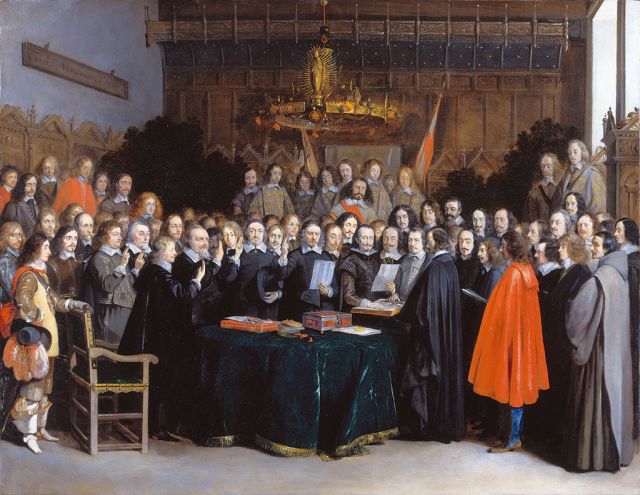
Westphalia is a region of Germany known for producing camper vans. It’s also known as the place where, in 1648, three treaties were signed in the cities of Münster and Osnabrück. At the time, Europe was in the midst of throwing, not one, but two wars (designated “the Thirty Years’ War” and “the Eighty Years’ War” by historians) which were ravaging the populace and destabilizing the whole region. These three treaties, collectively known as the “Peace of Westphalia,” ended both of them.

They also created the modern political world in which we live, move, and have our being.

In other words, it was created by these dapper gents. Ponder that for a moment. "The Ratification of the Treaty of Münster," 15 May 1648 (1648) by Gerard ter Borch. Public domain. Image via Wikimedia Commons.
In other words, it was created by these dapper gents. Ponder that for a moment.
“The Ratification of the Treaty of Münster,” 15 May 1648 (1648) by Gerard ter Borch. 
Public domain. Image via Wikimedia Commons.

To unpack that a bit: the Peace of Westphalia established the concept of “the state” as an independent entity with total and unquestioned control over its own internal affairs, free from any external influence. In the Westphalian system, each state is equal to all others, no matter how great or small, and no state is permitted to impose its will on another merely by dint of force. This concept, referred to as “sovereignty,” became a central component of international law in Europe and, later, throughout the world.

Sovereignty is a tricksy concept. It seems quite simple on its surface: “supreme power or authority,” as the Oxford Dictionary would have it. The nuances are where it becomes interesting, and harder to nail down. Following Westphalia, the term took on a particular set of connotations: independence, freedom from coercion, absolute control over one’s own actions and interests. Sovereignty is also applied to people at times, often people wearing funny hats: emperors, kings, bishops, and the like. The meaning is quite the same: a sovereign is someone over whom no one else has power, someone who has total and final control over their own actions and lives. When speaking of a head of state, or (as some Christians do) of a Supreme Being, it carries with it the implication of control over the lives of everyone under that individual’s power, as well.

It’s a compelling idea, as you’d expect from anything that’s been the core of modern geopolitics for going on 400 years. At its best, sovereignty supplies the logical foundations for self-determination and resistance, enabling a small nation to tell to a larger nation, “No, you may not invade us and take our goods, our land, or our lives, because we are us and they are ours.” At its worst, it tacitly supports the worst atrocities the state can bring to bear on its own people, as in the U.S. massacre and genocide of Native Americans, or the Nazi genocide of German Jews.

So, a bit of a mixed bag, as it were.

Autonomy is similarly tricksy and complex. The word, from the Greek αὐτο (auto, self) + νόμος (nomos, law), literally means “self-legislating,” as in “being a law unto oneself.” In ethics, it refers to the ability of an individual to make unhindered, un-coerced choices. Like sovereignty, though, it’s a bit more complicated than that. Deriving in great part from the work of Immanuel Kant, autonomy specifically refers to an individual’s ability to make moral choices: to choose to act in a manner consistent with an objective or outside moral standard, regardless of any desire to the contrary, precisely because that choice is consistent with the moral standard. To be autonomous, in other words, is to have moral agency, to be able to choose to do the right thing… even if you don’t necessarily want to.

In modern parlance, autonomy has taken on some of the characteristics of sovereignty, to the point that many people equate the two. For the purposes of this essay, however, I suggest that they are quite different things: related in their approach to questions of power, coercion, and self-determination, but ultimately referring to two different categories of entity: states (to include autocephalous entities such as churches) and individual people. Simply put, only states (and heads of states, who are effectively the State personified) have sovereignty. Likewise, only people can have autonomy.

“What’s the difference,” you may well ask, “and what the hell does any of this have to do with Faery?” Valid and valuable questions, both of them.

Sovereign Westphalian states exist in relationship to one another, but as separate entities without interconnectedness; in other words, they may have foreign policies and treaties with their allies, but their internal affairs and sovereign conduct are intrinsically isolated from the opinion and coercion of other states, even their allies. This is why, for instance, the United States can criticise other countries for their shabby treatment of children or the environment, but has yet to ratify the UN Convention on the Rights of the Child or the Kyoto Protocol, the tossers. They’re sovereign, which means they can do as they bloody well like within their own borders, even when doing so ultimately hurts everyone else.

Autonomy, by contrast, exists in the context of an interconnected moral universe. I can choose to act or to refrain from action, to speak or to remain silent, based on my estimation of the ethical weight of the choice, which necessarily incorporates the effect of my words or actions, or of my silence or inaction, on the world around me. Autonomy requires responsibility as an intrinsic component of moral agency. In other words, there is no autonomy without accountability. Thus, whatever autonomy means, one thing it cannot mean is “license,” defined as “I do whatever I want, whenever I want, without regard for the outcomes of my actions.”

cartman
NOT this. Pretty much the converse of this. Just… no.
Image from South Park.

South Park references aside, I hope the relation of all this philosophical blather to Faery is beginning to come clear.

What we’re talking about when we talk about “autonomy” is not merely Liberty, but the interrelation and interconnection of Liberty with all the other points of the Pearl Pentacle, and with Power, its own other name and its corresponding point in the Iron Pentacle. Liberty is an essential core principle of a truly Faery ethic… but no greater than any of the other points. It does not trump Knowledge and Wisdom, nor Love and Law, and without them it becomes nothing more than license, which is not a magical virtue, no matter what that one pseudo-Thelemite guy at the pub meet tried to tell you, all the while staring at your ass and offering to buy you drinks. In fact, even Aleister Crowley—that noted proponent of license, impropriety, and Doing What Thou Wilt—made it quite clear in his writings that there was a bloody great difference between “doing one’s True Will” and “doing whatever the hell you want.” Faery can, and should, have at least as solid a grasp on that distinction as Crowley did.

Blessedly, we do… and characteristically, perhaps even frustratingly, it doesn’t express well as a sound-bite.  If I have learnt anything at all about Faery (an open question, surely, but go with me on this), it’s that Faery is about relationships, about being in relationship: with Gods, with spirits, with our kinfolk, with our families and friends and neighbors, with the worlds around us and within us.

A central part of the work of being in relationship is being aware of how what I say and do affects those around me, and accepting responsibility for that: accountability, or as some would say, “owning it.” Sometimes, owning our words and actions means apologising and attempting to make amends. Other times, it means arguing, negotiating, or standing on our principles and refusing to budge, even in the fact of conflict with those we love. Sometimes, it’s mildly uncomfortable. Others, it’s excruciating, or joyful, or dull drudgery. In all cases, it’s about being authentically we you are, exercising moral agency, and accepting responsibility for what that means.

Accountability is the other half of autonomy, without which there can be no autonomy. Lacking accountability, the individual believes itself to be sovereign, as a state or a Supreme Being is sovereign, and inflates its own ego to the point of collapse (or prolapse, if you like). From there, everything else—magic, relationships, personality itself—follows suit. Accountability is what connects us to the world around us, what enables the very relationships that lie at the heart of Faery. To whom are we accountable? Why, to those with whom we’re in relationship: Gods, spirits, our kith and kin, the world in which we live and move and have our being. If we treat with them, we do so with the force of our very beings, and in so doing, we make ourselves accountable for what we do. This is why our oaths are sacred, why our words are imbued with power and meaning, why our actions cause change far beyond the range of our sight: because through them, we are accountable. If we are not accountable, we betray our words and actions, and the power leaks out of them as through a hole in our cup.

Or, you know, whatever vessel you put power in.
The Leaky Cauldron. Harry Potter film set at Warner Bros. Studios, Leavesden, UK. Image by Jack1956.

In the context of Faery, let’s look again at that statement from the beginning: “We recognize the value of individual autonomy, but we also recognize and honor the fact that our choices affect the choices of others.”

Viewed through the lens of autonomy and accountability, as defined above, this statement begins to unfold to us. After all, I cannot make a choice that changes the world without, y’know, changing the world. Of course, some choices are more impactful than others, and affect others’ choices to a greater degree.

Let’s say, for instance, that I decide to eat an orange. No one else may eat that orange, but that’s unlikely to cause much strife even in my home, where we lurve oranges. If there are no other oranges in the house, I can always pop out to market and pick some up. However, should I be amongst a group of friends when I decide to, say, spoil the new Star Wars film, my behaviour would get me tossed out on my ear, and rightly so. In both cases, I am accountable to those with whom I am in relationship, and to the fact that my choices affect theirs. If I eat the last orange, I merely need to pick up more oranges at market, but if I choose to spoil a movie (or book, or whatever) for someone, I’ve permanently ruined an experience for them, which is potentially an unforgivable offense. At the very least, it reveals me to be a churlish boor, and I’d have no leg to stand on if they chose not to invite me to future engagements… or to take a poke at me, for that matter.

So, then, how much more so with Faery? What if I wish to publicly reveal some shared material of the tradition considered by other initiates, folk I consider “kin,” to be oathbound? Or, if not oathbound, then “merely” sacred, to be held in confidence and secrecy? What if I should suggest to students, seekers, or other interested parties that my particular, idiosyncratic take on Faery is normative, and that Faery who practice in some other way are somehow beyond the pale? What if I decide to charge students money to be “initiated” into Faery, or to demand sexual favors from students, or to dox my fellow initiates, publishing their names and personal details for the world to see? When someone (or, more likely, several someones) comes to me with criticisms, grievances, even outright anger, how should I receive that?

Well, if we are in relationship to one another, as suggested by the term “kin,” then I am accountable to them. If it is my claim that we are part of the same tradition, I owe it to them—I am obliged—to hear their words, to consider their counsel openly and honestly, and to allow that counsel to inform the choices I make. If someone with whom I am in a relationship tells me that my choices are impeding or harming their own choices, I have a responsibility to take that seriously, to consider the possibility that I am behaving in an immoral and unethical fashion, and to modify my behaviour accordingly.

Why?

Because at the end of the day, as a wise woman once said to me, we are the choices we make and the stories we tell. The choices we make show us what kind of people we are; the stories we tell shape the choices we believe we have, and put those choices into some kind of context. If my story is that I’m wholly independent, beholden to no-one and nothing—save, perhaps, the Gods—then my choices I perceive will be limited in scope, and will tend to reinforce that worldview. If I see myself as sovereign, as hermetically isolated from other initiates, I am denying our kinship, spinning a story in which we have no relationship, and in which I’m therefore not accountable for how my choices affect theirs.

At the risk of belaboring an obvious point: that’s magic. It’s a spell… or, if you prefer, it’s a glamour, an illusion. It’s illusory, because sovereignty is a delusion. What we have, instead, is Liberty: power and agency. We have autonomy. We exist in a moral context, in relationships with others of our lineage and with the world around us. Our choices change the world, and affect the choices others can make, which makes us accountable.

At our initiation into Faery, we formally acknowledge and accept both our autonomy and our accountability, each as part and parcel of the other. However, being an initiate doesn’t grant autonomy; we have it merely by being human. As such, it shouldn’t require an oath to enforce accountability. All it should take is a basic level of consideration for others: Say “please” and “thank you.” Don’t steal somebody else’s things. Ask before you use them. Don’t spoil the movie. Share nicely, and without pouting. You know, the things we expect children to learn before they leave primary school.

After all, if we cannot be at least that accountable, if we cannot own our own words and actions, however do we expect to treat with spirits, Gods, or our own shadows?


Teaching a Witch (by Sara Amis)

[Slightly revised from these two posts on A Word to the Witch.]

There are quite a few articles out there about finding a good Pagan teacher, how to avoid bad ones, or how to know if you’re ready to teach or not.  Precious few are about teaching itself, or how to be a better teacher.

I am a professional educator, from a family full of educators on both sides.  Teaching is my day job.  As it happens, I have thoughts on the matter.

famtradteacher1

Knowledge is not enough

Every one of us during our educational career has encountered someone who may have been very smart, very knowledgeable, perhaps even a star in his or her field, but who absolutely stank as a teacher.  Possessing a body of knowledge or being good at a skill is necessary but not sufficient, because teaching is actually a separate skill with distinct requirements.  Fortunately, there is some overlap between the abilities needed to be a good priest/ess and those required to teach, such as perceptiveness about people and a certain flair for the theatric.

In related news, degrees and/or ordinations are also not enough; however, speaking for my own tradition (Faery), initiation is absolutely necessary.  You need the perspective of having walked the whole path up to that point in order to guide someone along it.  Some people feel that an advanced student teaching under the supervision of an initiate is fine, but in my experience students close to initiation (who are the only ones with enough knowledge and experience to teach) need to spend their time and energy managing their own progress.  Faery in particular is apt to go splodey on you at certain stages if you don’t keep your focus.  Your mileage with other traditions may vary, but one of the advantages of a lineaged tradition is that most of the time there are established guidelines for when you are considered ready to teach.  In my own line of Faery, we advise people not to teach until at least a year after initiation; it needs that much time to settle.

This is not about you

If you want recognition, to be seen as an authority, or some other form of egoboo, then you are not going to be as good a teacher as you might be.  Charisma does help and there are some egotists who are actually excellent teachers; but it is generally in spite of that, not because of it.  The reality is that teaching does give you a position of authority, which you can’t manage well either by pretending it doesn’t exist or by diverting it to some purpose other than the task at hand… which is ultimately to empower your student.  If that sounds tricky, well, that’s why I felt the need to write about it.

The point is not to create an intellectual or spiritual copy of yourself, but to develop the skills, knowledge, and mastery of the person in front of you.  To that end, start with what they already know or are interested in; Victor Anderson was reportedly good at this, with the result that he taught each person slightly differently but with a recognizable basic core.  Give them a manageable chunk, in which you offer both the big picture including connections to what they already know and a breakdown of the new information into component parts.  Step back and let them use or demonstrate the knowledge.  Step up again and offer feedback; but be sparing with both criticism and praise.  The reason is that both are information, and tossing someone information while they are learning a complex skill is akin to throwing them a plate while they are juggling.  One is plenty; four is too much.  I generally tell a student what I think their biggest obstacle or problem is, the most important thing they are doing right, and give one concrete suggestion, until the next round.  Lather, rinse, repeat.

Be very aware of your language.  Use words that emphasize the student’s competence, and avoid ones that undermine it.  This includes describing someone as a “newbie” or the like.  I know some organizations have formal designations such as “neophyte,” etc. but I assure you students are aware of where they sit in the hierarchy and don’t need their noses rubbed in it.  Even when a student needs to be gently reminded that they came to you for a reason, there are better and more subtle ways to do it.  Always be asking yourself, “what is the best way for this person to learn?”  The answer will vary, and you have to stay on your toes, even as you keep them on theirs.

At the very same time, you don’t owe anyone your time and energy and knowledge.  Being a martyr to someone else’s spiritual progress is all kinds of bad, and they are likely to resent you for it in the long run besides.

Don’t get bored

In graduate school I had a delightful professor and mentor who only ever gave me one piece of direct advice about teaching:  “Don’t let them bore you.”

There’s no excuse for being bored as a teacher under any circumstances if you ask me; teaching is fun.  But doubly so if you are teaching a religious tradition which ought to engage you on the deepest levels.  If you are bored, you yourself have stopped progressing.  If you are bored, you are energetically disengaged (bad enough in a classroom, practically malfeasance when teaching witchcraft).  If you are bored, you probably don’t actually like your student very much… so do both of you a favor and refer them to someone else.  Most of all, if  you are bored you will be boring.

Different models of teaching and their uses

Let me begin by reiterating that I teach for my day job. I have experienced the workshop/classroom model for teaching Pagan and witchcraft topics as both a teacher and a student. I received my Faery training under an apprenticeship type one-on-one model, and I have taught my own students in a combination of apprenticeship and coven teaching, depending on what was going on at the time.

The classroom or workshop model

Fundamentally, this means that you have a number of students and one or two teachers, and the relationship between teacher and student is limited in time and space.  That is, they interact mostly in the classroom setting, with a variable amount of individual consultation outside of it, and once the term of the class is ended there is no presumption of a relationship beyond that.

The classroom model is good for imparting mainly intellectual information, or specific skills that can be practiced within the constraints of the course. It is also an efficient way to maximize resources… either in terms of making sure more people get access to a particular teacher or (if the teacher is being paid) ensuring that the teacher gets a reasonable wage at an equally reasonable rate of tuition for the students.

The classroom structure inherently creates more of a hierarchy than the other types, relatively speaking. This in itself is neither good nor bad, but is a tendency to be aware of, especially if your stated values are otherwise. The frequent internal fights I witnessed in Reclaiming about who was or was not deemed a “teacher”… and who got paid… I believe are traceable in part to the structurally hierarchical tendencies of workshops and Witch Camp straining against the anti-hierarchical sensibility of the tradition as a whole.  A classroom model also creates emotional distance, which is useful to me as a college instructor, but as a means of teaching emotionally intense spiritual subjects, it may be counterproductive.

Apprenticeship

An apprentice is something like a student and something like an assistant; learning comes from both discussion and practice, often in partnership with the teacher, and it easily (almost inevitably) spills over into a personal friendship.  This approach is generally far less structured, which can be both an advantage and a disadvantage.  The down side is that sometimes major topics get skipped because they just didn’t happen to come up; the up side is that the practice is very much integrated into daily life and the student sees the teacher’s practice in action, not just in theory or by self-report.  This is the most supportive form of the teacher-student relationship, and that level of support is essential for some of the shamanic and ecstatic types of practice. It is also the most time-intensive, on both the student and teacher’s part.

Teaching in covens

In practice this is often a combination of the two, both structurally and in a kind of linear progression; that is, a coven may have “outer court” classes which are taught by coven members to a group, then as students advance they wind up working with a teacher one-on-one.  In a tradition like Faery where there is only one initiation and several initiates may be part of a coven, each initiate may have a student under his or her supervision for individual work combined with group ritual and other activities.  Ideally coven-teaching is the best of both worlds; in practice I could see the potential for screwed-up interpersonal dynamics finding a foothold or being exacerbated.  I will say that in my own personal experience that for any witchcraft beyond the most basic “this is how to cast a circle, here’s the Wheel of the Year, let’s talk about directions and elements” kind of information, the closer the teaching model is to apprenticeship, the more functional it tends to be.  There also needs to be a clear path forward for students, and a clear understanding of who is responsible for what.

Generally speaking, the more intellectual and dry the information you are conveying, and the less expectation you have of any relationship beyond the term of the course, the better a classroom or workshop model will suit.  The more intense and volatile the training, the more an apprenticeship or coven model is necessary; this is why the principles listed on the Faery Tradition website include “We recognize that Faery is highly transformative and extremely experiential, requiring closer attention and responsibility than workshops, seminars, or intensives provide.”

From both the teacher and student’s perspectives, knowing what your goals are (both short term and long term) is vital.  How much support and attention from the teacher do you need/are you able to give?  I have seen people struggling with the emotional fallout of practices learned via a book or a relatively inaccessible workshop teacher, sometimes to their detriment; in my own experience I have found that approach too ungrounded for anything energetically intense.  There are also potential pitfalls for the teacher: in an interview for the article “The Teacher Will Appear” by Christine Hoff Kramer and Sierra Black which appeared in Witches and Pagans #25, I made the observation that “in group situations people are much, much more likely to project their shadow stuff onto me than they are in situations where we have a more organic and personal relationship.” Obviously, I don’t think a classroom model is inherently bad; I teach in a classroom every week.  I have also given my share of Pagany workshops and talks.  I do think that for both teacher and student, understanding the limits and advantages of a given approach will help to avert difficulties and make sure the education you are seeking happens.

Conclusion

In academia where I spend most of my time, teaching is an entire skill and field of study (pedagogy) in and of itself.  I would like to see the awareness that how you teach can be as important as what you teach more widespread in Pagan circles.  As you contemplate your own teaching, consider that values, world-view, your relationship with your student, even theology can sometimes be more clearly conveyed by what you do rather than what you say.  To that end I try to be open, grounded, connected, and flexible as a teacher, emphasizing relationship and experience over declaration while being firm in my own knowledge and practice.  My own witchcraft and the results of it in my own life are the best teaching I can offer.

The Crafte and Feri (by Cornelia)

It is understandable, in this age of super information coming at us from all sides and media, that we have different kinds of information and lore from many various traditions and cultures mixed up together. This has resulted in many styles of modern Paganism.  Still, there is a certain bottom-line of cornerstones that connect all forms of Crafte.* Confusion about this occurs at times because people have either lost sight of what the cornerstones of the Crafte historically are, or because there has been a deliberate effort to destroy or twist these fundamentals into forms that serve no one.

Victor and Cora Anderson were called to the work of helping people through humanity’s entangled complexes and magical snares. Now more then ever, it becomes necessary to recall and reflect on these cornerstones of our Crafte and how they apply in any age.

I offer these to think upon for those who want to embark on the spiritual life of Feri/Faery Crafte:

  1. To respect and know nature in all its forms, for this is what we are all a part of.
  2. To strive to embrace life and humanity, and to value life’s lessons as well as its pleasures.
  3. To live with joy and wonder, understanding the wisdom that lies between dignity and ecstasy.
  4. To live honorably and in accordance with our oaths, so we have the strength of character, if need be, to shun that which has become broken or twisted in its nature or values.
  5. To defend the tradition with love and the courage of true warriorship.
  6. To know your life is of purpose, to be filled with education, creativity and spiritual truths.
  7. To strive for rightful pride and rightful humbleness, becoming your true self and reaching for your human refinement.
  8. To recognize, respect and celebrate one another’s gifts and talents.
  9. To honor and respect our elders’ experience.
  10. To offer help to those in need, especially our kin.
  11. To Honor the Gods and spirits of all nations and places.
  12. To live in balance in ourselves, our covens, and our communities in accordance with our oaths.
A witch holding a plant in one hand and a fan in the other. Woodcut, ca. 1700-1720. WellcomeImages.org. Licensed under Creative Commons 4.0.

The paradox that brings wisdom is knowing that, although the journey from birth to death is in essence one we make alone, the journey is not possible or complete without each other. Be it from our smallest cell, to the great forces all around us, it is all part of us. This is but one of life’s deep mysteries, what drives us to contemplation, meditation, prayer, science and all spiritual arts.

To walk the path of Crafte, it becomes our duty to endeavor to practice self-honesty and humility, as well proper pride before each other and the Gods. We must know when and how to be silent, for the greater good and for the inspiration and wisdom it brings. Our code of honor contains both kindness and discernment, joyfulness and dignity, that which seeks to explore and stretch boundaries yet not overstep common sense. Our code asks of us that we not conduct ourselves in such a way that brings confusion or mistrust to our kin or neighbors. We model Devotion not as enslavement, but as a unity of love and trust.

We are wise ones, artists and healers of various skills and talents. We should be trained well in these skills and have faith in ourselves as well as in our partnership with the divine. We should have clear understanding of our oaths and live to uphold them and our tradition. If one does not understand this, then one is not seeking the paths of the wise, but is at best having a well-meaning or innocent dalliance with the mysterious, or at worst becoming some kind of con artist of varying malevolence and criminality. There are many bitter pills in life, but none so choking as spiritual debasement; so remember you are living and walking a path, not just wearing its apparel.

When Initiation is fully realized, the doors of imagination open the mind to Wisdom and Science, the heart to Magic and Art, the spirit to Love and Reason. Realize that all the talent and genius of anyone without Love and Self-discipline comes to naught, for these provide the backbone and heart of true warriorship. The path of Feri Crafte offers skills of mind, body and spirit to strengthen and protect the seeker and Initiate. We learn to refine our nature as well as help uplift human kind. Only those who truly desire such goals and are ready to pursue them will see this Crafte for what it truly has to offer.

Know that any magic you make is real, because all of creation is an illusion that is very real. This is a paradoxical truth and one reason why genius and madness can walk hand in hand.

Realize that human evil is birthed from fear and greed, and these are the stepchildren of arrogance and ignorance.

Realize that all forms of slavery and violence are our enemy. Yet we will aid and defend, for such are our oaths.

We walk this path in partnership with the Divine as their children, and thus we have great possibility, and responsibility.


* Editor’s Note: The author has used the older spelling of “Crafte” here for historical reasons… and because it has not yet been the title of a major motion picture!

We do not charge for teaching the core of the Faery tradition (by Helix)

In the future, this blog will feature a series of essays from multiple authors, examining and expanding on the 2011 Faery statement of principles. Of these principles, “We do not charge for teaching the core of the Faery tradition” receives the most public attention, perhaps because among the principles, it is the most concrete and easy to grasp. In that way, I think this principle has overshadowed other parts of the statement that were intended to have equal or greater weight. In light of this attention, I chose to address the statement’s last principle first.

Although our opinions are diverse (with some having a more liberal and others a stricter view), many of those who embrace the statement of principles affirm that a witch can ethically charge and accept barter for a wide range of magical services. These may include, but are not necessarily limited to:

  • Divination
  • Spells
  • Herbal preparations
  • Magical tools
  • Spiritual direction or counseling sessions
  • Short-term in-person teaching of non-initiatory, skill-based Craft material
  • Writings and instructional videos of non-initiatory, skill-based Craft material
  • Long-term teaching of herbalism, personal development, occult philosophy and history, astrology, traditional medicine, bodywork, or other knowledge that may inform but is not formally part of an initiatory Craft tradition

As a group, our commitment to offering initiatory training without monetary obligation is rooted in our own experiences of economic instability and hardship and those of our loved ones. Unlike so many of the other occult innovators of the twentieth-century, Victor and Cora Anderson were not born into economic privilege. Their young adulthood was lived during the struggles of the Depression and World War II, and both experienced the death of close loved ones during childhood. As a young married couple, they experienced profound poverty and even, at times, hunger. Although the Andersons struggled financially throughout their lives, they taught their students free of charge. Especially during the Andersons’ later years, those who benefited from their work showed their gratitude in many ways, including gifts of food and money, visits, errands, and other support.

Some of those who embrace the 2011 Faery statement of principles are blessed to find themselves in comfortable economic circumstances now but have struggled in the past. Among us are those have experienced major illness, or supported families during the major illness of a spouse; who have struggled after a divorce or death, sometimes as single parents; who have lost jobs and unsuccessfully sought work for months on end while bills mounted; who have pursued advanced education and took on heavy debt, only to graduate in a contracted job market; and who have lived on a meager pension or disability payments. Some of us still struggle in those circumstances and are quietly helped by loved ones. We know that difficult times come to many individuals and families, especially in the political and economic climate we find ourselves in today, and we share a commitment to provide aid to each other and our communities during times of crisis.

Family Reading, by Carl Bengts. Public domain {{PD-US}}. Image via Wikimedia Commons.

Although some of us paid teachers for parts of our training, many of us were taught without financial obligation and fed in our teachers’ homes, even when our teachers themselves were struggling. Some of us were trained during financially difficult periods in our lives when we could not have afforded to pay for training. As teachers, we do not want the financial situations of either our students or ourselves to create barriers between us. With the generosity of the Andersons and our other teachers in mind, but knowing that our resources are finite, we have committed only to teach as many students as we can meaningfully welcome into our homes as family. This practice helps to create the permanent, stable, emotionally intimate relationships that are essential to our Craft.

We celebrate those among us who make a living teaching knowledge that, while not part of the Craft itself, informs our understanding of it: poetry, literature, religious studies, ethics, history, anthropology, psychology, biology, physics, and more. We do not, however, consider teaching to have a higher status than other kinds of work. Among us are health care providers, craftspeople, workers in the service industry, administrators, and many others—all of whom bring their insights as witches to relationships with co-workers, clients, and the public. We affirm that all these professions can be the right work of a witch, who creates a subtle but pervasive positive impact on hir community.

May we all be prosperous and surrounded by loving kin; may we all find our right work.


The Craft of the Wise (by Swansister)

I am a fourth-generation Appalachian Herbalist. Herbalism, hearth magic and ancestor worship make up a large part of my craft practice. I don’t separate my magical practices from my mundane life. My home is my temple and my apothecary. I find meaning, use and beauty in the things I have adorned and equipped my home with.

In my thirties, I took great joy in learning how to cook and bake in a wall-to-wall fireplace in a one-room cabin in the wilds of West Virginia with my ex-boyfriend. Two important times in my life I have gathered my water from a natural spring instead of from a city water source. In these instances, I gave thanksgiving to the water through seasonal rites of cleansing. I planted mint in my spring and called upon the Goddess to keep the water flowing and clean for consumption by chanting “Born of water, cleansing, powerful, healing, changing, I am.” (The chant is by Linda Lila from the CD Return of the Goddess, Sacred Chants for Women.) Water is very sacred to me and I find myself drawn to springs, creeks, rivers and waterfalls. The sound of water carries my mind away from mundane worries. Many times I have found a sense of peacefulness sitting beside the river on my favorite rock. This makes it easier for me to carry out my work and open to spirit and guidance.

Though I do work with the deities of the Feri Tradition, I don’t always need to participate in Deity worship to wield my craft. My work with the beings, plants and animals of nature can also be described as “shamanistic”. I gain understanding by listening to the spirits of nature and observing the plants and animals around me. I often see the image of a specific plant that a person needs for healing when I ask the plants for guidance. After being diagnosed with Celiac Disease, I began seeing the common mallow plant (Malva neglecta) everywhere and was relieved to discover this plant heals issues of the gut. The plant spirits had pointed me to an ally that would prove to be very helpful for my specific disease process. My Appalachian ancestors used the leaves and shoots as cooking greens and salad ingredients, while the seeds were used to accent dishes. The plant’s traditional medicinal uses included soothing skin rashes and easing coughs. Most importantly for me, it is also used to reduce inflammation in the respiratory and gastrointestinal systems.

Mallow Root Coffee 

  1. Use a digging tool to unearth a dozen or more common mallow taproots.
  2. Remove stems and leaves and wash and scrub roots with a vegetable brush.
  3. Chop the clean roots into 1/4 inch pieces and spread them out in a roasting pan.
  4. Roast in a 350 degree oven until dark brown, about 30-45 minutes.
  5. Grind and brew like coffee beans, combining with roasted chicory, dandelion, or coffee if desired.

I follow the rules of nature and consequence. My craft is not a religion; it is a daily practice of observation, prayer and listening. I work with items taken from or derived from nature such as bark, feathers, flowers, gemstones, herbs, rocks and soil. I gather my tools from my garden or woods and ethically wild harvest in the Appalachian forests surrounding my home. I prefer the company of nature and a few close friends. I feel most peaceful and powerful while working in nature.

I follow the rhythms of the moon and the seasons, and I plant during the appropriate time of the moon to bring about the desired outcome. I learned these techniques from my Great Grandmother, Grandmother and parents as a child watching them plant and harvest in our gardens. My father, grandmother and I often set out early in the morning with our backpacks loaded with trowels and lunch ready to hunt for treasures. I became acquainted with bloodroot (Sanguinara Canadensis), coltsfoot (Tussilago farfara), mullein (Verbascum thapsus) and other early spring herbs and flowers. I loved bringing our finds to Great Grandma Jack. She steeped the gathered mullein leaves for several minutes in boiling water and made a tea to drink as a cold remedy. A mullein root brew can also be administered to small children for the croup. However, she advised that it was best to gather the roots in the fall after the flowers had died away. Coltsfoot leaf, boiled in water and sweetened with honey, was also a well-tried remedy of hers for the common cold.

I make medicine as act of rebellion against Big Pharma, as part of my relationship with the plants and to honor the heritage of my Appalachian ancestors. I like knowing where my medicines come from. I enjoy having a relationship with and understanding the plants, watching them grow and respecting their wisdom as I harvest and celebrate the power of the plants I used to heal myself and others with. I believe it is vitally important for an herbalist to live with her plants. To know them and fully understand them, she must smell, see, hear, and live with them. This is part of the Craft of the Wise. I have been able to identify the plants of Appalachia since I was a child. It has only been in the last five years that I have come more fully into my understanding of the medicinal uses of the plants by completing basic and advanced herbal medicine programs. Every herb and root has a medicinal and magical property of some sort. Each shows its properties by its form, shape and spirit. This Doctrine of Signatures is a part of my craft of knowing and being aware.

The herbs I use in my Craft practice are not the same as used in other traditions. I use herbs and roots from plants that grow in Appalachia, whereas Traditions like Conjure may use plants that grow in other regions. It is important to note that many of the herbs and plants famous for their magical properties are highly toxic if ingested. It’s very important to never ingest plants unless you know exactly what they are and what effect they will have on the human body. Some herbs used in Traditional flying ointments are not safe for ingestion, such as henbane (Hyoscyamus niger) or Datura (Datura stramonium).

Flying Ointment

In general, most of the herbs in this recipe will cause your body temperature to drop and pulse rate to quicken. The “Witches Flying Ointment” produces psychedelic effects and was said to be used by Witches in the Middle Ages. It consisted mainly of parsley, hemlock, water of aconite, poplar leaves, soot, belladonna and henbane. The ointment was supposedly rubbed on various parts of a Witch’s body to enable her to “fly” off to the Sabbat. The ointment induced incredible hallucinations, psychic visions and astral projections.

  1. Melt four parts shortening, over low heat, to one part herb mixture.
  2. Heat on low for approximately 4 hours. Strain into a heat proof container, add 1/2 to one teaspoon tincture of benzoin as a preservative.
  3. Mix equal parts of: cinquefoil (Potentilla), hellebore (Helleborus niger) and henbane into an ointment.
  4. Spread a small amount ointment on arms and legs. Be careful not to ingest any ointment.

Common aromatic herbs like sage (Salvia officinalis) are not only good for culinary and medicinal use but also have surprising magical uses too. Sage is one of the best protection herbs there is. It can shield you from evil and harm, banishing negative influences and aiding in divination work.  Sage smudge bundles come to mind for me.

I honor the spirits of the land and my Appalachian and Native American ancestors in my practices. My family has lived in the same area of Appalachia for over 150 years. One afternoon, as my sister and I were playing in the creek behind my Grandmother’s house, a bee stung my sister. Grandma immediately sent me down the creek bank to search for the brilliantly orange and yellow colored jewelweed (Impatiens capensis). She knew jewelweed soothed many skin ailments, including bee stings and rashes caused by poison ivy. Later, as an adult, I learned our native orange and yellow jewelweed is part of the Impatiens family. The annual flower Impatiens we plant in our flower gardens each spring is related to the jewelweed native beauty. Grandma used to simmer a quart of jewelweed in a pot of boiling water for ten minutes. She would take the strained mixture and apply it to affected areas of the skin.

Jewelweed Decoction

  1. Gather a fistful of jewelweed plants by lightly grasping the stems and pulling upward to unearth the shallow roots.
  2. Shake the roots to dislodge soil and crumble the entire plant into large pot.
  3. Add fresh water to cover the crumbled plants and bring to a boil.
  4. Reduce heat, place a lid on the pot, and simmer for 10 minutes.
  5. Allow the orange decoction to cool to room temperature and pour through a strainer into jars or ice cube trays.
  6. Refrigerate jars or freeze trays and dispense as needed for stings, bites, or rashes.
"Jewel Weed Impatiens capensis Flower" (c) 2006 Derek Ramsey (Ram-Man) - Self-photographed. Licensed under CC BY-SA 2.5 via Wikimedia Commons.
“Jewel Weed Impatiens capensis Flower” (c) 2006 Derek Ramsey (Ram-Man) – Self-photographed. Licensed under CC BY-SA 2.5 via Wikimedia Commons.

I was born on Memorial Day and spent my birthdays at our family cemetery cleaning, tending, playing and adorning the graves with flowers and mementos. I remember having conversations and learning things from family members who had died years before I was born. My Grandma served favorites foods of our dead on these Memorial Day picnic dinners, like green bean sandwiches and wilted lettuce topped with bacon. These visits taught me respect for my ancestors. I am passing this on to my daughter whom I named after my favorite herb, and I hope she will become the fifth generation of my family to learn the Craft of the Wise. We are Appalachian Herbalists!

Witchcraft of an Old Way and a New (by Helix)

[I’ve updated the title on this essay because too many readers were missing the statements that “these are tools for thought” and “not definitive” and “not without overlap,” etc. I understand that not everyone finds contrasting pairs* helpful, and further that not everyone will recognize their communities in these Ways — in which case, don’t use the model; it’s not relevant! For those who DO recognize these as dominant narratives in their communities, and have experienced (as I have) the conflicts that arise from not acknowledging them or respecting the differing points of view, I hope this way of thinking helps you. It would have helped me tremendously ten years ago!

*See the post-postscript for why these two ways do not form a meaningful dichotomy.]

I came to the Craft primarily through the workshop model of learning and teaching. In this model, a teacher (sometimes from inside the local community, but often from outside of it) presents a day-long or weekend intensive on a particular area of Craft practice. A fee is charged, usually on par with what a small church charges for a spiritual retreat. The relationship between teacher and student is a professional one: time, skills, and information are exchanged for dollars. After the workshop is over, if the student is very lucky or lives in a tight community, s/he may be able to work with what s/he learned in the context of a group or coven. More likely, s/he is left to work with the material on her own—at least until s/he can attend the next workshop.

There are variations on this model that have advantages and disadvantages, of course: some communities emphasize peer teaching, and others provide linked series of workshops that a committed group experiences together. In general, however, the workshop model best supports people learning in groups but practicing on their own.

When I began to study Craft material derived from the teachings of Victor and Cora Anderson, I joined electronic mailing lists in order to learn more. The discussions I witnessed there perplexed me to no end. Some participants had dogged attachments to magical secrecy and in-person, unpaid, one-on-one teaching that struck me as superstitious, almost nonsensical. Their reasons, when explained, might as well have been in another language; their perceptions of the Craft and its meaning left me helplessly scratching my head. I wondered if some of them were just plain crazy.

Fast-forward some years. My workshop-based training sent me down a spiritual rabbit hole that I now recognize as a drawn-out initiatory crisis. I was largely without supervision, though I had a peer working group for support. I struggled, formed deeper relationships with the gods and spirits of my tradition, and leaned hard on my friends.

By that point, I was becoming disillusioned with the workshop model of teaching the Craft, at least for anything that was not strictly skill-based. I had been introduced to gods and spirits in these workshops and then left to negotiate my relationships with them on my own. The road was rough, and I felt abandoned, having no one who had walked the path before to advise me.

Happily, I reconnected with a friend in the tradition who was willing to teach me. We circled together, and as my training focused in toward initiation, something amazing happened: all the stuff those crazy witches on mailing lists had been saying suddenly began to make sense.

I realized that there is more than one kind of witchcraft, more than one way of being a witch—and I don’t mean “there are different traditions of witchcraft.” The differences I’m talking about cross traditions and often exist uncomfortably side by side in a single tradition. I had initially been trained in a late twentieth/early twenty-first ethos of the Craft (ethos is the characteristic spirit of a group or culture, especially as exemplified in its beliefs, practices, customs, and ethics). For the purposes of this essay, I’ll call this ethos the “New Way.”

When my eventual initiator and I began working together, though, my eyes were opened to the existence of the “Old Way”—a Craft ethos that is internally coherent and, importantly, not particularly compatible with the New. In the Old Way, I found what I had been so earnestly seeking. I was lovingly initiated, and the Old Way became my own.

I write this essay because, although there is nothing wrong with either of these ways of doing the Craft, many people seek to practice witchcraft without realizing that these differing ways exist. That lack of awareness leads at best to confusion among people who try to work together, and at worst, ethical violations and ongoing conflict.

My purpose here is to explain the Old Way and the New Way in broad and even deliberately oversimplified terms. These two ways have some basis in history—the New Way is rooted in the Human Potential movement of the 1960s and 1970s, while the Old Way harkens back to traditional societies of many kinds. However, I don’t see these as “pure paradigms” that witches should strive to emulate. The reality of life is that almost no one practices the Craft purely “the Old Way” or “the New Way” (my own practice, though tipped toward the Old, contains elements of both). However, in defining these two ways of doing the Craft for myself, I’ve been able to unpack my own confusion when I, as a witch trained in New Way workshops, first encountered Old Way witches. This model has also helped me understand the philosophical differences that underlie persistent conflicts in our traditions, as well as uncovering where ethical pitfalls lie when combining Old and New Ways.

I’ve tried to avoid politicized terms such as “New Age witchcraft” and “traditional Witchcraft,” as I find they cause readers to bring too many pre-existing assumptions to the discussion. I hope that readers will allow themselves to recognize similarities between the ways I define here and these other concepts without leaping to the conclusion that they are identical.

TL;DR: “The Old Way” and “The New Way” are categories that I have created to help readers think about differences in approaches to the Craft. They are not meant to be definitive or 100% historically-based, and it is normal for an individual witch to have elements of both.

A circle of witches dance around a central figure. Woodcut, ca. 1700-1720. Via Wikimedia Commons.


Time and Justice

The New Way: Time may be thought of as linear or cyclic, but in either case, it is ruled by a myth of progress (cyclical time might be modeled as a rising spiral, for instance). The New Way is often millennial or apocalyptic. The human species is thought to be approaching a cusp or already in the middle of a great change, the beginning of a New Age or New Aeon. Witches may see themselves as trying to influence humanity to make particular choices and alliances in order to avoid a species-wide extinction. The New Way’s sense of time is that it is short, and spiritual action in the direction of justice is urgent. Witches may see themselves as attempting to steer great natural forces with planet-wide survival as the stakes.

The Old Way: Time is cyclic, and claims that a New Aeon is at hand are seen without urgency. For a witch practicing the Old Way, every Aeon is a New Aeon and every time is one of great change. Although witches of the Old Way may care greatly about justice issues, they are skeptical of governments, ideologies, and organizations, seeing them as fundamentally ephemeral. For Old Way witches, social movements and ideologies—as well as disasters, famines, and wars—are like waves in the ocean: to attempt to alter their path only results in being swept up by them. Old Way witches are concerned with riding the waves, and helping those around them do so too; they are unlikely to claim the power to steer. Their justice work is most likely to focus on the land on which they live and on their families, friends, and neighbors: the sphere in which they have the most power.


Self, Community, and Training

The New Way: The development of the individual self is a primary goal for New Way witches. Embracing the feminist motto that “the personal is political,” the New Way witch sees hirself as the first thing s/he must transform in order to bring about harmony in the community and the world. Because the foundational work of witchcraft is individual, New Way witches don’t tend to see a cohesive group as essential to their Craft. Individual distance training as well as short-term trainings such as workshops and classes are considered effective methods of conveying the essence of the Craft. Each individual’s self is seen as unique, and training is often aimed at uncovering the authentic self. Much attention may be given to the question of identity and to building political or spiritual alliances with identity groups, from whom co-practitioners may be drawn. Authority and any credentials the witch claims are usually granted by teachers rather than by peers or students.

The Old Way: The Old Way witch is defined primarily by hir role in community, which grants hir whatever authority s/he holds. Maintaining community cohesion is an important goal, and it may be pursued even when doing so disadvantages the witch. Old Way witches make their living as others in their community do (for example, in rural communities, by farming or producing goods; in urban communities, by pursuing a profession), but they also take on tasks that discomfort or disturb others: treating the sick and the old; adjudicating disputes; preparing the dead for burial; looking into the future; casting or removing curses; advising the desperate. Perhaps because their loyalties are not solely to the human community, witches who serve in this way may find themselves set apart from others. Further, the nature of their work is marked by the particular community and land that they serve. Any training that they grant, therefore, is deeply personal, a product of their specific time and place. For them, there is no generic “Craft” that can be taught outside of that context. Individual self-development work, if pursued at all, is seen as secondary to forming relationships with land and neighbors of many kinds. If the witch has a coven, this small group of fellow outsiders may be treated as a sacred haven, the only place the witch feels fully seen.


Secrecy and Silence

The New Way: The New Way witch usually sees little to no useful role for secrecy and magical silence. Bigotry is believed to be based on ignorance, the antidote to which is knowledge. For the New Way witch, being open about witchcraft practices protects witches and helps to secure them their rights under the law. Secrecy is thought to have been useful only in the past, when mainstream culture was more overtly Christian and witches were in danger if they were exposed. Now that witches can safely be public in many parts of the Western world, it is the duty of all witches to band together to support any witches who are still being discriminated against. As for magical secrecy, it is generally irrelevant; the mysteries of witchcraft traditions have to be experienced and can’t be fully conveyed in a book or on a website, so there is no need to keep them secret. The keys to the mysteries can be hidden in plain sight, since only those who are ready for them will see them.

The Old Way: The Old Way witch sees women’s rights, gay rights, movement toward racial equality, and protection for non-dominant religions as extremely recent developments. Given the patterns of domination and violence that have marked the course of human history, these rights are viewed as potentially fleeting and not to be taken for granted. Secrecy and circumspection still provide protection for the witch, whose community may fear hir as much as value hir. Further, magical secrecy is part of what builds the container of intimacy that the witch may share with a few carefully chosen students or peers. This container deepens the intensity of shared magical work in much the same way as confidences between lovers deepen a sexual relationship. When peers are absent, secrecy may sometimes make a witch lonely. The Old Way witch, however, assumes that most people will not understand hir work, much of which others find uncomfortable or disturbing. S/he also must guard against those whose interest in the Craft is purely self-motivated, rather than in service of community. It is better to be lonely than to see sacred knowledge mocked or misused.


Money

The New Way: New Way witches are accustomed to living in a capitalist economy, where money is the default basis of exchange and education happens formally at schools or universities. For them, charging money for training in witchcraft helps to legitimize the Craft in the public eye and makes it more accessible to the modern world, which deeply needs its insights. Teachers who are paid for their work are thought to be able to focus more completely on their Craft and raise the quality of their material and their instruction, which creates better value for students. New Way witches may also sell spiritual counseling sessions, spellwork, witchcraft supplies, witchcraft instruction books and videos, and more, either in person or over the internet, and they may use modern marketing techniques to do so. For New Way witches, nothing is profane except that people make it so; money is simply a form of energy exchange and can be made sacred with fair trades and good intentions. These witches work to make such training widely available because they see themselves as serving a global community. Most believe that anyone can become a witch, and that most people should.

The Old Way: The Old Way witch often makes a living doing work that complements her witchcraft (for example, growing food or herbs, nursing, teaching, counseling, scholarship, arts or crafts, etc.), and s/he also may take money or barter for spells and remedies. Old Way witches, however, often dislike anything but the most perfunctory advertising of their witchcraft, as calling undue attention to oneself can be dangerous. Though they may write about the Craft, they are more likely to self-publish a plain-looking pamphlet than to offer up a colorful trade paperback from a major publisher. This is both to avoid attention from seekers who are not serious, and also because books are considered a poor substitute for person-to-person training. Old Way witches do not teach students for money, both because their Craft is so personal and because it is considered a calling, not a profession in the modern sense. Their teaching style is apprenticeship, in which the apprentice may be fostered in their house and takes on the status of a family member. A personal relationship is formed in which energy exchange is continuous: the student learns by assisting the witch in hir work. An Old Way witch wants to pass hir Craft only to a loved one, to a person who will care for the community they both serve after s/he is gone.


Purpose

The New Way: The purpose of witchcraft is to change the world and remake it in the image of justice.

The Old Way: Witchcraft has no externally motivated purpose. It is done for its own sake, because we are here and in relationship with all beings around us.


If you have read these comparisons thinking that the Old Way only makes sense in a pre-mass media, rural setting, while the New Way sounds specifically adapted to the urban twenty-first century—well, you have a point. It’s a struggle to practice witchcraft of the Old Way in a society dominated by the internet, where most people live in cities and have limited contact with the seasons and the land, and in which people routinely move across the country for education and jobs.

But here’s the thing—the Old Way and the New Way are not equivalent. They produce different kinds of witchcraft, and different kinds of magic workers.

If the New Way makes sense to you, go for it. It’s a coherent way of working magic. And similarly, if the Old Way feels right in your heart and in your gut, then please do join those of us trying to preserve its intimacy in these rapidly-changing times. The Old Way, we believe, is a way that made sense to witches three, five, ten, fifteen generations ago; it’s a way of working magic that draws on the things that stay the same even as times change.

What I earnestly ask you not to do is to hybridize these two ways without deep reflection. The truth is, the Old Way and the New Way are already all mixed up in modern witchcraft traditions, and the fact that they reflect two separate and largely incompatible ways of being has not been recognized. The results have often been destructive.

Take, for example, the practice of teaching oathbound witchcraft material for money. In the New Way as I described it, the belief is that the mysteries are in plain sight, available (for example) in nature, in the rich literature of the Western occult tradition, in mythology, in poetry, and in the world’s religions. In the New Way, payment is meant to reimburse a professional teacher for their time and skill. When you add the concept of “occult secrets” to paid training, the teaching model becomes incoherent. If the mysteries are all in plain sight, then to sell “occult secrets” is at best misleading and at worst, a scam.

Some New Way witches nevertheless believe that Old Way witches have secret knowledge that should be available to the public. Attempts to infiltrate Old Way groups to steal their oathbound lore and then sell it in the spiritual marketplace, however, are sleazy and exploitative. Further, these attempts reflect a fundamental misunderstanding of the nature of oathbound material under the Old Way. Old Way “secrets” are passed from mouth to ear because they are the product of intimacy between witches, their gods, and each other. They are context-dependent and deeply personal—the magical equivalent of pillow talk between lovers. To sell these “secrets” for money is much like selling a family’s heirloom love letters while claiming they will help the reader have better sex—an invasion of privacy that does not bring the world anything genuinely new, no matter what the marketing claims.

Witchcraft of the Old Way is often not served well by New Way approaches either. Because we are all living in the twenty-first century, and most of us are Americans and heir to the United States’ heritage of rabid individualism, it is the rare witch who understands what it means to be defined primarily by one’s community role. Most of us struggle to imagine how de-emphasizing the individual could be a good thing; we have probably noticed that without self-work, one tends to get mentally unbalanced, unstable witches who are little good to those around them.

In the past, perhaps, the fact that one could not choose one’s community and must cleave to it for survival molded witches differently. Today, in an era defined by individualism and mobility, some kind of explicit self-work seems necessary for magical workers. Our emphasis on unique individual identity, however, complicates “self” and “ego” work and has undermined our ability to maintain stable communities and small groups. The willingness to compromise and negotiate on matters large and small has waned as people’s perceived options for distance community have increased. Many self-identifying witches now practice without in-person teacher or peers, preferring to seek out others who share their niche interests on the internet. Because no local group fits the practitioner’s highly specific sense of identity, no local group can ever be “good enough”—and the witch’s opportunities to experience intimacy in practice are much reduced. The modern sense of disconnection, of true community always just beyond reach, plagues witches of all types, regardless of whether they find themselves attracted to the Old or the New Way; but is it particularly destructive for Old Way witches, whose practice requires local, embodied relationship.


To close, I will simply repeat that the “Old Way” and “New Way” as defined here are primarily meant as tools for thought. They are a product of my observations of modern witches and of my own evolution in understanding of the Craft, not the result of historical research. However, I think they help to untangle some common debates in witchcraft. Rather than seeing our debate opponents as necessarily wrong, we could instead see them as working within a different, internally coherent ethos of the Craft.

Additionally, I’d like to suggest that both Old Way and New Way witches would benefit if they respectfully declined to work together, at least closely in a coven or circle. While Old Way and New Way witches have the potential to be allies, in intimate working situations, their contrasting values set them up for bitter conflict. As in many areas of life, distance can be healthy.


POSTSCRIPT: I’m a little surprised to hear readers describing the Old Way as “apolitical” or “disengaged” or “not interested in social justice.” To quote from the above: “witches of the Old Way may care greatly about justice issues… Their justice work is most likely to focus on the land on which they live and on their families, friends, and neighbors: the sphere in which they have the most power.” Having a purely local focus for one’s service (and perhaps a pessimistic outlook on our effective reach as individuals) is not the same as having no interest in justice.

I see this as a misunderstanding among witches of different approaches: there seems to be a perception that if service work doesn’t have a national or global focus, or if it doesn’t use the language of activism, it’s not really justice work. My own justice work (primarily in advocacy for sexual minorities and around sexual ethics), has resembled more the New Way than the Old; but I would like to see people who do their service locally–perhaps without talking much about it or formally joining a justice-oriented organization–given more respect.

Additionally, I see some readers assuming that despite all the nice things I have to say about the New Way, I don’t really mean them; what I *really* think is that the Old Way is the One True Craft. Well, I don’t think that, plain and simple. I continue to have some New Way elements in my practice–for instance, I’ve taught witchcraft workshops for money before, and I might do it again if I felt that a professional, short-term teacher/student relationship was the appropriate one for the material. I also still greatly value my relationships with particular Reclaiming practitioners and communities (love you, TejasWeb!). I’m glad that witches are walking a New Way path, even if I’m not walking it myself anymore. The fact that I wouldn’t join a Reclaiming coven at this point in my life is not because I don’t think Reclaiming witches are awesome, but because the core of what we want from witchcraft is different; and if we tried to circle together we’d probably all get really frustrated!

Additionally, just to be clear, this essay has nothing at all to do with Pagan traditions that don’t consider themselves witchcraft, nor with the Pagan community as a whole. The intended audience here is one that doesn’t think of “witchcraft” as strictly Pagan, and definitely not as synonymous with contemporary Paganism.

Further, I am sure there are more ways of doing the Craft than just two! However, when I think about the witches I know who have broken each other’s hearts, who are still curled up around betrayals or perceived betrayals that happened years or decades ago, thinking about these two Ways (with their differing expectations and obligations) has often made the cause of the conflict clearer. Although often not fully articulated, one or both narratives have informed all of the Craft communities I have been part of (Faery/Feri, Reclaiming, BTW).

In any case… Please don’t make this essay be about how one group of people or another suck, because that is very much NOT what I think. This essay is about how some witches are really different from each other, and that is not because one set or another is wrong, wrong, wrong. In fact, THEY CAN BOTH BE RIGHT. If we can acknowledge our differences and respect them, I think the possibility of mostly-Old Way witches and mostly-New Way witches being able to be allies (at least in certain areas) would be much greater.

That’s not possible, though, so long as we cannot conceptualize each others’ positions in positive terms. The New Way and Old Way as I’ve described them here are both GOOD THINGS. That’s how I see them, anyway–though I am beginning to realize that some readers see some of their qualities as obvious flaws; so obvious, in fact, that surely NO ONE could EVER think they were virtues. And it’s right there that communication breaks down… To understand one another, we need to be able to imagine that some way of being that would be terrible and broken for us could be beautiful and healthy for someone else. (BDSM educators, I’m sure this point sounds familiar!)

So yeah. I know it’s all too easy to perceive someone else’s very different point of view as a moral failing, rather than as a product of benign human variation. I’ve done it; we all do it. But let’s try a different way today, okay?

Old Way with a sprinkle of New, carefully considered. New Way with a sprinkle of Old, deeply contemplated. A concept of BENIGN HUMAN VARIATION, plus the realization that just as not everyone is cut out to be married to each other, not every kind of witch is meant to circle or coven together.  Even in the wake of terrible witch wars and years-long conflicts… In appreciating difference, could there be a basis of friendship there, or at least civility? Perhaps the potential to work harmoniously on projects of mutual concern?

I hope so, very much.


POST-POSTSCRIPT: Initially when folks referred to these two ways as a dichotomy, I agreed, thinking, well, they have some oppositional qualities that are in tension, sure. But I’m rethinking that. Just because these ways have been perceived as a dichotomy in various Craft communities doesn’t mean that they are.

Thinking in dichotomies is always tempting because they are such useful teaching tools. Anyone who has ever taught a small child knows the usefulness of pairs like big/little, quiet/loud, and yummy/yucky. Most child development books teach parents to present no more than two options for any given choice, because small children are otherwise easily overwhelmed or confused by more. (Heck, my kid sometimes looks at me wide-eyed when there are two — he’d rather there be one which he can accept or refuse.) Even the education of older children and adults often begins with a simplified model of a topic so students can get some signposts in places before they learn more. If one is studying Buddhism, for example, the most common way to introduce the topic is to contrast Mahayana and Theravada Buddhism — not because these are the only forms, but because they are historically important and present helpful contrasts. Knowledge of these major branches of the tradition can provide context for studying others.

The truth is, all dichotomies are false.

Shall I repeat that?

All dichotomies are false.

The world is a complicated place. Any contrasting pair leaves out myriad other options. Nor does a contrasting pair necessarily describe extremes that define a middle ground. Some pairs helpfully define a spectrum; others are more like areas on a grid.

I’m not sure yet what I think the relationship of this particular Old Way and New Way are to each other. Some facets are in opposition, such as their attitudes toward secrecy and whether or not the teaching relationship should also be a love or family relationship. Some are more complementary, like their approaches to justice, with the New Way being more big-picture while the Old Way is very locally-oriented. With that latter pairing, though, I don’t see the two categories as exclusive. I imagine few New Way witches engage in justice work with no local component at all; and similarly, in this age of mass media, I doubt any Old Way witch does local justice work with no knowledge of national or global issues.

Further, although the New Way is well-adapted to our current historical moment (in fact, I would say it is a response to it!), the Old Way reads like an artifact, a portrait of a way that fits uncomfortably with the demands of modern life. I think in the 1970s and 1980s, many witches saw the evolving New Way as an heir to the Old. Today, this conception of the two makes less sense to me, as the differences in their purposes and effects seem increasingly stark. The fact that New and Old Way witches attempting to circle together consistently spend more time fighting among themselves than actually doing their work leads me to believe that the distance between the two is more than a simple generational gap.

To connect this P.P.S. back to the main essay, I am still convinced that although there are some areas in which practitioners of these two ways can borrow from each other, there remain many areas in which attempts to combine the two ways result either in ethical problems or in a loss of effectiveness. Witches who are attracted to the Old Way, I think, would benefit greatly in talking among themselves about how an intimate Old Way ethos can be best translated into a modern world dominated by communications technology.

Since I am no longer an active part of a witchcraft community practicing the New Way, I can’t speak to what witches practicing that way most need. What I do know from my time there is that some New Way witches are anxious that something essential to their Craft has been lost with the decline of the Old Way, which is what has driven the publication of so much formerly oathbound material. I don’t believe this is the case; I think for those who are called to it, the New Way really is complete unto itself.

Do the Old Way and the New need each other? I think they do not; just as in love relationships, to need someone often comes with the desire to control them. Instead, I continue to dream of a relationship based not on need, but on mutual respect and friendship.

[Thanks for Yvonne Aburrow for a thoughtful response to this article and to those who commented there.]


Witchcraft and the Monkeysphere (by Sara Amis)

[Republished from the original at A Word to the Witch.]

Diana the Huntress by Orazio Gentileschi (via Wikimedia Commons)

And thou shalt be the first of witches known;
And thou shalt be the first of all i’ the world;
And thou shalt teach the art of poisoning,
Of poisoning those who are great lords of all;
Yea, thou shalt make them die in their palaces;
And thou shalt bind the oppressor’s soul with power.

— from Aradia, or the Gospel of the Witches, by Charles G. Leland

Witches generally speaking work in small groups and have a certain anti-authoritarian, anarchistic bent. The latter is especially true of traditions like Faery which have no effective hierarchy beyond “initiate/non-initiate”* but it remains a trait of even (relatively) more hierarchical traditions. As people experiment with more “churchy” organizational structures, that tendency may wane; however I think that inevitably the “witchiness” of a given group will wane along with it.  In his post “When Wicca is Not Wicca” Jason Mankey says “Wicca works best in covens, and not groups of 200 people.” This is emphatically also true of other forms of religious witchcraft, possibly more so. But why? And what do hierarchy, authority, and group size actually have to do with one another?

Part of the answer I believe lies in the monkeysphere, also known as Dunbar’s number. This is an anthropological theory which states that there is a practical limit, determined by the size of the neocortex, to the number of others that a human being or other primate can perceive as distinct individuals; therefore, a limit to how many individuals with whom we can maintain stable social relationships. Groups above that number tend to either break apart or develop restrictive rules and norms in order to maintain stability, along with ever-more-authoritarian means of enforcing those rules. That number for human beings is somewhere between 150 and 250, depending on a number of factors including how much outside pressure there is to force cohesion and how much the members communicate and interact.

Wait a minute… I just said that witchcraft works better in small groups, much smaller than 150. Dunbar’s number is the upper limit of any kind of group cohesion, including the kind between neighbors and tradition members. It’s worth noting in this context that not long after the number of Feri initiates passed 250, the tradition split. The level of intimacy required between coven members in order to function as a coven… in order to do good magic… is far greater.  I would say, an order of magnitude greater. It just so happens that if you reduce Dunbar’s number by one order of magnitude, you get 15… which is darn close to the traditional number of 13 witches in a coven.

Well and good. This is a rationale for why witchcraft traditions are (dis)organized the way they are, and a counter to the arguments for bigger organizations and paid clergy (which by necessity go together). Note that I am not saying that Pagans can’t have large organizations or church-type structures, if they wish. What I am saying though is that it is a trade-off, and that if you choose a hierarchical group with by-laws and dues and so forth you are choosing not to have the kind of intimacy with one another that is an inherent feature of smaller groups. I am also saying that once you do that, it’s going to become less and less like witchcraft, and more and more like Baptists.

I don’t have one single thing against Baptists as such. But there is a reason why I am no longer one, and part of it is that my current religion feels more like home. I am respected and seen in some important ways that I did not experience in the religious tradition I was raised in, despite their genuine efforts to reach out to all members of the congregation as a matter of both theology and practice. I would like to suggest here that it’s possible that one of the most significant things which create the difference between a Pagan group and a Christian one is not actually theology but structure. That is because most people, unless they take it up as a hobby, are fairly fuzzy about theology, but everyone participates in the way their particular religious tradition is structured… by necessity.  Which in turn shapes both behavior and ideas.

The notion of the monkeysphere and its corollary with regard to coven size also points to some valuable insights about how witchcraft groups should work:  spending non-focused social time together as a group, one on one time with each other as individuals, talking out how the group as a whole feels about various issues.  Of course, all that requires time, and some months it’s all my coven can do to get  together for ritual, but on the other hand the majority of our “ritual” time is actually spent eating and talking…

That intimacy is important for its own sake, but it is not “just” social time. We humans are social creatures; it defines us. The relative lack of rules and enforcement in a small, intimate group, where boundaries of behavior are negotiated between individuals of equal standing, means that such a group has the potential for reaching an ideal balance between compassion and freedom possible nowhere else; the addition of religious ritual has the added bonus of fostering group cohesion without having to enforce additional constraints. And because we are not just talking about a quirk of religious witchcraft traditions but inherent qualities associated with being human, all of this also has implications for society as a whole.  “How can we best be human with one another?” is perhaps the most crucial question we can ask. How can we retain that humanity when, as we must, we are dealing with the larger world? I think ironically the answer lies in those small groups, where we can be seen most fully as ourselves, and learn to see others most fully as well.


*I know some people have attempted to assert or form a hierarchy with wand colors indicating rungs, however I am here to tell you that it never actually worked.

Witchcraft 101: So You Want to Be a Witch (by Traci)

[Slightly edited from the original published at Confessions of a Hedge Witch.]

Sometimes I imagine what I would say if one of my children explicitly asked me for training, or intentionally sought it for themselves. They were all exposed to the Craft, as well as general pagan perspectives (and I will continue using the general term ‘pagan’ because I feel it provides a touchstone we can come together on politically and academically). They also engage in witchy activities and hold very pagan beliefs, though they may be in various stages of consciousness on that front.

I think about the heartfelt advice given by one of my early initiators, Juniper. We shared a similar Christian upbringing, and we both had children. Through tears she bravely confessed that if she could go back, knowing what changes and pain lay ahead, she wasn’t sure she would choose this crooked path again. You see, once you put your foot to the path, there is no way but forward – whether to madness or transformation.

Most of my friends who are witches say they always knew they were. That there was never a moment of decision, only one of recognition. It may be that they were outsiders, or just felt themselves different, somehow. This is a critical point to ponder.

If you feel ostracized, if you feel outside the group: take notice whether these feelings make you uncomfortable. If there is a part of your mind seeking validation or the experience of fitting-in – you may want to reconsider this path. Certainly there will be a feeling of kinship, and a relief in having found your own kind, but consider: The Witch lives on the outside of society. Hir path is alone, through a forest darkly. There is no band of brothers who march off to fame and glory together, nor is there cultural acceptance or wide-spread recognition. There may be camaraderie, and you may finally understand your inherent difference, but think long and hard before committing yourself to further differentiation. To be Marked… is for life.

But, if one of my children did ask… even after I ignored them, or tried to put them off (you see, it is a dark path…and I can’t say I would wish it on anyone), the first task I would give them would be to GO OUTSIDE.

Not to glory in airy fairies, or rainbow ponies. I would require they spend a year learning the land: what her seasons are; what her geological history is; what other-than-human persons share the land with them; what the history of her communities are; what weather patterns are dominant; where is the sun in the sky on the longest day; what celestial observations when the season changes; what ARE those seasons there, on that land; what orientation is associated with significant phenomena, whether seasonal, atmospheric, or historical.

I would NOT ask them to leave their locale. This work does not require leaving the city and finding some idyllic country location. The Witch knows the environment he resides in, not one of hir imagining. The Great Powers are everywhere, and everywhere, are different. Know them.

At least I think these would be my first remarks…. if a child of mine saw this path in the forest and reached for the gate.

gate