A Witch Perceives First, then Believes (by Helix)

[Or: the personal is political, but the political is not necessarily meant to be personal]

Image by Gerd Altmann from Pixabay

In 1988, Mike Nichols wrote an essay on how the experiences of new Pagans in the 1970s and before differed from those in the 1980s and after (read it here: “Old Guard Paganism”). Some of his observations continue to ring true today; others are out of date now that the internet is the main way that new seekers come to Pagan traditions.

Nichols’ remarks about feminism, however, have continued to resonate with me. He writes that before the late 1970s, many Pagans became feminists as a result of their Pagan beliefs. In the late 1970s and thereafter, the causality of that relationship flipped: many feminists became Pagans because of their feminist beliefs. Nichols considers both approaches valid, emphasizing that these different generations of Pagans are indeed each others’ siblings (complete with sibling tensions and rivalries).

Nichols’ essay got me thinking about my own journey with feminism and Paganism, especially about how my attitude toward ideology in general changed as I became more committed to the Craft. So I will tell you this, and some of you will not like it any more than I would have when I was most committed to my feminist identity:

The Craft will always challenge your ideology, regardless of which one you hold. To perceive before believing, you must be able to lay ideology aside.

Before I go on, let’s make sure we’re on the same page. What do I mean by “ideology”?

An ideology is a system of ideas and ideals, especially relating to social policy and politics. Ideologies guide us in making big-picture decisions about ethics. They give us frameworks to look at how decisions play out socially, politically, economically, and otherwise. They contribute to a coherent worldview and help us determine what things mean and how to tell right from wrong. Examples of ideologies are feminism, neoconservatism, Marxism, and nationalism.

Religions can also be ideological, sometimes in an all-encompassing way. Evangelical Christianity, for example, offers an ideological worldview that can help the believer figure out how to do basically everything, from having sex to losing weight. All decisions, even the most minor, can be tested against core evangelical principles, which are discussed in community using specialized language (“Have you surrendered?” “How’s your walk with God?”).

Ideology is not something we can ever escape. Human culture is shot through with competing ideologies. Our thinking is informed by them, regardless of whether we “drink the Kool-Aid” and fully embrace one, or whether we attempt to remain skeptical of all.

The ideologies we grew up with can be especially hard to think critically about, as the attitudes we were exposed to in childhood form our perceptions of what is “normal.” Even if we reject the ideology with which we were raised, it can be easy to get stuck in a reactive mode where we criticize everything associated with our upbringing rather than evaluating it piece by piece.

All of this is to say, most of us are trained to believe first—to filter all new information and experiences through an ideological lens, either one we were raised with, or one we embraced as adults. Our ideologies tell us what our experiences mean and what to do about them. Only rarely are children raised to sit in a state of uncertainty with experiences and allow their meaning to unfold. Children look to adults for answers and, hoping to grant a sense of safety and stability, adults often give answers—and yet in that moment of dictating meanings, the opportunity to perceive first can be lost.

Needing a feminist religion was a large part of my original motivation in seeking out Paganism. I was struggling with being female, struggling with my gender identity, and groping for tools to explain myself to myself. Happily, I came to Paganism through a part of the women’s spirituality movement that was feminist but not gender-essentialist. The feminist Paganism I found showed me many, many different ways to inhabit a female body, and in that freedom I found healing.

For some years I was a committed feminist. Feminism opened my eyes to systemic inequalities that affect women in superficially egalitarian Western countries, as well as to the overt oppression that women and girls face internationally, oppression that white Christian nationalists now seek to return to the United States. Feminism became a lens through which I approached the world and evaluated political decisions, media, and my own life choices.

Even as I was embracing feminism, however, feminism was losing much of its ability to engage younger generations. When I taught my first college class in the early 2000s, none of the young women considered themselves feminists at all—as far as they were concerned, it was a movement that had accomplished its aims and was no longer needed. The feminism I embraced in the late 1990s had more complex ideas about gender and sexuality, race, and class than feminism had had in the 1970s and 1980s. At the same time, new queer, postcolonial, and neo-Marxist theories were popular in universities. I was thoroughly seduced by the sophistication of these theories, which feminism could not completely assimilate. For a time I became critical of feminism, particularly feminist philosophies that seemed to deny the full range of female sexuality or the fluidity of gender. My ideological loyalty shifted toward queer theory and stayed there for a time.

At length, I got out of grad school. I took jobs that involved working with people from a large variety of race, class, and educational backgrounds. I lived in predominantly Black neighborhoods. I had a child. And I studied the Craft, always practicing to see the world and the beings around me more clearly.

None of those university-based ideologies held up in the face of experience. In fact, some of them threatened to get in the way.

An example. One summer, a Black teenager was murdered on my block by two other teenagers. The neighborhood came together to mourn; my neighbors were his relatives, his friends. I went to the community vigil that the neighborhood held for the young man, and I walked there thinking about the injustices of systemic racism, the impact of poverty, the ongoing intergenerational trauma of broken families, the legacy of slavery and colonialism.

When I arrived, I listened to the local leaders of the Black community speak about the ongoing gun violence between young men in our city. They talked about the negative influence of rap music and of video games, and the need for Jesus. I saw a woman scoop up her four-year-old son and mutter, half to herself, half to him, “You’re never going to listen to that music.”

I held space for the community and for the young man. I walked home, and I kept my mouth shut. Nothing I had learned from theory helped me be an effective support for my neighbors. To the extent I was a positive influence at that vigil, what I was able to bring came from studying the Craft: being present, being open-hearted, suspending judgment, mourning with respect.

Feminism ultimately broke my heart. I withdrew from groups identifying as feminist when it seemed to me that the members spent most of their time criticizing each others’ beliefs and behavior, rather than building coalitions and pursuing actions to create a more just society for all people. After the success of the movement to legalize same-sex marriage in the US, I noticed the same concern with ideological purity (and resulting infighting) in the LGBTQ+ movement that I continue to serve. Too often I observe fellow activists—even friends—shouting at each other without listening in return, objectifying each other as straw men for the opposing viewpoint, to be torn down at any cost.

Without a robust sense of justice—an idea of a community in right relationship, one that benefits all—ideology is dangerous. It leads us to categorize each other with collections of identity labels, rather than being open to the inconsistent and multitudinous complexity that makes up every human being. It leads us to cast aside or embrace others’ opinions based on their apparent gender or sexuality or race or class, rather than waiting to fully perceive who they are.

What a disappointment it can be when a brilliant representative of one’s favorite ideology turns out to be driven by revenge! What a sweet surprise when the seemingly backward and old-fashioned neighbor is the one that rushes to others’ aid regardless of who they appear to be!

None of this is to say that my engaging with ideology was useless. I am far more sensitive to power dynamics, and far more aware of the privileges I enjoy, than I would have been without those theories. When I hold those ideologies loosely, informed by all of them but committed to none, they often guide me in making ethical decisions.

But—and here’s the most important part—all of them tried to tell me about how the world is, and from that analysis, how it should be. But the world is too complex for any ideology to encompass.

It is not easy to perceive first, then believe, as Victor Anderson often advised. I do not claim mastery of that skill, though I aspire to it. I do believe, however, that a certain skepticism is necessary in order to see others accurately. We cannot take for granted the things we are told are true—not by our families, not by our communities, not by our friends or our religions. We must wait, and test; we must listen and touch and see for ourselves.

I no longer call myself an –ist of any kind, although there are –isms that continue to inform my thinking and behavior. As I grow older, however, and especially as I raise a child, I desire ever more deeply to see what’s really there.

Without being able to see the child I have, I cannot parent him well; if I am driven too much by ideology, by a fixed idea of who my child is and should be, I will inevitably deny his authentic self and damage our relationship. It is ideology that leads conservative Christians to try to reprogram their queer and trans children; it is ideology that causes parents to dress their children exclusively in pink or blue and provide them with “gender-appropriate” toys. If I had taken away my son’s beloved trucks and given him only dolls, would that not also have been ideology? Shouldn’t my parenting be guided by my insight into my child’s needs, talents, and joys, rather than by expectations set either by mainstream culture or by the queer subculture I joined as an adult?

I have the same goal when it comes to my Craft: to see what’s really there. For me, true seeing is the foundation of relationship, the foundation of intimacy. True seeing is at the heart of my work as a witch.

The Conduct of a Feri Witch (by Willow Moon, with Helix, Shea, and Peaseblossom)

Introduction: View Teachings as the Basis of Conduct

Conduct, or the way one comports oneself, is critical to building community. One’s conduct will either build bridges or burn them. Our conduct is as inescapable as our shadow, and it flows from our worldview.

As Helix wrote in “Feri and View Teachings,” worldview orients practitioners of religious or spiritual paths in their lives. It describes what right relationship with natural and divine forces looks like by giving us examples. Worldview, in other words, is a kind of belief, a belief that is based on anatomy and physiology. Each animal has their own particular sense organs that determine what is possible to perceive. However, it is our habits both physiological and psychological that determine what we actually perceive. We can alter our view of the world by changing what we pay attention to, thus developing new neuropathways that change our experience. In biology, this is called neuroplasticity. What we believe in drives what we pay attention to; thus, belief is the foundation of our worldview. 

Our worldview shapes what is possible for us and determines how we will act. For instance, if we view ourselves as independent individuals in a competitive, hostile world, it could make sense to harm others to better one’s own lot. If we instead see ourselves as cells in an integrated living body that is the earth, we are more likely to behave cooperatively.

Feri is an extremely diverse tradition, and our rituals, our gods, and even our initiations vary from line to line. Yet our story of creation—which is the basis of our worldview—is one of the core things that unites us. Although each telling of the story is different and emphasizes different elements while omitting others, we all still recognize and treasure the origin myth of the Star Goddess (one version of which is quoted here). Helix explains:

The creation myth conveys much about the qualities of Feri. Ours is an embodied, fundamentally relational tradition that affirms the erotic nature of being in all things, especially the interdependent ecosystem of which humans are a part. The life force that we move in our practices arises from love and desire between Self and Other, who are part of each other, reflections of a divine and holy birth. We know that the universe began in lovemaking, not by word or commandment. We honor these ways of being not just in our overtly spiritual practices, but in every breath and moment of our lives. To practice Feri is to seek the constant awareness of God Hirself’s unfolding in us.

We are a relational tradition in that we relate to our world with pride and care. We recognize that we live in an interdependent ecosystem from which we are never separated for a moment, even after death. We can fantasize about the past and future, but we can never leave the present moment. Since the present is inescapable, we must live in and relate to it, including the environment of which we are a part. 

When we retell our creation myth, we remind ourselves of how it feels to embody our tradition. It gives us an anchor point that keeps us from losing ourselves in philosophical speculation that leads away from the deeper experience of Mystery. When we teach students, our worldview also acts as a signpost along the path. It keeps us pointed in the direction we want to go and helps us recognize our destination. That recognition can be felt in our bodies as a current of life force. Body sense connects us to the present and to the presence of the Feri current. The flow of the current doesn’t stop where our bodies end, but rushes ever onward into the future. 

The Feri current is a mighty river of life itself. Tumbling and surging with desire, we learn to subtly seduce the raging raw power of sex that flows through the land. Unapologetically and with delight, we skillfully steer the course of our own boat through the rapids and eddies of life. 

Recognizing this inherent blissful life force, we don’t need to coerce spirits to cooperate with us, and we instead engage them with a lover’s tenderness. The universe is that which desires, and like responds to like. Do we not feel deep in our bones that the greatest gift we can give to the gods is to honor ourselves and each other? Not only in the lofty space of spirit, but in everyday life as well. 

Ritual is the pillow talk of the witch with the world. The rites of witchcraft are our way of talking to nature, the divine, and each other. The world’s response is found in subtle signs and omens: a look, an offhand comment, a suddenly rising wind, the moon revealed from behind a cloud, or any of a range of natural human or other-than-human expressions. When we understand the part we play in the dance of life, we are able to talk with our world as an expression of our spirituality.

Our spiritual practice is embodied because our world is itself spiritual. Our breath synchronizes naturally with the rhythm of our hearts and the beating pulse of the earth. Resting in being, there is no greater seduction, and no greater honor.

Photo by Zongnan Bao on Unsplash

Conduct: The Self and the Other

How does the worldview described in our creation myth lead us to interact with others?

1. Mutual, Consensual Relationships

In our creation myth, the Star Goddess, complete within Hirself, looks into the curved black mirror of space. This alone tells us that the universe is a reflection of Godhirself. At the very core of our being is Godhirself; what we experience is our own reflection. Considering this makes sense of the phrase, “Do unto others as you would have done to you.” Mutuality is the basis for all authentic interactions. If you want respect, give respect. 

By hir own light, Godhirself sees hir reflection and falls in love, desiring Hirself. This part of our creation story shows us that love of the other flows from the feeling of love within. It also calls us to honor desire as the driving force of creation, without which we would not be. Love and the desire to unite with love is holy. Sex is holy just by itself. 

Of course, sex must be completely consensual, or it not an expression of love, but of power. Victor Anderson saw sexual predation as the worst sort of violation against humanity and condemned it vigorously. He insisted those who sexually prey on others for whatever reason or in whatever way are anathema to the Goddess of all creation. They must be held accountable regardless of their status in the community. When consensual, however, sex is to be celebrated as a divine act. That includes sex in all its forms. Thus Feri witchcraft celebrates all diverse gender expressions and sexualities. 

2. Hospitality

The way we treat others is encapsulated in our hospitality, or lack thereof. How we welcome people into our home or community reflects how we welcome people into our coven or indeed, into our hearts. Do you want your guests to have everything they need to be comfortable? Do you want everyone to be respected and listened to? Being conscious about welcoming guests and seeing to their needs helps to create warmth and respect among all people in the home, whether they are newcomers or old friends. Hospitality also plays a part in public places, whether physical or electronic. We can choose to be hospitable by co-operating with others as siblings of the Star Goddess, or we can have a hostile attitude by viewing our interactions as competitive.

Hospitality is not a difficult practice. Simply ask yourself how you would like to be treated as a guest, and be curious about your guests to learn how their needs may differ from yours. The opportunity to welcome a guest well is an opportunity to honor Godhirself in all hir mystery, as it honors yourself.

3. Responsible Power Dynamics in Teaching

As an initiate of several witchcraft traditions, I have led training covens for decades in traditions that are based on a degree system of initiation. I was fortunate to have been trained by a dedicated and professional teacher in these systems, and I have experienced harmonious coven dynamics in the various covens I have led.

However, I have also witnessed damage done to covens and coven members from authoritarian behavior within these hierarchical systems. Although authoritarianism is not necessarily inherent in hierarchy, I have seen how easily it can arise as an expression of fear. Fear and its subsequent desire to control another often drives the complexes of superiority/inferiority which can interfere with healthy relationships.

In hierarchical coven structures, the teacher rules the circle, but the teacher must always understand the value of their students: not for their skills, but for who they are. If the teacher doesn’t recognize the inherent value of the student from the beginning of training, then the teacher will never fully accept their equal status later. 

The Feri creation myth informs the responsibility Feri teachers have toward their students. As children of the Star Goddess, we are all equal and deserve equal respect, although we may not have equal levels of skill or knowledge. As teachers, if we want to produce the best sorcerers, then we have to support our students in developing their maximum ability. One cannot fully develop one’s capabilities from a sense of being “lesser than.” 

If the student’s value is diminished by the teacher, then the teacher is restricting them by encouraging a lack of self-esteem. The student can maximize their potential only if they can feel their worth and that they are capable of meeting their goals. The teacher’s confidence in the student is infectious. It is part of a teacher’s job to encourage their students by helping them change their thoughts of “I can’t” into “I can.”

Thus the dilemma of training someone with lesser skill to become one of greater skill than yourself! If one starts the training emphasizing the lesser ability of the student, then one needs to ask, at what point does the student become a master? Is that at initiation? After a certain number of years or amount of skill and wisdom developed? What is the test and what are the necessary skills?

The benchmarks to assess this must be based in reality and appropriate to each student. They need to be definitive and expressed openly so that there are clear goals and boundaries. Otherwise, there is the danger of the student never gaining the status of an equal in the mind of their teacher. However, if the teacher simply focuses on teaching to the best of their abilities instead of being overly concerned with the status of the student, then the learning process develops naturally to nurture the student.

We are fortunate in Feri witchcraft not to have a degree system of initiation with its potentially incumbent hierarchy. Theoretically, this means that helping a student to develop their sense of empowerment should be less encumbered. A good teacher will rejoice when their student exceeds them. For is that not why we teach—so our traditions will thrive and flourish?

4. Ethical Community Relationships

Occasionally, a situation develops where a student who is studying with a teacher of the Craft expresses interest in studying with another teacher. If we respect all seekers and students, as well as our fellow initiates, as children of the Star Goddess, it follows to handle all involved with tact, courtesy, and care.

Firstly, before taking on a student, it’s helpful to protect yourself by doing some research. As a prospective teacher, it’s a good idea to talk with others who know the potential student. If they were previously studying with another teacher, it can be useful to talk with that teacher to learn about possible pitfalls the student may be prone to. 

If the student is still studying with a teacher, it’s especially important to get feedback from their teacher, not only to avoid possible conflicts of interest, but to show respect for the teacher themselves. Perhaps there is a good reason why the student wants to change teachers, or perhaps not. In either case, talking with their current or previous teacher can help to avoid problems with their training. 

It may be that asking questions reveals that the teacher was exploiting or abusing the student, either sexually, financially, or for labor. Teaching someone is a lot of work, which can lead teachers to feel that they must be due some compensation. However, Victor and Cora Anderson never required any form of payment, labor, or other compensation for their teaching. They are the source of every Feri lineage, and I follow and recommend their example in this matter.

For me, the best “payment” a teacher can receive is for the student to practice well and then to ensure that the teachings are properly passed on. This is the only energy exchange that is necessary for a healthy teacher/student relationship. In my opinion, the continuation of the tradition is why teachers teach: because we recognize that it is valuable for our traditions to continue, and we wish to pass on the benefit that we were freely given.

Abuse or exploitation of students is never okay. If I became aware of such a situation, I might not be able to change the behavior of the teacher, but I would consider helping the student to circumvent that behavior. 

5. Equality Among Initiates

My initiator Niklas Gandr often said: “All are equal within the Feri circle of initiates because all points of the circle are equidistant from the center.” This means to me that no Feri initiate has authority over another. One’s teacher or oath mother may feel protective and wish to guide the new initiate, but that has to be done while recognizing the initiate as an equal. After initiation, it is not appropriate for a teacher or oath mother to try to restrict the behavior of their initiates or exert authority over them. Every initiate is autonomous and free, bound to other initiates only by love.

As members of a diverse tradition, different teachers and Feri lines train students differently. Accordingly, we often have different understandings of what lore is held secret based on the ways we were trained. This can cause friction when initiates gather together with students to discuss our tradition.

When in a forum where a teacher expresses a desire not to share certain lore with students, I respect their wishes. What is the harm of deferring to that other teacher so that one doesn’t interfere with their students’ training? There seems to be only benefit from showing respect to them and to their teaching process, even if it is different from one’s own methods. Showing respect makes it more likely that one will be treated with respect in return.

We all know what respect does and doesn’t feel like. It is obvious when an initiate treats others as reflections of Godhirself, and it is also obvious when they treat others as a mere means to benefit themselves. Healthy relationships between initiates are based not on power or control, but on co-operation and respect for self-determination.

6. Respectful Treatment of Creative Works

Feri initiates and their students have responsibilities to other initiates surrounding their original contributions to the tradition, such as ritual, poetry, and liturgy. If our rituals are the pillow talk of the witch with the gods, our poetry and liturgy are our love letters. If the appropriate boundaries around a piece of liturgy are unclear, then if possible, ask the creator or their close Craft kin what they would want. After asking for advice, then respect their wishes – or else, why bother to ask?

In the past, original liturgy and other materials that my late husband Niklas Gandr gave another initiate in confidence were published without his permission under that person’s name. We were deeply hurt by this person’s choice to steal our creative work and others’ in this way. Additionally, because of this violation of trust, traditional training materials that we believe require person-to-person context and guidance have now entered the public domain, where they may be easily misunderstood, exploited, or used unethically. 

Ethical behavior toward others simply requires treating other initiates as you would want to be treated. Would you like it if material you created were published and copyrighted by someone else who makes money from your work? How would you feel if a prayer that was special to you was taken out of context, commercialized, or used against its intended purpose? Respectful treatment of ritual, poetry, and liturgy helps to maintain the integrity of our tradition, as well as to preserve harmonious relationships between initiates.

7. Integrity in Diversity

Different rivers take different courses. Each river traverses different terrain and has its own beauty; each is fed by many tributaries, and each creates their own rich mud. Yet a river with many sources and traversing many environments is still called by one name. So it is with the many lines within a tradition of witchcraft. 

The various branches of the traditions of witchcraft are like a tree rooted deep in the earth. Like a thicket of hazel trunks arising from a single root of wisdom, traditions of witchcraft arise and branch abundantly. All are equal in value and splendor, in that they all can entice and seduce the divine through ritual. 

It can be difficult to determine what is and isn’t specifically Feri as opposed to simply witchcraft or esotericism. However, our tradition does have a distinct flavor. It is different from other witchcraft or magical traditions in certain ways, particularly in its co-operative approach to spirits and magic. Although we are incredibly diverse, kin can be sensed. Some initiates say that Feri initiates have a certain glint in the eyes or scent about them that is recognizable. 

As a bardic tradition, creativity is encouraged in Feri, but there is a recognizable cultural milieu which is passed in training. This milieu, which we express as the Iron and Pearl Pentacles, is based in a self-empowerment that recognizes the value of others. As teachers we each must decide for ourselves whether or not certain creative output should be recognized as Feri. My test is simple: Does it resonate with my Feri worldview? Does it teach the skills necessary to practice Feri witchcraft? If it was adapted from another tradition, was that tradition learned in an authentic and appropriate way? We return to our creation myth as our anchor point in order to maintain the integrity of our tradition while also celebrating its many expressions. In the same way, the multitudinous variety found in nature and in human culture remains connected to its source and is thus integrated within Godhirself.

The Ethics of Interconnection

This article is written in the hopes of encouraging discussions. We don’t need to tell each other what to believe or do, but discussion helps us come to a greater understanding of our role in making our world a better place. Although Feri is amoral, our ethics are based on our creation mythos of a mirror-gazing Star Goddess. These ethics are not a set of rigid moral rules, but instead are principles of conduct. We recognize as sorcerers that our actions have effects. If we want a certain effect, we must pay attention to our actions to discover for ourselves their real consequences. Otherwise, we stumble through life blind.

As part of a tradition that emphasizes the importance of embodiment, we draw some of our understanding of ourselves from the life sciences. Biologically speaking, we are holobionts: in other words, we have evolved as discrete biological entities composed of many different organisms, each with their own consciousness. Within, on and around our bodies live communities of many diverse organisms that help make our bodies functional. Forests with matrices of mycelium and oceans teeming with life are holobionts, as are human societies and earth Hirself. Our inherent interconnectedness within a complex web of life is the reason why we feel enjoyment in harmonious natural settings and in harmonious interactions with other humans and non-humans. That interdependence is the basis of our biology and a source of basic satisfaction and strength, particularly in times of difficulty.

When we acknowledge our interdependence, forming communities of initiates and students can be of great benefit to us all. Talking with community members can help us develop appropriate boundaries, deepen one-on-one relationships, and learn more about our customs. A community can be relied upon in times of need, which helps us survive individually and as a tradition. Additionally, supportive bonds between Feri witches help us to be of service to our friends, family, and larger communities. We are interconnected, and we cannot survive isolated or cut off from the world of people, politics, and societies.

If a view of Feri based in our creation myth and in interdependence naturally leads to appropriate conduct, then conduct is the glue that holds communities of Feri witches together. Having codes of conduct that are based on core beliefs can strengthen Feri communities, but only if transgressions carry consequences. We obviously cannot police such codes with force or law. However, in addition to encouraging appropriate behaviors through training and community norms, ancient methods of discouraging harmful behaviors such as shunning can be applied. These tools are not used lightly; careful discernment is necessary for how we hold each other accountable.

Conclusion: Kinship Among Initiates

Though our creation myth continues to connect Feri witches in spirit and guides our conduct and ideals, our tradition has grown rapidly and our practices have become ever more diverse. There are now many lines and communities of Feri witches that have little to no direct communication with each other. As a result, our assumptions about what it means to be an initiate among initiates have diverged.

We have found that when relationships deepen between initiates of different lineages, it can be helpful to craft rituals that align our expectations. We suggest to our estranged or distant siblings that affirmations articulating the joys and responsibilities of kinship are one tool that may help us better recognize the mystery of each other. With statements of trust, gifts of love, and acts of service, we stitch the fabric of our tradition back together where it has become frayed.

May we work to reweave bonds of kinship when we are called to do so, not out of some misguided optimism, but in recognition of the values that Victor and Cora taught us and the love of God Hirself—and so strengthen our bonds as bearers of the beloved Mystery that we hold in common.

Articles by Willow Moon and Niklas Gander

Editor’s Note: I am pleased to say that Willow Moon has granted us permission to share articles written by himself and his late husband Niklas Gander (also known as Tom Johnson) in the early 2000s. Willow and Niklas have been important mentors to me and many others in our beloved Feri tradition. Their generosity in sharing their knowledge, wisdom, and experience has touched many of us over the years, both those who have been their students and those who have corresponded with them from a distance. Their thoughtful contributions to the Witch Eye zine and to online discussion lists helped make them two of our most respected elders. We are deeply grateful that Willow Moon has continued to share his work here on the Anderson-Faery.org blog.

Niklas was a scholar of the Swedish grimoire tradition and an initiate of multiple lineages of witchcraft. He crossed over in 2014 and was beautifully memorialized in The Wild Hunt. Niklas is very much missed, and we are blessed to honor him as one of our ancestors in the Craft.

“Concentration: Gateway to the Celestial Arts” by Willow Moon

“Mountain and Lake: Primal Polarities” by Willow Moon

“The Names of Our Tradition” by Tom Johnson

“Feri and Wicca: So What’s the Difference?” by Tom Johnson

“Glimpses of the Swedish Cunning Tradition” by Niklas Gander

“The Lead Pentacle of Night Hares” by Willow Moon

“Buddhism and Feri” by Willow Moon

“Musing on the Dark Time” by Niklas Gander

“Quickening Heart” (poetry) by Willow Moon

“Feri and Chaos Magic: A Marriage of Methods” by Tom Johnson

“Fith-Fath or Shapeshifting” by Niklas Gander

“Christian Agendas: A Study in Social Control” by Willow Moon

“By Which Eye?” by Willow Moon

“The Divine Twins: A Mystery of the Feri Faith” by Niklas Gander

“The Athame, or Knife with the Black Handle” by Tom Johnson

“The Art of Divination” by Willow Moon

“Scourging in Witchcraft” by Niklas Gander

“Spirits Abound!” by Willow Moon

“Is Feri an Eclectic System or a Tradition?” by Willow Moon

Photo by Emily Underworld on Unsplash

How Many Feri Witches Does It Take to Screw In a Light Bulb? (by Peaseblossom)

How many Feri witches does it take to screw in a light bulb?

Only one, so long as you yearn for the feeling of the curve of your own bulb, radiant in your own darkness–just as She did as She first turned on the Light.

How many Feri witches does it take to screw in a light bulb?

An infinite number, for all life in all the worlds screws in Her womb, Her radiantly dark/light bulb.

How many Feri witches does it take to screw in a light bulb?

There is no simple answer, as there is significant dispute among the various lines of the tradition about the exact number required. The discussions about this issue are often heated and even acrimonious. However, all agree that the current is dangerous, and that in changing light bulbs, one will become either dead, mad, or an electrician.

Happy New Year!

Feri Division (by Eldri Littlewolf)

Editor’s note: It is an honor to share the wisdom of one of the Andersons’ earliest initiates with a wider audience. This reflection was originally published in early 2011—over ten years ago now—regarding the conflict of values that resulted in the writing of our principles. Since then Eldri’s essay has been my favorite explanation of why esoteric traditions must split from time to time, as part of a natural process of growth and change. In editing, I have preserved Eldri’s style of capitalization and punctuation (reminiscent of another poet, Emily Dickinson), as part of her distinctive voice.

No doubt in the future, there will be other splits, other divisions among those of the Andersons’ lineage. I pray that the witches of that time will realize that such separations can be necessary for the health of the whole and need not be acrimonious.


Long ago, all dogs were wolves. Now there are Many kinds of dogs—each with a thing they (to human eyes) Do well. The others are not ‘Wrong’, just not that breed…
English Springers, American Springers—Now judged to ‘Different Standards’, still springers. Still dogs.

Apples: some sweet, some tart, some store well-, some with *Pink Flowers!*-
all apples. No one would take them for plums.

Feri; some public, some private—*Still Feri*, just not the *Same kind* of Feri.
Different needs, from deep in our souls—All still changing, and growing, all Her children.

…We are still working out our ‘standards’ here.
To Stop kinstrife, this Had to happen—It Did Happen, years ago. (That part is done.)
Nobody is ‘better’, ‘more Feri’ or ‘less Feri’—we are Different, and that is Good.
When tribes get too big, they often divide—bands go different Directions- (hunt different game)—sometimes they meet up and camp together, later, then go separate ways once more.
This is not war—only clan division.

Photo by Hudson Hintze on Unsplash

Change happens—we are witches.
We choose our paths, sometimes they diverge—that does not make us better, or worse, than those who have taken another path. But, we Cannot remain tied together, and still freely follow All Paths.
—Paths need walking, some are called to one, some to another.

We chose to cut the rope instead of *Endlessly Tugging*, trying to make others follow One path, instead of the ones that call Their feet.
Now we have fallen in a Heap—and some are hurt, and angry.
Hopefully we can get up, go our ways, agree to ‘report back’ our adventures, when next our paths may cross—or *Write* in civil words, and with respect, what we have found.

I hear a lot of loose talk about ‘evolution’. I don’t buy it.
We can Not know about that, we haven’t the time scale- Changes, sure, That we have Got.
No one in our tradition is Exactly the same—as each other, as we were when we were ‘brought in’—and, isn’t that kind-of the point?

Folks are taking offense where *None was intended*—and then not listening when we say, that Is Not what we meant.

“Look, we had to move the work-bench, folks were jostling our elbows—”

Outsiders were Telling me what my tradition was… I get Tired of it.
I spent many years defending the honor of Wolves (no, really, kids, they were Hated) or explaining that all ‘hippie chicks’ do not sleep with anything that moves…
That part is done… but now I should start all over with my religion…? NO.

Now I can just say, “Sorry, you mean those other Feri, over there…”
I can point to a page that explains, with *No Name Calling*, what *I* am about.
I am private, and do not Owe my time to strangers, but feel like I ought to explain.
“I am not a ‘red delicious’, I am some other apple from that!”

I bid you all—
Good Hunting!

Intercourse, Shape-Shifting, and the Witch (by Peaseblossom)

The word ‘intercourse’ is used for both speech and sex. This is no coincidence, and for those who practice magic, it points to deep truths about our interconnectedness, the relationship between witchcraft and shape-shifting, and the mystery of our embodiment at this difficult point in history. I offer this essay to you in the hope that it will change your shape to be a bit more like mine, that you may experience some of the blessings I have gathered in my sixty-nine years in this life.

But I’m running ahead of myself. We were talking of speech, and sex!

Dialogue

When I touch my lover, we are in dialogue. I enlarge and open my entire body, my hands and mind as much as my sex. In response to my touch, their breath changes: perhaps they sigh, or they reach to kiss; perhaps they arch their back.  My touch arises when I imagine what my lover will become in response to my touch. Will they change with my touch, becoming like my internal image of their future? What I do next is guided by their sigh, or the change in their pulse, or what I hear in their breath, for this listening influences my image of what they are becoming, and this image dictates my body’s shape—that is, the entire constellation of my sense of self changes in response to this dialogue, and thus my hands and my body move. As my lover touches me, my breath changes: perhaps I sigh, or I reach to kiss; perhaps I arch my back in response to their touch. I change, and I become more like them.

Yet if my lover and I were talking, and I apprehended that which they meant to convey, how would this dialogue, in its bodily and mental essence, be any different from our lovemaking? In speech, meaning is conveyed by so much more than the dictionary meaning of the words. The shape of your bodymind when you speak conveys meaning, and I receive that meaning through the shape of my bodymind when I am touched by the sound of your words. As my bodymind apprehends your thoughts, in response to your words, I become more like you were when you spoke.

Dragonfly Love

It was on the day of the solstice that I stood by my friend’s pond in New Mexico and watched the dragonflies make love. It was a warm day, and I watched for several hours as they hovered, remaining connected. Yet to say they ‘made love’ is presumptuous, anthropomorphic, because it assumes their experience of coupling parallels mine when I am with a lover. If I say ‘the dragonflies were making love,’ versus ‘the dragonflies were mating,’ I am implying that the dragonflies were not only having an experience, they were aware of that experience. I am even suggesting that the dragonflies were communicating their experience to me because I was able to watch them. I imagined that the shapes that I saw on that hot summer day meant the same to them as they would to me, were I to hold my body in a similar way.

Watching, I saw their slowly changing cojoined shape, and I remembered.  I have been privileged to hold a similarly changing conjoined shape when receiving, when giving, while touching and being touched. And as I watched, my imaginal body, my palpable sense of ‘what could be,’ took on the dragonflies’ shape as I remembered communications of hands and lips and skin: how my body arched, and how my lover’s body arched; how their touch and my touch made us take on the same shape as these insects. More than that, however, I knew this: to have that shape was what told me (and perhaps also my lover) that the sex was love.

Was what the dragonflies were experiencing also love? Did my watching mind, taking on their trembling shape, allow me to become more like the dragonflies?

Sharing a Shape

You have a thought and you decide to speak to me. You speak words and I hear them, and I am changed by the meaning of the speech. Your desire that I comprehend your words suggests a desire that I become more like you. Your speaking does not necessarily involve a wish that I accept what you have said as truth. Rather, it is a wish that upon hearing your words, I will have thoughts and see imagery that reflects your own imagery as you spoke. Your desire, perhaps, is that my bodymind should hold a shape that resonates with your shape when you spoke, and that we might become more similar in the shapes we each hold.

What has happened to both of us to allow meaning to be shared? Observe as your speech arises in your mind and your breath, tongue, and lips move in concert; observe how meaning develops as your senses and mind receive and interpret my words. The process between us that we call conversation or dialogue is largely invisible to the inner-eye of the conscious mind. Yet larynx, lungs, diaphragm, tongue, eardrum, and middle ear are as much involved in speech as my hand and sex are when making love.

I feel a scintillation here in my bodymind as I speak words. The words direct how I shape the tissues and organs of my body to emit a sound that moves through the air to touch your ear. Upon hearing, you also create within yourself a similar scintillating structure, and this structure carries the meaning.

I have tried to catch the moment where sound becomes meaning and I have never succeeded. I hear the words and something happens within me: perhaps mind’s-eye images appear; or as you yell ‘Stop!’ I cease to move; or my own wordy thoughts bubble forth from my mouth in response. What occurs appears instantaneous and without an intermediate step. An internal dictionary does not seem an appropriate explanation; I can find no a priori mapping between word and image. Rather it seems that the process of conversation pervades my bodymind. It has no location and seems to have no clearly defined steps. Emotional affect, metaphorical imagery, and intellectual meaning all emerge and develop simultaneously within me when I either speak or listen.

The meaning of language, then, resides not in the words themselves, but rather in their effect on my embodiment. By sharing language, we share our bodies.

Creative Resonance

It is a commonplace to say, regarding relationships, that opposites attract. As with magnets, our differences connect us and bind us. Gravity, however, is a non-polar force: like attracts like. Language seems more like a type of gravity than a type of polarity. In dialogue, the desire for similarity, to become the other’s mirror, provides the binding force. The Moon and Earth are in their joint and loving orbit around the Sun because of a three-way mutual attraction due to gravity. In this oversimplified metaphor, they all love each other and dance together because they share a similarity, the state of having mass.

For there to be communication, both speaker and listener must also share a similarity. Perhaps communication is possible because language preserves memories of the shared history of our separate embodiments—in other words, we create a shared narrative to contain both our personal histories and the history of the relationship. A friend prefers another metaphor for this kind of non-polar, gravitational attraction: we resonate together, like affecting like, as sounds do. If I play a guitar in a room full of unattended guitars, all the guitars will sing, though more quietly than the one I am playing. Instead of sharing “mass,” the guitars share vibration.

Is dialogue, then, not so much a process where those involved become ‘like each other,’ but rather ‘in resonance, they create something in each other that has never existed before’?

A Shape-Shifter’s Blessing

I am a witch, and I cast spells. The words of my spells are crafted and spoken with careful intent, sometimes with a particular gesture or a specific breath pattern. My careful intent, the words, my gestures, this dance, all form my shape. When I speak a blessing, someone listens, and the world is touched, and the world’s shape is changed.

Speech, sex, magic: we are shape-shifters, ever-changing our shapes in response to the speaking world, and causing changes with our speech. This is witchcraft, and intercourse; and in the full bloom of our practice, perhaps it is also love.

For the sake of the union of Shekinah with her Holy-and-beloved-hidden-face-of-the-divine,
We take upon ourselves the mitzvah (performing the beautiful deed),
“That we love our neighbor as ourselves,”
And by this merit
We accept the gift
Of our heartbeat and our breath,
And we act within the world,
As we open our mouths
and speak.


All images by Peaseblossom.


The Law of Polarity (by Willow Moon)

“The old Kahunas would transmit their power from one to another via sperm. To be a Kahuna was to be bi-sexual because their relationships with their Gods was sexual. Homosexuals are so greatly feared in our culture because of an ancient memory of the awesome power of homosexual sorcerers.” –Victor Anderson 2/21/1995

The so-called “laws” of magic are descriptions of how magic works. There are many laws which are used singly or in combination to produce spells. The law of polarity is one description of the way in which magical body force is generated. Magic, in the traditions I am heir to, is of the body. The body is the battery, conduit and shaper of the power of the witches. So, it is no surprise that polarity is grounded in the body and is such a wonderful, delightful and powerful force. Freely accessible to all, everyone has the potential to feel it; the only requirement is to have a living body.

The Law of Polarity, like sex, is a straightforward function of the body. Unfortunately, it seems that many people make it more complicated than it is. By straightforward, I mean it’s easy for people to understand once the complicated social issues are stripped away.

The conceptual edifice that often accompanies the word “polarity” is fraught with emotional tensions. Rigid social conventions around gender and gender roles are overlaid onto a simple sexual attraction. The way that polarity is explained in some circles causes some to freeze their understanding of power into a small box and others to feel that it is a ridiculous concept that alienates many worthy people.

Image by Filter Forge via Flickr (CC BY 2.0)

My understanding of the Law of Polarity is simply that it describes how sexual attraction can generate a lot of power. By power, I mean the energetic juice that exudes from our bodies and flows throughout the world around us. It is a power which fuels our magics. When there is sexual attraction between people, a joyful force is generated by the bodymind which is noticeable: noticeable in facial expressions, movements, and other changes in their bodies. The power is palpable to others. It’s called “polarity” because it’s like charged electrodes which are separate and yet emit a force around them. It is in the magically charged gap between the poles where the discharge happens, releasing the built up charge. When the charge is released, the deed is done and the spell is sent.

Simple biology! However, as humans, we have a need to elaborate, which in this case often confuses the issue. Some conflate the build-up of sexual tension and its release with unrelated issues of gender and sexuality. Yet power is power no matter what form it takes, and no matter what human form we happen to be in. In the womb, each and every one of us starts out as female in form. All the diverse bodies we see around us are manifestations of the female body, even the most apparently male ones. This reality is also expressed by the simple fact that every body contains both female and male sex hormones. Each person, of course, has their own unique mix.

A well-respected American Gardnerian high priestess of the most conservative line once used pheromones to explain why polarity must alternate only between females and males. As a medical professional, I kindly explained that in fact pheromones are a good explanation for why power doesnt only flow between females and males. Pheromones are hormones that are excreted into the air around us. Pheromones work like hormones. Hormones are spread throughout the whole body equally. They operate in specific locations in the body because that’s where the receptors for the hormones are located. In terms of sexual attraction, the sexual pheromones emitted by every person present permeate the whole room equally. Pheromones do not travel in a straight line from person to person; they disperse into the whole space. Yet they only activate sexual/emotional feelings in those who have the proper receptors. Homosexual men and heterosexual women have receptors that are activated by male pheromones, so naturally both might experience sexual attraction for a male. Sexual attraction is sexual attraction regardless of gender.

An Alexandrian priestess once told me that her coven felt the energy of a circle moved only between the women and the men of their circles. It seems natural to me that would be the case in groups of heterosexuals, who are attracted to the opposite sex, but it isn’t natural for non-heterosexual members. Preconceived and learned ideas of social relationships come into play when we perceive power and may prevent us from perceiving realities we do not expect.

Some practitioners of witchcraft believe that the Goddess can only possess a female body. This belief seems to me to be based on the same narrow view of gender polarity that I have questioned above. It seems inconsistent to me to believe that the Great Goddess, who is the mother of all, can be found everywhere and in everything, except inside a man’s body! In fact, I know from experience that the Goddess can be wherever She wants! In Faerie witchcraft, which is historically older than Gardnerian witchcraft, it is common for both men and women to be possessed by both Goddesses and Gods. This practice does not harm them, it enriches their lives and the lives of those around them.

Some may wonder how non-gendered roles would work in traditions that have specific roles for women and men. In Feri witchcraft, there are typically no specific roles based on gender or sex. In some traditions of witchcraft, however, it is believed that women and men must fulfill certain ritual roles in order for the rite to be effective. Although women are allowed to fulfill the role of a man, men are forbidden to fulfill the role of a woman. Some have said in the past that women must rule the circle to counteract the harmful effects of living in a male-dominated society. That surely has a healing effect on the psyches of both women and men. For women to claim power and men to release control is most certainly an important part of healing our society by redressing wrongs. However, I personally feel that at this time in our history, equality is a more powerful longing and a greater force of positive and deeper change in our social structures.

One advantage of conceiving the power generated by Polarity as based on something broader than gender or biological sex is that power can be generated and recognized by everyone present regardless of sexual orientation or gender expression. There is no need to try to trap the power into flowing in narrow lines between specific participants. Power can thus be raised exponentially because there are no barriers to power. Energetically, pheromones cause the power to boil like water in a cauldron, roiling in all directions! Thus trans, non-binary or intersex members of the circle can fully participate.

In popular imagination, Gardnerians are famously connected to the concept of alternating female/male polarity. Once, I was in a California-Gardnerian coven meeting with some friends. The tradition is one that allows same-sex initiation. In that circle was a woman (a guest, not a priestess in the circle) who insisted that my male lover and I should not stand together even though she was standing next to four other women. Niklas and I refused to separate; the circle continued, and the Gods were pleased. The enforcement of the alternating female to male “rule” is an example of how these guidelines are social rather than magical or spiritual: it is as unequal as the distribution of women and men in that circle. Too often, such policing of behavior in witchcraft circles only pertains to and affects queer men.

Some say alternating female participants with male participants is the tradition that Gardner passed and thus it must be adhered to. However, what Gardner “passed” and what he did were not always the same. I once had the chance to ask Dayonis, who was for a time the high priestess of Gardner’s coven, if a man could cast a circle. She replied, “Of course; Gardner did!”

Clearly, such “rules” are adapted to suit an occasion. They can be used to uphold the integrity of a tradition or to denigrate and disempower members. The reality is that each of us is unique and valuable. What does it mean for our integrity if we don’t uphold that belief when we stand before the Gods?

Some covens hold the belief that a woman must teach a man and vice versa. If that is the case, then a woman must know the man’s parts and the man, the woman’s. A part or role cannot be known by reading it a few times. In order to know a role, one must perform it repeatedly. So, ironically, the only way for a woman to teach a man or a man to teach a woman is for there to be no gender-based roles at all.

Social concepts and rules that deny reality do not last. The Law of Polarity as I teach it acknowledges the power of people of all gender expressions and sexual orientations. I am confident that this view is the future of witchcraft.

Feri and View Teachings (by Helix)

In religious studies, a cosmology is a collection of sacred stories and philosophical teachings about the origin and nature of the universe. A cosmology helps practitioners of that religion to orient themselves in their lives. It describes what social harmony and right relationship with natural and divine forces look like. For example, many traditional Christians look to the biblical book of Genesis for their cosmology. The creation stories of Genesis tell them that the world is good, that human beings are caretakers of that world, and that humans get themselves into trouble when they violate the edicts of the biblical god.

For better or worse, beliefs such as these help many people navigate the confusing, inconsistent, and often unjust mess that is an actual human life. Cosmologies help the world feel like it makes sense even when the facts before our eyes do not. In this way, religion can help people deal calmly with adversity, or it may keep them passive when they should demand change.

Feri as an esoteric spirituality

Esoteric spiritualities like Feri (or tantric Buddhism or Western ceremonial magick or alchemical Daoism) also have cosmologies, but they function differently. These spiritualities are non-ideological in nature and are often critical of social norms and conventions. Their teachings are meant to be conveyed mouth to ear or in small groups, and they are easily distorted when co-opted by broad social or political movements.

Concepts that may be liberating for individuals in a particular time and place may have a different, even destructive resonance if they become part of a rigid ideology that is meant to order a whole society. A famous example of such distortion is the use of Friedrich Nietzsche’s esoteric notion of the will to power by German fascists. Nietzsche, a sensitive and passionate literary artist and thinker, is often remembered for his confrontational remark that “God is dead,” but he also wrote that he would only believe in a God who dances. His ideas, which were framed in the Romantic tradition of seeking individual freedom and artistic expression for the self, were part of his personal search for spiritual, intellectual, and artistic freedom. Nietzsche’s writings were published as part of his ongoing relationship with other artists and philosophers who were on a similar journey. They were never intended to prop up a political party or justify mass violence or warfare. I can only imagine the ugly use to which his writings were put was terribly painful to those who loved him and had benefitted from the artistic risks he took. [EDIT: An initiate friend tells me that Nietzsche’s sister, a proto-fascist and anti-Semite, inserted her own political statements into some of his works before publication. This occurred while she was his caretaker and literary executor and he was not able to handle his own affairs. I was not previously aware of this particular history and am saddened to hear it, though it expands my point.]

Like Nietzsche’s philosophy, esoteric teachings are high-context concepts that are meant to be conveyed within a framework that is not solely, or even primarily, intellectual. Esotericisms are not primarily systems of belief, but of practice informed by thought. Esoteric ideas conveyed outside of a container of guided practice can easily be misconstrued.

Sacred stories and philosophical concepts have a symbiotic relationship with practice in esoteric traditions. Esoteric concepts inform, support, and correct practice, and practice produces an embodied state that allows esoteric concepts to be understood in a way that deepens that practice. Additionally, healthy esoteric traditions are often said to have a “current” that can be received or experienced in a variety of ways. The experience of a tradition’s current awakens the understanding of the student or initiate, not intellectually, but through embodied knowing. The presence of such a current in the student helps them to encounter the tradition’s teachings in a life-affirming way, one that is harmonious with the tradition’s understanding of the universe.

View teachings

In some Eastern esoteric traditions, the vision of reality that practice harmonizes with is called the view. The view is similar to a cosmology in that it presents a model of the universe. Unlike in religious traditions, however, the view is for use on an individual spiritual path; it is not intended to help maintain social stability.

Christopher Wallis, a Western practitioner-scholar of nondual Śaiva Tantra, emphasizes the concept of the view in Tantra Illuminated. He writes:

In the Indian tradition, the first and most crucial step is getting oriented to the View (darśana) of the path that you will walk. The Sanskrit word darśana is often translated as “philosophy,” but the connotations of that English word miss the mark. Darśana means worldview, vision of reality, and way of seeing; it is also a map of the path you will walk. We may understand the importance of View-orientation through an analogy: You might have all the right running gear, a snappy outfit and the best shoes, and you might be in great shape, but none of that will matter if you are running in the wrong direction. (Second edition 2013: 51)

In Feri, our creation myth is a view teaching. Because Feri is an oral tradition, there are many versions of this myth, but the most famous was published by Starhawk in her 1979 book The Spiral Dance:

Alone, awesome, complete within Herself, the Goddess, She whose name cannot be spoken, floated in the abyss of the outer darkness, before the beginning of all things. As She looked into the curved mirror of black space, She saw by her own light her radiant reflection, and fell in love with it. She drew it forth by the power that was in Her and made love to Herself, and called Her “Miria, the Wonderful.”

Their ecstasy burst forth in the single song of all that is, was, or ever shall be, and with the song came motion, waves that poured outward and became all the spheres and circles of the worlds. The Goddess became filled with love, swollen with love, and She gave birth to a rain of bright spirits that filled the worlds and became all beings. […]

All began in love; all seeks to return to love. Love is the law, the teacher of wisdom, and the great revealer of mysteries. (20th anniversary edition, 41)

Hubble Telescope: The Butterfly of the Galaxies (Public Domain)

The Feri creation myth and practice

At the risk of repeating myself, I want to emphasize again that esoteric teachings are non-ideological. They are not meant to be the philosophical basis of widespread political or social movements (although they may inspire or empower individuals within those movements). Esoteric teachings and lore are easily distorted when co-opted for ideological purposes.

The Feri creation myth does not present a philosophy or moral system by which people can be judged as worthy or unworthy. It is meant as a frame for practice that leads into the mystery of our embodiment.

The creation myth conveys much about the qualities of Feri. Ours is an embodied, fundamentally relational tradition that affirms the erotic nature of being in all things, especially the interdependent ecosystem of which humans are a part. The life force that we move in our practices arises from love and desire between Self and Other, who are part of each other, reflections of a divine and holy birth. We know that the universe began in lovemaking, not by word or commandment. We honor these ways of being not just in our overtly spiritual practices, but in every breath and moment of our lives. To practice Feri is to seek the constant awareness of God Hirself’s unfolding in us.

In Feri as I learned it and as I teach it, spiritual practice is at minimum a daily setting of intention that the whole human, embodied self be aligned with and under the guidance of the Godself, the individual’s reflection of God Hirself. What we are each doing on this earth is manifesting our individual divinity, as collectively all of being is manifesting divinity.

Spiritual practice does not always have to be complex or formal. In fact, during the householder phase of life, when we are focused on professional and family responsibilities, by necessity it is often quite ordinary: a morning prayer, a quick breath directed to the Godself in a spare moment, an offering made with minimal ceremony, or mindfulness practiced during a commute. It is not always a good time for the formalities of “witchcraft” to be a major life focus, with all the ritual and spellwork and trance journeys and other elaborate practices that can entail. But the commitment to manifesting the Godself must be consistent. Only regular contact with the Godself gives us a choice to do something other than simply recapitulate the patterns received from our families of origins or our life experiences (especially traumatic life experiences).

Refining the self to allow one’s divinity to manifest is not about spiritual accomplishment or impressing others or being a “priest” or a “witch” or an “adept” or any such social or intellectual achievement. It’s about being present to this one precious life, to the one unique manifestation of God Hirself that only you can bring through.

The role of view teachings in practice innovation

Many parts of the Feri tradition were held close by the Andersons and only shared in one-on-one or small group conversations in their home. However, they published their practices for aligning the parts of the human self with the Godself, initially in an article and later in the book Etheric Anatomy. I believe this reflected their feeling that these practices can be widely helpful for people, regardless of whether they are studying with a teacher of Feri. In my own training, I also benefited from the alignment exercises given by T. Thorn Coyle in Evolutionary Witchcraft.*

As my practice has deepened, I have come to understand the importance of view teaching in the evolution of an esoteric tradition. View teachings help to form the container of a tradition’s practice. They shape our creativity and help initiates to ensure that any new practices they innovate will help other initiates and students to embody the tradition’s current.

Some new practices, while not “wrong” per se, can be incompatible with the existing body of practice and can undermine students’ progress toward initiation. This is particularly common when non-initiates, or initiates who have not allowed their initiation experience to settle, attempt to create practices to teach to others.

At the risk of calling out a well-meaning but misguided teaching effort, I will give an example that illustrates my point. I once was given a handout written by an initiate of different witchcraft tradition, one that was heavily influenced by ceremonial magick. The handout appeared to be a variation on a chakra-aligning technique, except instead of chakras, the exercise used the names of the Feri parts of the self. The exercise instructed the student to “align and purify themselves” by running elaborate bridges of energy, not in a single line from root to crown, but up and down the middle pillar of the body, looping back and forth between different energy centers.

While this may have been a fine ceremonial magick exercise—I am not familiar enough with that system to know—it badly misconstrues how Feri understands the relationships within the human self. Alignment with the Godself is not a strenuous, mysterious, or difficult-to-achieve state requiring occult knowledge of energy centers or a specific pattern of visualization. It is a natural human birthright, one our dense and energy bodies are inclined to return to with gentle intention and presence. Alignment is also not a process of purification. Alignment, instead, is a state of communication and communion—warm, embodied, erotic relationship. To seek alignment is to evoke love, mutuality, and pleasure within and among the parts of the self.

In our natural human state, all our souls “speak as one” because they ARE one. No elaborate energy bridges or secret techniques are needed to connect them. They are not separate or alienated from each other; instead, they permeate each other. As Victor Anderson remarked to Willow Moon, “Talking to the Unihipili [Fetch] is like talking to yourself, because you are!” (personal communication 4/25/1995)

Every time we return to a view teaching like the Feri creation myth, we remind ourselves of what the experience of embodying our tradition feels like. Such teachings provide anchors that can keep us from getting lost in elaborate theological models which may titillate the Talker, but do not lead us deeper into the mystery of Self. Keeping the view in mind helps us to retain the energetic integrity of our tradition and ensure that, when we choose to guide students along this uncanny path, the transmission of our gifts will be robust and of benefit to all.

Love is indeed the law. Let us walk this path with all the care, grace, and attention we can muster.


* If you desire to train with a Feri teacher, it is best to avoid reading books or websites on how to practice the Feri tradition. A good teacher will tailor your training to your particular needs, and any habits you have developed from attempting to practice out of books will have to be undone. If you must read books from the Feri tradition, I recommend Etheric Anatomy by the Andersons, Cora Anderson’s autobiography Kitchen Witch, Cora’s biography of Victor In Mari’s Bower, and Victor’s two books of poetry, Thorns of the Bloodrose and Lilith’s Garden.

Is Feri an eclectic tradition? (by Willow Moon)

“Our Pagan community is growing and showing much bright promise. The Craft is a tough weed that will grow many strange flowers and bear strange fruits, so we must try and tolerate different ways of practicing it. Learn from what we see and if we cannot use it, let the others try, even if they eat bad fruit and go balls up!” 

Victor E. Anderson, copyright © 1993, 2001, 2004. First publication in Green Egg, Vol. XXVI, No. 100, Spring 1993.

Feri can seem eclectic because it is still an oral tradition. We don’t use a book as a standard. As an oral tradition, our circle casting rite changes with each performance. The tradition morphs and grows as each initiate makes it their own and adds their own knowledge.

However, as all initiates know, there are basic understandings/approaches/exercises passed from one Feri practitioner to the next. That is the definition of a tradition. Yet our tradition is not static or stale; it lives and puts forth shoots from deep roots. Our roots are Feri’s cultural milieu. 

The basic psycho-physical exercises passed from one generation to the next are like the scales in music which make further musical development possible. Without the experience of scales as a muscle memory, there is no musical creativity. Different cultures have different scales which inform their musical forms and thus their culture. Our traditional psycho-physical basic training informs and is informed by the cultural milieu of Feri. The basics provide a structure upon which creativity can thrive and yet still be a part of the traditional milieu. That is what is meant by a “living tradition.”

Of course, there are those within the circle of initiates who say this or that teaching of some initiates isn’t Feri. They may not recognize other lineages as kin. That is to be expected with any group of folks. To me, it seems to simply boil down to “How big do we want our community to be?” Some opt for a smaller group; some are more inclusive. As with any community, each of us has to figure that out for themselves depending upon what one finds comfortable and sustainable. However we may squabble among ourselves like a family, like a family we all have one thing in common. For a blood family, that is DNA; for us, it’s initiation. 

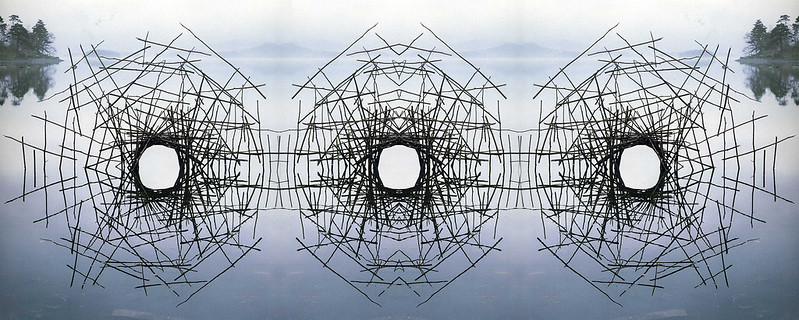
Andy Goldsworthy – Montage by iuri – Sticks Framing a Lake (CC BY 2.0)

Feri is different from an eclectic tradition. Eclectic, I define (based on Merriam-Webster’s dictionary) as a collection of various diverse cultural artifacts. It has the connotation of being an indiscriminate mishmash of unrelated elements. Although Feri folds various cultural artifacts into our milieu, for those who are well trained in Feri, items are not added indiscriminately, but with a purpose. Typically additions come from a personal gnosis based on knowledge gained with integrity: that is, knowledge based in traditional forms that the initiate is heir to, not something solely gleaned from a book. 

Feri is also different from a literary tradition. Literary traditions often judge inclusion into the corpus of a tradition by how closely the accepted literary forms are followed. Some literary traditions do not allow for changes in the corpus (in other words, the corpus is closed and new works cannot be added). In Feri, we do not use a book as an arbitrator of inclusion. However, it doesn’t mean that we aren’t literary folks. In fact, we don’t have one Book of Shadows, we have many! In Feri, any initiate can add to the corpus of their lineage.

We also have diverse lineages, some of which practice and teach in radically different ways. Yet, in the same way that one can recognize a story to be of the Arthurian legend milieu, even though the individual stories can be very different as told from different characters’ points of view, Feri initiates can recognize each other. In this way, Feri is similar to a literary tradition.

According to Albert B. Lord in The Singer of Tales, literary traditions arise from the belief that one specific performance of an art form is a “real” form of the art, even though the form changes with each performance. This is just like life: even though something may appear the same from day to day, each day that thing is subtly different, even if the difference isn’t noticed. The real form of the art is in its performance. 

I don’t understand Feri to be an eclectic tradition, but instead a multicultural one. Perhaps because it has thrived in American soil for so long, Feri is yet another manifestation of America’s multicultural identity. For thousands of years, many various and diverse cultures have found a home here. Maybe Feri is a reflection of that. Or perhaps, Victor Anderson was correct when he suggested that Feri is the source of all magic, and its repository. 

Running toward Fear, Falling in Love with Self (by Helix)

To be Faery is to fall in love with your Self as you run straight toward that which you most fear.

Most adults move through the world in a state of internal conflict. Their thoughts run in circles of preoccupation with the past or the future; they have emotions but avoid expressing them, or they let them build up until they are expressed abruptly and unconstructively; and they abuse their bodies with drugs, unhealthy food, or lack of movement. Accordingly, their ability to set an intention and follow through on it, or to accurately identify and act on their deepest desires in a sustained way, is severely lacking.

One cannot be an effective witch in this state of affairs. A witch must be able to focus all their energies in a single direction, to pursue goals both mundane and lofty with consistency and passion. This is one of many reasons why the Andersons emphasized integration work, where we return to a natural state where the physical, animal, human, and divine parts of us are aligned. (For an introduction to what is often called “Triple Soul” work, see the Andersons’ book Etheric Anatomy.) Only when the many parts of the self are entwined in an erotic embrace and moving in concert can the witch manifest their Self in the world.

“Desire” by Worak via Flickr. (CC BY 2.0)

It can be difficult to begin this work when so many of us have been raised to be divided from ourselves. Our families or religions of origin may have taught us to repress our emotions or condemn some of them as wrong; we may have been led to believe that some desires are “spiritual” and good while others are dangerous, destructive, or downright evil. This kind of upbringing leads many of us to hide what we really think and feel, even from ourselves. Others may rebel against such systems by chasing desires willy-nilly, allowing our animal selves to run wild without guidance from the human self about how to tend to our own well-being or that of others. Neither of these approaches arises from integration and alignment. An aligned witch should evaluate and govern their own actions, but they are able to accept their emotions and desires without judgment. Without this open-eyed compassion, we cannot fully know ourselves.

Whether you are studying Faery with a teacher or are simply a seeker, one of the ways to begin the work of integration is to identify fears and desires. For those who have been conditioned to hide their desires from themselves, fears are often easier to identify, since anxiety is what haunts and motivates so much of modern life.

Faery initiate and Reclaiming co-founder Starhawk has often been known to say, “Where there is fear, there is power.” Fear is one way the animal self signals that we have given our power away to an external force. The most persistent fears are often the most productive to explore.

I should emphasize, however, that I am speaking here mainly of irrational or exaggerated fears. There are good, rational, survival-based reasons for avoiding dangerous situations or for engaging in them only while carefully calculating risks. The fears that are most productive to run toward are often interpersonal or those that invite creative self-expression. For some people, the fear will be expressed as intense and obsessive disgust. Our aversion to those externalized parts of ourselves can manifest as monomaniacal focus on manageable risks—for example, avoiding sexual relationships out of a debilitating horror of sexually transmitted infections. The persistence and intrusiveness of an aversion is a clue that it is concealing a lost part of the self.

For some of us, fear will manifest as anger or hatred. In my own sheltered youth, witchcraft and Paganism were targets of my contempt and anger. I was articulate and critical and able to find a thousand faults with the people who practiced these traditions. Yet my rejection of these forms of spirituality was actually a rejection of myself. The harder I fought them, the more those traditions appeared synchronistically in my life, attracted and tantalized me. When I recognized this and (initially holding my nose with disdain) began to read books, go to Pagan campouts, and participate in rituals even when doing so caused me anxiety, discomfort, and downright irritation, paths began to open up for me. I found friends who practiced those traditions whom I could respect; I found an ethical, talented teacher I could look up to. I started to make progress and become a bit less divided against myself.

Strong emotions of this type give clear indications of where the risky but growthful path lies for a given individual. Tackling these fears should never be rushed, however, nor should anyone pressure you to engage them prematurely. Claiming the power and Self that you have externalized in what you fear takes time, care, and careful engagement with the rejected object. To prepare, a meditative practice that gives you experience with tolerating uncomfortable emotions is essential. Buddhist or Western mindfulness practice can help us to regulate our emotions enough to curiously discover what is hidden behind our fear. If our fears are associated with trauma, it is a good idea to enlist the help of a trauma recovery therapist when beginning this kind of work.

To fall in love with our Self, we must also unfailingly respond to desire. Integration requires the gentle work of allowing the human self to befriend the animal self, and vice versa. Only when they are in a close, loving, and erotic relationship will the human self become consistently and completely aware of the animal self’s desires. These desires must be acted upon if the trust of the animal self is to be maintained—but they should be pursued with wisdom and guidance from the divine part of the self. Acting on desire should not result in behavior that is careless toward self and others.

However, if ever you find yourself struck speechless, burning with hunger for a new experience, or feeling yourself to be alive in a way you never have before: if you cannot safely move in the moment, you must make a plan to act. Wrap up or put on pause whatever stands between you and the desire. If the desire is inaccessible in some way, reflect: is there some other way you can approach the essence of the desire? If the desire is for a person who is not available for relationship, what elements of that person attract you, and are there other ways to bring those elements into your life? If the desire is to make music or art, are there ways you can lower your cost of living or survive on less in order to spend more time on projects? What loving risks can you take to manifest the desire? Such decisions feed our animal selves and allow the free flow of life force through all our parts—and cultivating the free flow of life force is an essential part of Faery.

Making a commitment to run toward fear and desire is a simple thing on the surface, but if we practice it in earnest, we will experience moments of towering joy and ego-destroying terror. Life will become vivid—and dangerous.

Are you seeking a Faery path? Make your promise now: never turn away from Self.